
As I alluded to in an earlier post, City Staff put together a proposed eviction ordinance and it got its first reading last night. And it was a quietly contentious affair.
The proposed ordinance basically adopts SB 567 on an accelerated timeline (the state bill isn’t set to become effective until April 2024), with two critical tweaks: it would require landlords to both promptly notify the City when conducting a no-fault just cause eviction and provide affected tenants with relocation assistance equal to two months’ fair market rent rather than the one month effective rent.
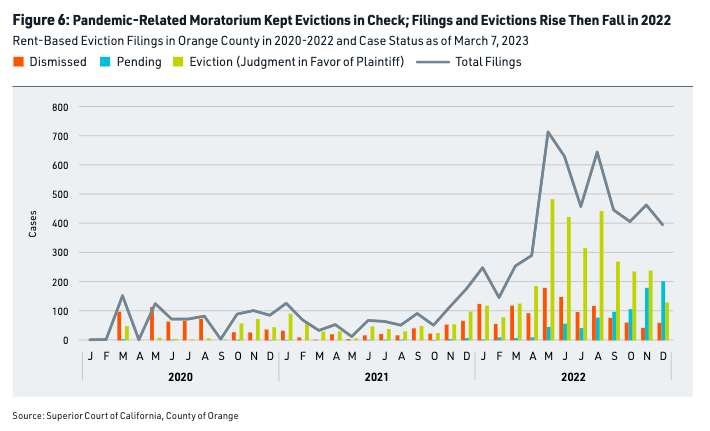
Is there an eviction crisis? Oh yeah:
But do we know the causes of the eviction crisis? Depends on who you ask.
If you ask the activists in the room last night, including the public speakers who gave compelling personal testimony regarding their housing struggles, the high number of evictions was driven by unscrupulous and greedy landlords. These landlords only want to raise the rent beyond the rent control caps created by AB 1482 in 2019, and the only way to do that is to reset the units by kicking out existing tenants. The “substantial remodel loophole“, which was the subject of some of SB 567’s reforms, was simply the most convenient fig leaf to justify these evictions.
If you asked the landlords, who showed up in some force, they seemed to imply that no-fault just cause evictions were pretty rare. But they also insisted that changing the rules around these unusual affairs would change their risk calculus about the benefits of supplying housing in Costa Mesa. From an optics perspective it wasn’t great; the suit/tie intimidation routine, with scary lawyer letter in hand alleging violations all the way up to the US Constitution, contrasted sharply with the earnest, emotional pleas from renters with significant, tangible housing problems.
But unfortunately the landlords are probably onto something.
It seems beyond obvious that this whole conversation is framed by the remarkable, ridiculous, outrageous, nauseating run up in rents that this area has experienced in the last couple of years. I mean c’mon, look at this:

That’s about a 72% increase in average nominal rent. And it is pretty clear from charts like this that the pandemic has reset rents about 40-50% higher than the trend prior to the pandemic. So it’s no surprise when Resilience OC undertook a (very self-interested) resident survey in Costa Mesa, the surveyed residents listed rent increases, rather than evictions, as their top priority.
Unfortunately around the same time that the pandemic hit, AB 1482 went into effect. AB 1482, a response to the dramatic increases in rents in years 2017 and 2018, imposed statewide rent control such that rent could not be increased year-over-year greater than 10% or the rate of inflation (whichever was lower).
Not only did the passage of AB 1482 have the perverse effect of triggering a wave of evictions as landlords sought to offload below market or troublesome tenants before it went into effect, it also imposed statewide rent control right before one of the most rapid inflationary periods in the last 100 years. COVID then imposed an effective eviction moratorium.
Coupled together, AB 1482 and the COVID moratoriums appear to have created a bad bottleneck where many tenants have leases with under-market rents. And now the eviction restrictions in both AB 1482 and SB 567 present a quandary: if the tenant is perfect, you are stuck with her and over time her rent will fall farther and farther behind the market (assuming rents continue to rise); and if the tenant is a huge pain but pays on time, you are stuck with her, too, even if she neglects the property and makes life difficult for the neighbors.
Contrary to what the Staff apparently believes, landlords aren’t just going to eat these risks. They are going to find other ways to de-risk, including requiring higher credit scores, being less forgiving of criminal records or (miserably) prior evictions, or imposing other conditions. Or…
If they have to evict someone, they are going to resort to an informal eviction. And that’s where we probably need deep reforms in our current system. More on that in a follow up post.
 Goat Hill Rodeo
Leave a comment