
If I keep up this blog the way I’d like, you’ll find I’m a big fan of Strong Towns. Chuck Marohn, the founder of Strong Towns, is a traffic engineer by profession, so it is no surprise that Strong Towns talks a lot about street design. When Chuck visited us this week to give an informal presentation hosted by the Costa Mesa Alliance for Better Streets and the nascent Strong Towns OC, he emphasized how American local street design was led astray by incorrectly applying the lessons learned from building the largest and safest freeway complex in the world.
It turns out, sadly, that the design elements that make a freeway safe – generous turning radii and lane widths, large clear zones around intersections, and an emphasis on minimizing cars traveling at different speeds (known in engineering parlance as “turbulence”) – not only make local streets unsafe, they also make those streets miserable places to be. Which, you know, is a problem if we are expecting people to use those streets to make our towns vibrant, productive and enjoyable.
It has been long recognized that vehicle speed is a huge factor in street safety, specifically the danger vehicle strikes pose to pedestrians and bicyclists. As Pro Publica quips, vehicles these days are unsafe at many speeds, especially for the elderly:
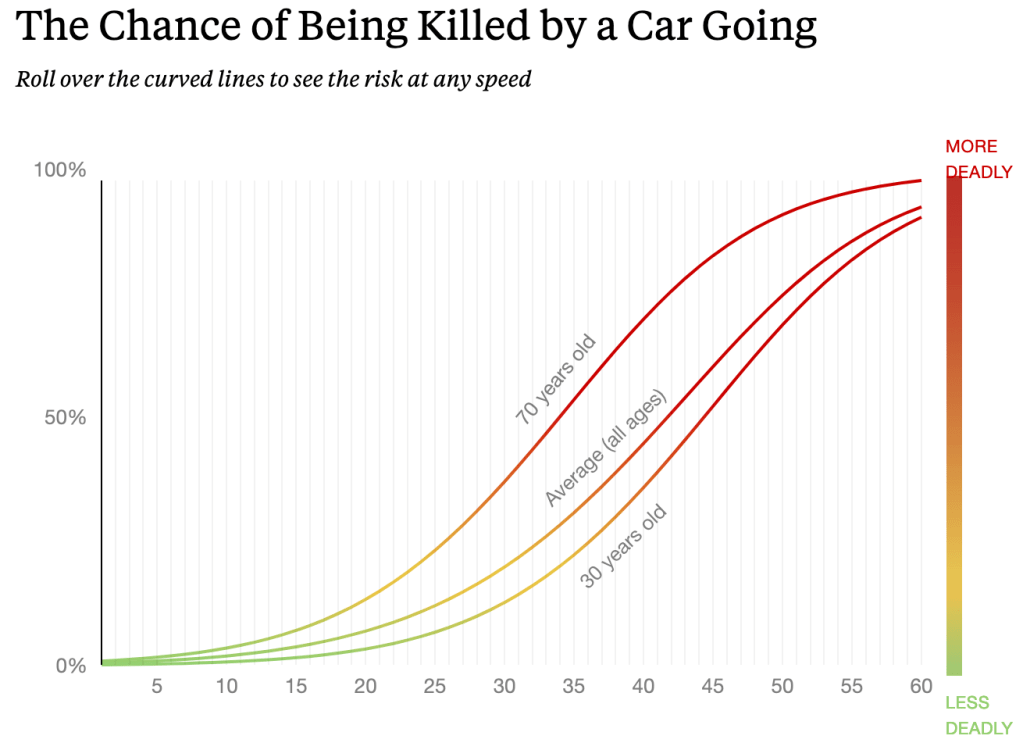
Many thoughtful people take a look at graphs like this one and say, “ok, obviously we need to lower the speed limit to [30 mph, 20 mph, etc.] to make our urban streets safer.” Which would be great, except that, as Chuck Marohn pointed out in his talk this week, this idea runs directly contrary to the way traffic engineers think about safety. Remember that point about “turbulence” above? Turns out, setting the speed limit below the speed for which the street was designed may increase the number of traffic collisions, as some drivers will follow the lower speed limit while other drivers will continue to drive as fast as they feel comfortable. This results in cars going at different speeds, which is a recipe for collisions.
This concern about turbulence gets traffic engineers backing into this line of logic: if drivers are routinely and significantly exceeding the speed limit, then the speed limit, and not the speeding driver, is wrong:
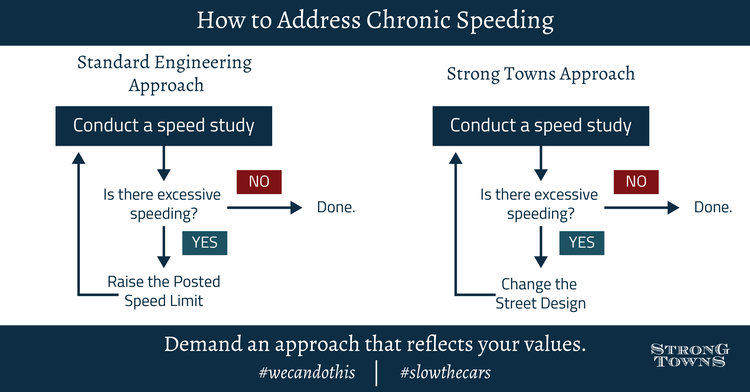
Now as you can see, the Strong Towns approach when a street has excessive speeding is to “change the street design”, which is something I wholeheartedly agree with. But there is one problem, which is very important to municipal leaders trying to put this idea into practice.
What does it mean to have “excessive speeding”?
See, for the traffic engineer, “excessive speeding” under the standard approach is easy to determine: the 85th percentile speed of vehicles on the street is significantly greater than the posted speed limit. It’s objective and data-driven. Under the Strong Towns approach, however, “excessive speeding” is a lot fuzzier. Just saying that most drivers are significantly exceeding the posted speed limit begs this question: is the posted speed limit the “right” speed for this street, and if so, why?
Take Tustin Avenue in Eastside Costa Mesa for an example. The posted speed limit is 30 mph. From my experience (and the experience of neighbors who have complained to us at CMABS), cars speed down Tustin significantly above 30 mph. So from a Strong Towns approach, assuming a speed study backed up this observation, we should be redesigning Tustin Avenue until we achieve an 85th percentile speed of 30 mph.
But here’s the question for policymakers: Is 30 mph even the right speed? Recall the graph above about vehicle speeds and pedestrian fatalities. Tustin is a residential street, running directly adjacent to homes as well as amenities such as parks and schools. It also provides direct access to walkable restaurants and shops on E. 17th Street. Dog walkers, children on bicycles and scooters, and parents pushing strollers are common. Additionally, I understand that Tustin has been designated as one of the suggested routes to school for Ensign Middle School, which may have prompted the painting of sharrows on Tustin. Taking these factors into account, vehicle speeds should probably be targeted to be around 25 mph or even 20 mph.
So here is where I’d expand on what the Strong Towns graphic above implies, which Chuck himself has emphasized as well: If residents are complaining about vehicle speeds, first step should NOT be a speed study. The first step should be a comprehensive context survey, taking into account the way the street is being used today, what city needs it needs to serve, and how the street’s surrounding land uses imply how speeds are preventing it from being used in a more enjoyable and productive way. The result of this survey should be a vehicle speed target (what Chuck calls “design speed”) that would inform what changes to the street need to be made to achieve that target for the 85th percentile driver. This almost certainly will diverge from the posted speed limit.
And that’s why we should get away from getting too tied in knots about speed limits. Without constant, oppressive enforcement, setting speed limits below the design speeds of the street just isn’t a strategy for reducing vehicle speeds. We have to accept that speed limits were never intended to slow down cars. They were intended to allow engineers to sleep at night. So let’s put them aside and focus on what we want our streets to accomplish instead.
 Goat Hill Rodeo
Leave a comment