
In 1892 the Strand magazine published The Adventure of Silver Blaze as part of a compendium of stories about Sherlock Holmes, written of course by Sir Arthur Conan Doyle. In the story, the key piece of evidence used to solve the mystery of a horse theft is that the barn dog did not bark when the theft took place, which leads Sherlock Holmes to deduce that the thief was well known to the dog. In other words, the assumption that the horse was stolen by a stranger was refuted not by the presence of certain facts, but by the absence of a fact that must exist for that assumption to have been true.
In urban policy, “dogs that didn’t bark” – or maybe in Costa Mesa, we can call them “goats that didn’t bleat” – are really tough to spot. That’s because noticing the absence of something requires that you know it should be there.
For example, I don’t think most people think twice about why certain bus routes don’t exist. First off, few think about the bus at all, because 90%+ of trips in Costa Mesa are by car. In an area like this the bus isn’t one transportation option among many; it is the mobility option of last resort for those who can’t use a car (the poor, the disabled, the underaged or the disqualified). And second, if you are using transit in this area, you probably aren’t also spending a lot of your free time petitioning the government about service issues. Again, speaking generally, you probably have other things to worry about.
So our transit system is a good place to hunt out our “goats that don’t bleat” – stuff that is missing that explains some of our problems. Are we missing a bus route? I think so.
First, let’s take a look at what we have. Here is the OCTA route map for Costa Mesa:
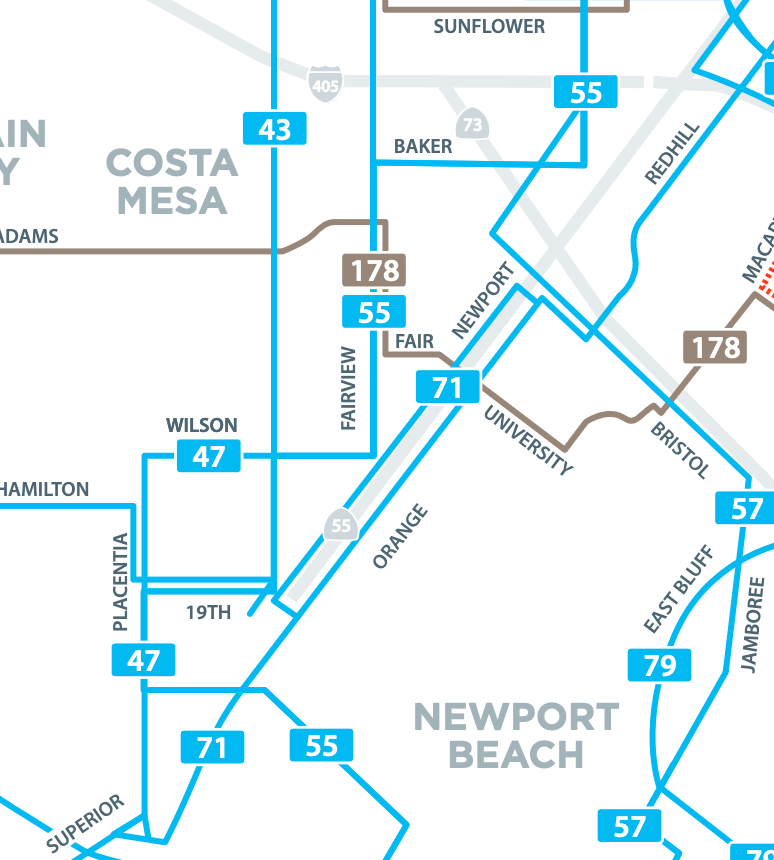
Now, some observations:
- There are only five “local” routes: 43, 47, 55, 57 and 71.
- There is only one route that goes to the beach (47), and it doesn’t serve the wealthiest parts of the city (Mesa Verde and Eastside)
- We have one route that serves South Coast Plaza and the surrounding area from Costa Mesa proper (55), and otherwise you literally have to leave Costa Mesa and come back on a different line (taking the 71 to Newport Beach, then coming back on the 57) to reach it.
- The 55 route doesn’t even go on the 55 Freeway, or even Newport Blvd.
- Every bus route runs on commercial streets; none serve residential areas directly.
Now, compare this map to the maps of cities of comparable size that have good ridership (in the US, that would be the 7-10% of trips range). Here’s Iowa City, Iowa and Ann Arbor, Michigan; both college towns:
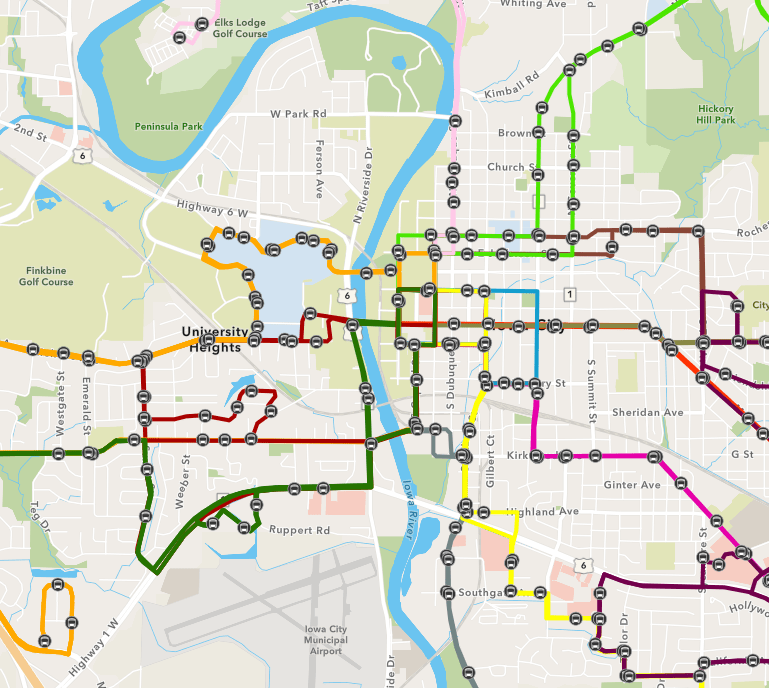
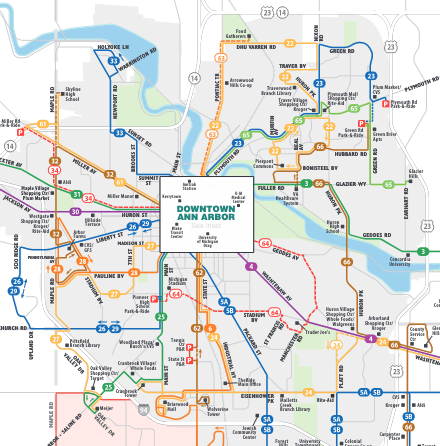
Now, I am NOT saying that we should copy what these college towns do. They are both built on an older development pattern and they have a large, captive residential population that are “car-lite” by nature (college students), so the similarities admittedly end at geographic and population size. But what is notable is that part of what supports higher ridership (7.8% and 9.4% of trips in Iowa City and Ann Arbor, respectively) is the much more comprehensive bus route coverage. As you can see from the maps, buses do tend to stick to commercial areas but also wind through residential streets. And the routes tend to center on downtown cores where riders can access jobs and shopping.
When looking at the maps together, it is remarkable that Costa Mesa’s bus system does not have a discernible “center” of any kind. And that isn’t because we don’t run bus lines to our areas of greatest economic activity – South Coast Plaza, E. 17th Street, W. 19th Street and the Lab/the Camp all are on bus routes – it is because our residential areas are radically underserved. There is not a single bus line that connects the Eastside to any of these destinations. Similarly, Mesa Verde is a big blank white spot on the map above.
And this is because none of the lines on the map above are truly local, but rather regional per OCTA’s mandate. Only local bus services would concern themselves with connecting local residents to their nearby amenities. Regional bus services, however, look to connect density nodes with economic centers, likely across city lines. Thus, our densest residential area in the Westside is served by three regional lines (43, 47 and 55) while the Eastside and Mesa Verde are effectively transit deserts.
Our missing transit lines through residential neighborhoods are our goats that aren’t bleating. They’re something we’re missing but, unless we look at our city like Sherlock Holmes, we don’t know even know they’re supposed to be there. If we want to start chipping away at car dependency, taking our case to OCTA should be one of our first steps along with beefing up our active transportation routes.
 Goat Hill Rodeo
Leave a comment