
All I wanted to do when I started paying attention to city issues was fix my local park. My kids used it every day. It was the only park within walking distance of my house. And it hadn’t been touched since 1994, and it had the wear and tear to show for it. It’s name is Harper Park.
Unfortunately, if you go to the park today, you will be greeted by one of the most quizzical signs in the city:
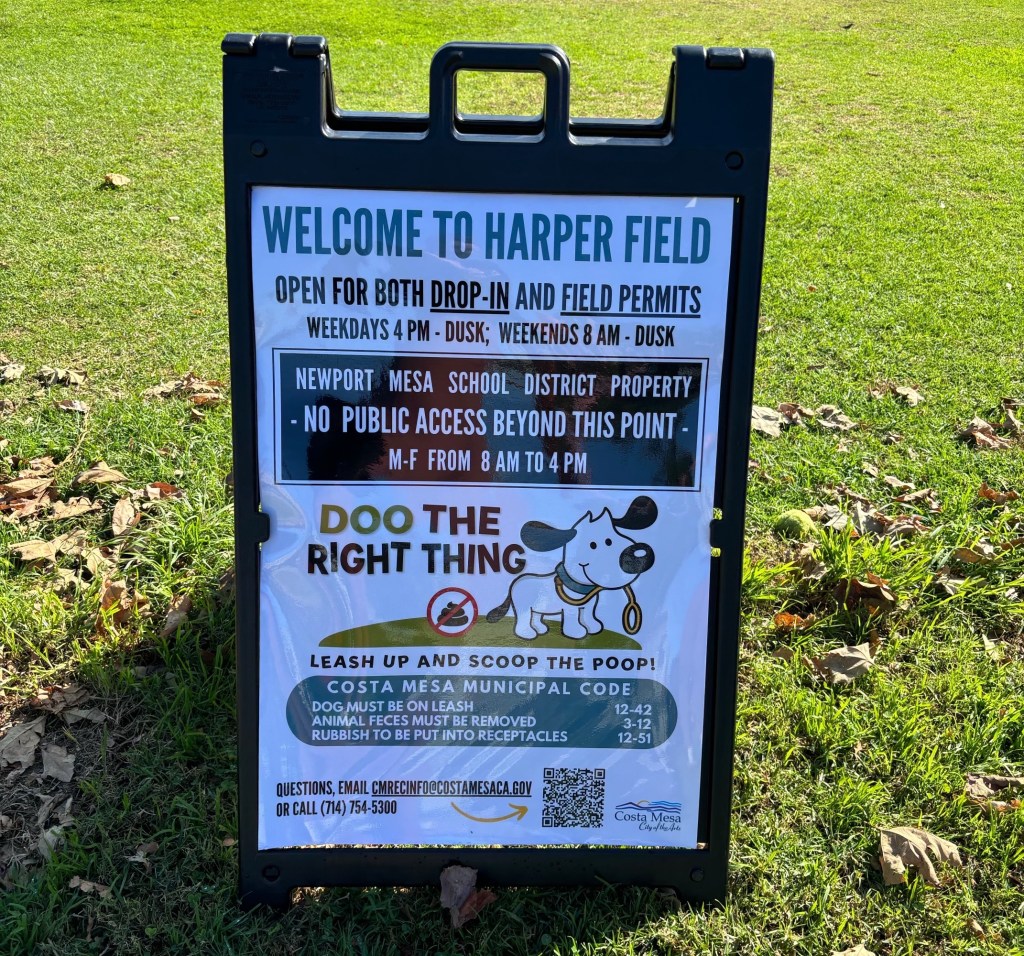
This sign is a metaphor for how it can be so hard to get anything done in this city. Packed into the text are two entirely different bodies of law (the Costa Mesa Municipal Code and the Orange County Code of Ordinances, which governs school property), the interests of three governmental entities (NMUSD, the City, and a charter school occupying the Harper campus), and a decades-old web of contracts among all three. Not pictured are the park rangers that are now patrolling this park constantly during daylight hours, trying to enforce all of these confusing and overlapping rules with tickets and arrest threats. All that for this little park. How on Earth did we get here?
“Too many off-leash dogs” is the short story. The long story involves COVID, a few vocal and incensed NMUSD administrators, institutional arrogance at NMUSD and laziness at City Hall, short-term thinking causing long-term problems, and ultimately, bad government.
Almost everyone in Eastside Costa Mesa knows that Harper Park has long functioned as an informal dog park. Neighbors with dogs, including yours truly, would meet up around dusk and let their pups run off-leash in the large grass fields, far from the playgrounds or other users. For a long time the group was manageable and self-policed dog behavior and sanitation, and it all worked reasonably well.
But then a couple things happened in quick succession.
First, COVID happened, and everyone and their brother got a dog. It was pretty clear some of these folks never had a dog before, because dog misbehavior started to tick up noticeably. Both my kids were knocked down in Harper Park by large, out-of-control dogs.
COVID also brought changes to the adjacent elementary school campus. Harper Elementary was closed in 1976, and while it functioned as a preschool for a while, most recently it housed NMUSD administrative offices and the Harper Assessment Center. Neither the administrators or the Assessment Center educators had much use for the Harper fields, until… again, COVID happned, and many activities were forced outside. Suddenly pandemic puppies and social distancing were on a collision course.
And to add fuel to the fire, the International School for Science and Culture (ISSAC) was shoehorned into the Harper campus by the Orange County Board of Education over the strong objections of NMUSD in 2019, and the charter school has been on rocky ground ever since. Part of that forced marriage including ceding use of the Harper fields, which belong to NMUSD up to the border with the city park, during the mornings on school days, further complicating the park’s usage and adding even more conflicting parties.
One quick sidebar about that border: no one actually knows where the NMUSD fields end and the city park begins. In true “Parks and Rec” fashion, the attachment to the 1965 agreement between the City and NMUSD establishing the city park was lost by all parties. The “border”, then, is merely a maintenance line between the two entities with no legal backup whatsoever. Moving on…
Unsurprisingly, with two school entities and the off-leash public sharing the fields at the same time, the conflict eventually came to a head. I’ve been told different things but the most common story is that one or two administrators from the Harper Assessment Center had some bad run-ins with uncontrolled off-leash dogs, and those complaints triggered action inside the NMUSD staff. Seemingly uninterested in investigating the problem further or engaging any of the neighbors, NMUSD moved to fence off the fields and close the residents off entirely. This resulted in a 90% reduction in park space available to the public. Amazingly, not only did this action not trigger any angst within the NMUSD staff about possible public backlash, it was blessed by our own Parks Director at the time, Jason Minter. His only response was to instruct his staff to tell the public they weren’t welcome in their own park anymore. And no one breathed a word to the NMUSD Board of Trustees, the Superintendent, the City Council, the Mayor or the City Manager. They just cut the public off from 90% of the park area they always enjoyed and hoped no one noticed.
Well, they noticed. The Daily Pilot has a good summary of what happened next: residents complained, the City Councilmember representing the area called the decision to install the fence “an epic fail”, and finger-pointing ensued. And finally, after a lot of internal back-and-forth with NMUSD, the City finally struck a deal. The City would fund, at its own expense, a park ranger dedicated to policing off-leash dogs during school hours and signage explaining the complicated rules that govern the fields, and NMUSD would remove the fence. Which they did, about two months later.
All’s well that ends well, right?
Not really. The end result is a confusing mess that makes it hard to know if you are breaking the rules by just being in the park: no one is allowed in the field space, which is poorly defined, before 4pm on weekdays. Dogs can be on-leash in the City park area, which again has no border, but on-leash dogs cannot be on the fields at any time, including after hours on and on the weekends. And all of these confusing rules are being strictly enforced by park rangers, who spend most of their time watching empty fields.
On the one hand, it’s good to see that the City and NMUSD will (eventually) respond to public outcry. But the end result leaves a lot to be desired. Stationing a park ranger at the park full time just to police off-leash dogs is an egregious and obvious waste of resources, especially when many of our parks struggle with vagrancy and drug use. And the confusing thicket of rules is already starting to get on residents’ nerves.
Hopefully the City will do the right thing and devote some time and resources to straightening out the confusing and overlapping rules that govern the park. If the residents were informed of the problems and interests at the park and were given a set of alternatives (which certainly could include permanent infrastructure), I think we could find a good solution that everyone can live with. But instead I fear my little park will continue to limp along as it always has, lost in between the cracks.
 Goat Hill Rodeo
Leave a comment