
So as promised the City Council did in fact take up a proposed permanent outdoor dining ordinance last night. They did so with the backdrop of overwhelming public support for the program, the tune of what must be almost a hundred written comments (no, I didn’t count) in support of continuing outdoor dining, specifically for hotspots like the very popular Semi-Tropic Wines.
But there was one public commenter determined to put a fly in the ointment, and her comments opposing a permanent outdoor dining ordinance were earnest and, perhaps, even understandable. I think her name is Iris Lagrimas, as the comments delivered in the chambers were very similar to a letter sent in by someone with that name.
As her letter indicates, her zeal seems to stem from her unpleasant experience with Trenta, a beloved pizza restaurant in town that also has been pushing the envelope in terms of using its parking area as outdoor dining space. In particular, she is extremely concerned about more cars coming to restaurants, especially restaurants near residential areas: “expanding dining areas means increased customers. Which means increased vehicles. Consequently, when you give up parking spaces [to accommodate more outdoor dining], you are reducing parking spaces. This has created a parking problem [for my neighborhood]” (emphasis hers).
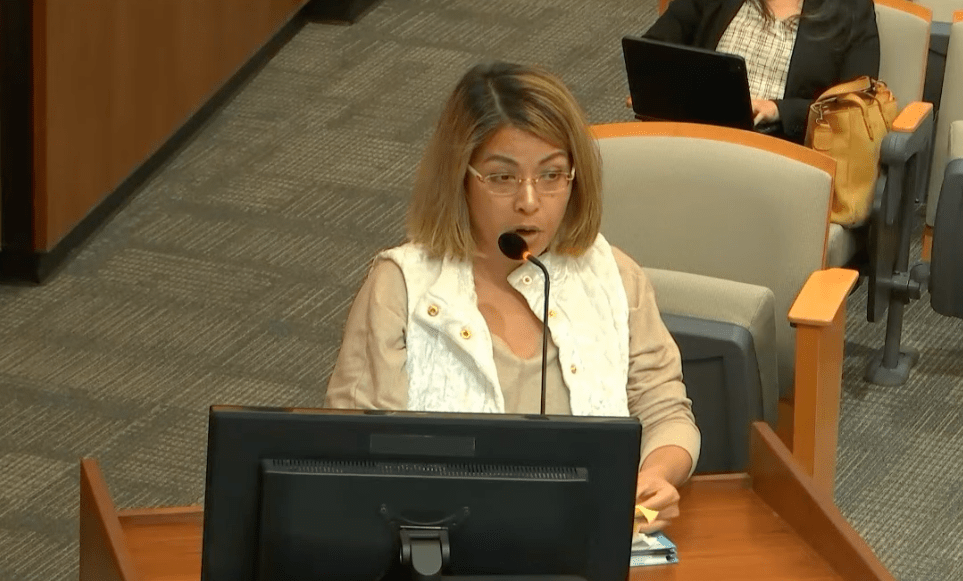
On its face, that seems like a completely logical complaint! In fact, Planning Commissioner Jon Zich brought up the same issue at the Planning Commission level (comments start at about the 59:00 mark). He was deeply concerned that allowing business owners to expand their dining rooms without providing additional parking or, worse, reducing the amount of parking provided onsite would cause cars to pile up on adjacent streets or properties: “Where do the patrons who drive [to a restaurant with no parking] park? The neighbors? Residential areas that are adjacent? I mean that’s just not fair. Your impact by not providing for your customers is an impact on somebody else. That’s just not fair. That’s why we have parking standards” (emphasis mine). His objections to the credits given for parking to restaurants that want to add outdoor dining likely cost the ordinance his vote.
The way Ms. Lagrimas and Commissioner Zich are thinking about parking — that the businessowner, who stands to profit from converting parking spaces to usable commercial space, must be held accountable for the transportation habits of its customers — is absolutely the most common and intuitive way people think about parking in this area. But I think it’s wrong.
First, to set the stage, it’s true that cars create a LOT of negative externalities. As I wrote in the meeting preview, some examples of these negative externalities for people and properties adjacent to busy streets are that they are noisy, smelly, potentially dangerous to those outside of them, and they take up a lot of space (the average parking space is about 162 square feet (!)). In an urban environment space is at a premium, and where 95%+ of trips are by private vehicle, lacking parking means a business or home will lose easy access to the only transportation system in town. An unacceptable outcome for most. So the solution that most cities hit on is to require property owners to “internalize” this negative externality by forcing them to provide on-site parking, both for themselves and for their visitors or customers.
Now, a LOT of ink has been spilled to explain how parking requirements are hugely problematic in the development context. But that isn’t the point I want to make. What I want to point out is that it doesn’t really work to force property owners to internalize the negative externalities created by the parking of their customers, because those negative externalilties simply don’t belong to them. Instead, it is the customer who brings her car and decides what to do with it when she visits the business: she decides to use it, she decides where to park it, and she decides how far she’s willing to walk before she’s willing to either pay for it (if that’s available) or break some rules. The negative externality is caused by, and under the control of, the customer. This is clear when you walk into a restaurant: the server who greets you does not care how you got there. If you walked, biked, skateboarded, rode a bus, rode a horse, hitched a ride, or drove, she’ll seat you just the same.
So the problem with forcing businesses to account for the negative externalities caused by their customers is that, ultimately, businesses have no interest in exercising control over where their customers park or any means to exert such control. You could require that a business have ample off-street parking — at great expense — but that lot theoretically could sit empty if all of its customers prefer to park elsewhere or don’t drive. Businesses absolutely can control their own parking lots and ensure that only their customers park there. But there is nothing they can do if their customers choose to park on the street, park in front of someone’s house, or take the bus. So why are we trying to force businesses to control the actions of others?
The reason is that we are constantly, constantly, trying to solve our parking problems without reaching for the easiest solution: asking the creator of the negative externality, the driver, to internalize the costs she imposes on others by choosing to drive by asking her to pay for parking. But, seeing as free parking is one of California’s original sins of entitlements, it’s hard for politicians to come out and even discuss that policy, let alone actually implement it.
So instead we effectively tax businesses so that we can force them to keep providing free parking to their customers, even though we know that customers’ parking decisions are out of the businesses’ hands. And, in truly Californian fashion, this decision to tax harms everyone. For example, Green Cheek Beer, a very popular spot in Costa Mesa with a large outdoor patio enabled by the emergency outdoor dining ordinance, reported that it would have to lay off up to ten employees if it were to lose that space. That’s ten residents out of a job, a business radically diminished, and a whole city deprived of a fantastic place to mingle, throw back a few IPAs and generate sales tax.
And that’s what brings us back to the proposed outdoor dining ordinance. Even though Commissioner Zich is thinking about parking all wrong, he did slip in a great change that will, in the long run, help our parking problems far more than forcing businesses to provide tons of off-street parking, even if that wasn’t what he intended. The ordinance reviewed by the City Council last evening now provides, courtesy of one of Commissioner Zich’s comments, that, “if parking shortages or other parking-related problems arise, the business operator shall institute appropriate operational measures necessary to minimize or eliminate the problem in a manner deemed appropriate by the Director of Economic and Development Services.” In most cases, this means that a business faced with complaints about overflow parking will opt to hire a valet service rather than reduce hours of operation or reduce seating.
This in turn means that, if a customer comes to a business and finds the lot full, they are going to be given the option to pay for parking. And this one subtle fix, by itself, may be the long run key to solving parking problems in Costa Mesa. First, and most obviously, it provides a disincentive for a customer to drive to access the business. Yes, it is possible to access most Costa Mesa businesses without a car! In fact, I can tell you this works first hand. For example, I absolutely refuse to drive to get takeout from our favorite lunch spot on E. 17th Street, because it has effectively mandatory valet parking. I am happy to strap on my helmet and pick it up on my bike, even if it is drizzling, because I’m not going to pay $5 to the valet to pick up a $12 sandwich. Boom: negative externalities internalized, resulting in one less car in the lot, and one less unhappy neighbor.
And better yet, creating an environment where customers pay for parking aligns the interests of the businesses and their neighborhoods better than any mandate ever could. If the specter of having to ask her customers to pay for parking is frightening, a business owner will think twice about replacing a parking spot with a few more outdoor tables. Or, if the business owner thinks their customers might be comfortable walking, bicycling, or taking the bus, that owner has an incentive to support investments in those transit modes and to accommodate them onsite (perhaps through better bike parking, or investing in the local bus stop, etc.) so that she provides a way for her customers to reach her for free.
If she opts for paid parking, a valet service will minimize the impact on the neighbors. In turn, if the neighbors still feel like overflow parking is a problem, they will have an incentive to demand that on-street parking is metered or to adopt parking permits, which will further ensure the driver, and not the neighborhood, bears the full cost of her vehicle. And if paying for parking turns out to be too much of a burden on a business owner’s customers, she will have an incentive to work with neighboring businesses to create more parking. Business improvement districts and other structures emerge all the time from parking issues, and often result in the creation of public or private parking garages that are constructed and maintained through — you guessed it — charging for parking. This is the way cities grow: by creating collective solutions to collective problems, and by creating more square feet of built area when each square foot of land becomes too valuable to set aside only for parking.
I know smoothing the transition from suburban town to legitimate city is a cosmic ask for a little outdoor dining ordinance. But believe it or not, I think Commissioner Zich’s little tweak has put us one small step further down that path. And I’m all for it.
 Goat Hill Rodeo
Leave a comment