
The City recently released the dates for the next rounds of public input workshops for Fairview Development Center:
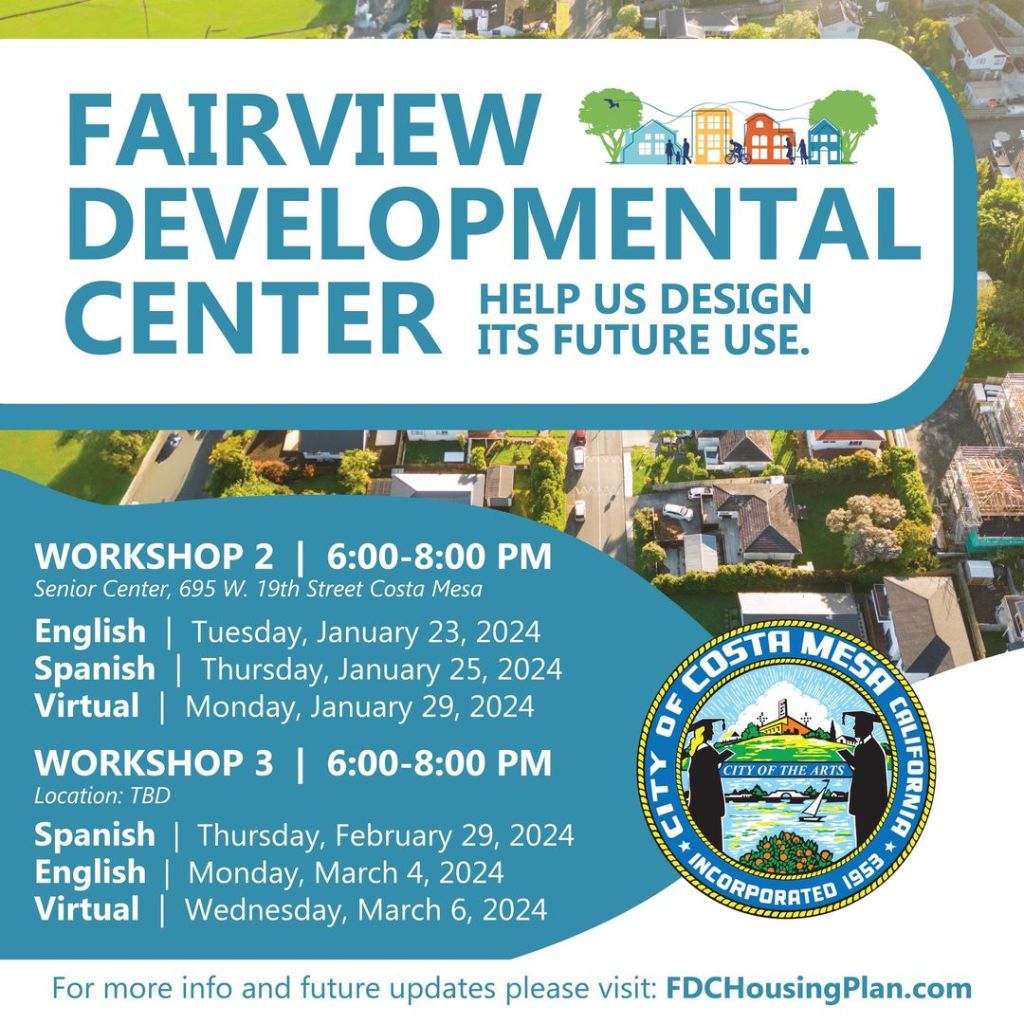
As I’ve written before, I find this “workshop” approach to public engagement deeply problematic. And the recent City Council study session on all things housing only amplified my concerns. As confirmed by the Staff presentation at that meeting, just over 100 people participated in English, Spanish and Virtual meetings put together, and that count likely doesn’t take into account the fact that there may have been some overlap in attendance (I know for a fact that at least one resident attended all three meetings, and likely was counted three times). One hundred participants in a city of over 110,000, and in a metro region of over 3,000,000, could not possibly be representative of the residents’ “vision”, if there can even be one.
And maybe someone on the City Council will surprise me, but I’d bet they plan on skipping these sessions too. Honestly I can’t entirely blame them; at the end of the day we can’t provide the public with any concrete specifics about the site other than (1) we almost certainly have to live with the planned Emergency Operations Center that the State has decided to shoehorn into the site, and (2) we have to, by State law, build a ton of affordable housing, in each case no matter what the public says. So it’s not much fun to tell the public that their input is valuable unless that input is to disagree with the State’s plans for the heart of its own city.
Besides, as has been confirmed by the consultants both at the workshop and at the study session, the long term plan is, once the zoning is completed, to hand the entire development over to a private master developer. Honestly I found that revelation to be disheartening; I still held out hope that we would permit a bit of competition across the site. And all honesty, most master planned communities in California give me the heebie jeebies. But is this necessarily a bad thing?
One of my favorite urban economists, Edward Glaeser (author of the excellent Triumph of the City and the not-as-good, but still thought-provoking Survival of the City) recently penned an op-ed in the New York Times championing privately built communities, even whole cities, on the premise that, in California at least, “billionaire-built cities would be better than nothing.” Ok, so perhaps he isn’t championing them so much as identifying them as a plausible last-ditch effort to get notoriously anti-housing California to build anything, anywhere, for anyone.
In particular, Glaeser praises private developers for something that most find to be their most distasteful attribute: to center values in their designs that are contrary to those of the broader public, especially residents of neighboring cities. For example, in Columbia, Maryland, a private developer saw the need for racially integrated housing as neighboring Baltimore embarked on a regime of de jure and de facto residential segregation. In turn, Columbia grew into a place of significant upward mobility for all races, though the positive outcomes for Black residents were the most striking. Glaeser I think correctly implies that, if the planning of Columbia had been left in the hands of the Baltimore government at time, it would have become just a racially segregated as other Baltimore neighborhoods, which now darkly boast of the worst economic outcomes for Black Americans of any city in the country.
However, he warns, this freedom can run amok. Such a privately planned city, he warns, “will succeed only if it puts people before buildings.” If we are to follow Columbia, MD as an example, this would mean sticking closely to the creedo of its developer, James Rouse: “the purpose of cities is for people, and that the objective of city planning should be to make a city into neighborhoods where men, women, and their families can live and work, and, most importantly, grow in character, personality, religious fulfillment, brotherhood, and the capacity for joyous living.” That seems really simple but, as many a soulless development can attest, it really isn’t.
So if a master developer is destined to lead the way at FDC, what role can the City play to ensure that it “puts people before buildings”? Thankfully, two huge factors that will determine the “values” of the site will be out of the developer’s hands: the zoning, which will dictate what is permitted to be where and what it is allowed to look like, and the streets, which, almost more than any other factor, will determine the character and feel of the area.
So instead of starring at pictures at various sized and colored apartment buildings, I think it would be much more fruitful for our public input meetings to be laser focused on zoning and streets. With respect to zoning, I’m not sure there is any community in California built after 1940 that can be used as a role model. Almost all Californin communities have been shaped by rigid, Euclidean zoning, including master planned communities. So if we want truly mixed use zoning, which would include not only commercial/residential mixing but also religious, recreational and social opportunities as well, we may need to even go outside state or even the country for useful models. What might be allowed to develop if we, say, zoned on the basis of nuisance rather than on the basis of use? This is the approach used in Japan, where low-intensity zones allow both houses and quiet commercial establishments like doctors’ offices, cafes and grocers. This is because their zones are determined based on how much noise is generated by each use rather than by a strict differentiation between “commercial” and “residential” uses. Could we do something like that in FDC?
And with respect to streets, really, size and approach matters. If we are going to be a bicycling city, we should be building separated bicycle paths on almost all of the streets we can, including in residential blocks. And no street in this area should end up on the Orange County Master Plan of Arterial Highways (MPAH). The MPAH effectively allows OCTA and other regional planning organizations to bigfoot Costa Mesa’s priorities and instead try and jam as much vehicle throughput as possible through our streets. This shortsighted approach has ruined many of the Westside roads by making them unpleasant and dangerous (see, for example, Victoria, where the MPAH handcuffs the City’s ability to do anything about excessive speeding). Street size and shape is within the city’s control, but I’ve not yet heard the FDC consultants really drill down on that.
Obviously my preferred approaches would have some serious pros and cons. But I wish we were having these kinds of brass tacks discussions rather than amorphous “visioning” meetings where the public is asked to freeform project its hopes and dreams onto a space with far more limitations than meets the eye. Otherwise, we’re very likely to get the worst of all worlds: a city that ends up planning the fundamentals on autopilot, and a developer that is given the freedom to execute its vision, for better or for worse.
 Goat Hill Rodeo
Leave a comment