
Some of the most frustrating exchanges about housing policy in Costa Mesa have centered on the requirements of the so-called “Regional Housing Needs Assessment” (RHNA), or the production goals for housing at various income levels mandated by the State. So what the heck is RHNA, and what is it actually asking us to do?
What it is: a mandate to plan
California has been mandating that cities and counties plan for adequate housing since the 1960s. The current approach is to have the CA Department of Housing and Community Development (HCD) calculate future housing needs on a regional basis. These allocations are then assigned to each region’s “council of governments” — in Costa Mesa’s case, our regional council would be the Southern California Association of Governments (SCAG) — who must then further apportion the RHNA allocation among its various member cities and counties. Note that RHNA allocations include both an overall unit count as well as units in particular income brackets. For example, here is Costa Mesa’s current RHNA allocation from SCAG:
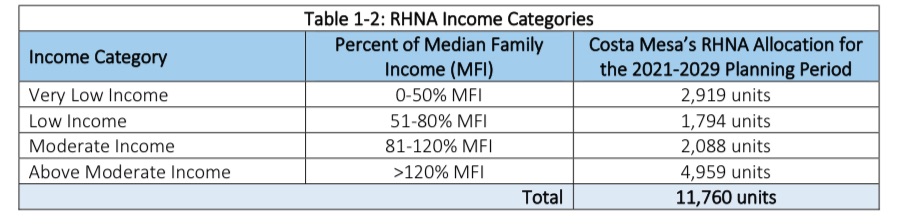
Once a city receives its RHNA allocation from its regional council, it must plan for that allocation in its “housing element”. A housing element is a document each city and county must prepare and submit to HCD every 8-10 years (there are grace periods so the actual cadence can vary) that must adequately describe the jurisdiction’s housing needs and its plans to meet them.
What it is not: a mandate to build public housing
Note the emphasis above on the word plans. This is where many people (members of the Planning Commission and City Council included) get tripped up: RHNA IS NOT A MANDATE FOR CITIES TO BUILD PUBLIC HOUSING. Rather, State law requires each jurisdiction to adjust its zoning and other housing regulations to permit the private market to deliver the mandated units, and it must further demonstrate that other policies won’t place an undue burden on private housing production. So while the RHNA and the Housing Element process are entirely creatures of government, housing production is still left squarely in the hands of private actors.
So I’ll say it one more time: the City of Costa Mesa is not obligated to build 11,760 units of publicly funded housing in the next decade. Period.
But then how do we “plan” for low income units? Doesn’t the market set the rental rates unless we impose rent control or require deed restrictions?
Yes, the market DOES set the rates! And the HCD’s quizzical interest in Costa Mesa adopting an inclusionary housing ordinance notwithstanding, RHNA does not require the production of deed-restricted affordable housing to meet the very low, low and moderate income RHNA targets.
Rather, HCD uses a fairly complicated site inventory analysis to calculate how many zoned-for units applicable to a particular parcel can be deemed, by law, to be likely to be developed at prices affordable for very low, low and moderate income households. You can go through the brain damage of reading this methodology yourself if you wish. But here’s the TL; DR version: for any particular housing site, once certain feasibility and suitability criteria are met, HCD will assume that housing suitable for low income households will be built based on the density assigned to the site:
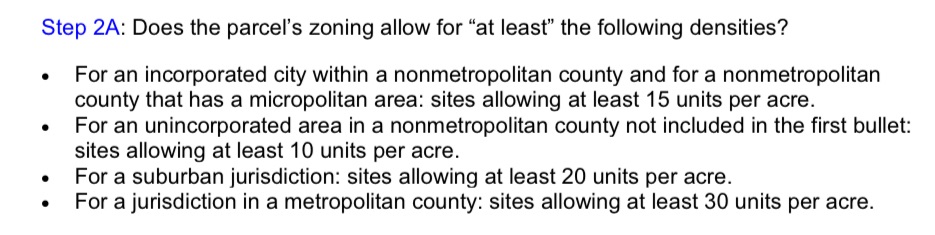
Once the applicable density is achieved (for Costa Mesa, it would be 30 units per acre), we can just assume housing units at certain income levels will be developed and count those units towards meeting our RHNA allocation. This is spelled out in our Housing Element:
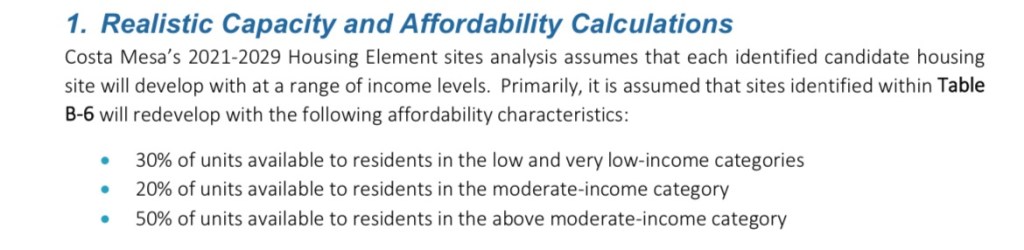
Will each of these sites actually develop into housing that is affordable to very low, low and moderate income families in these proportions? Probably not. But for the purposes of meeting the planning requirements of RHNA, that doesn’t matter. What matters is that the city shows HCD that it has enough adequate parcels, zoned at appropriate densities, to deem that housing at the required income levels could feasibly be developed, again by the private market.
Note that this means that adopting an inclusionary housing ordinance is entirely beside the point. There is no requirement that the very low, low and moderate income housing assigned by RHNA has to be deed restricted. In fact, HCD usually looks skeptically on IHOs as potential constraints on the production of housing (which is what makes HCD’s blessing of our Housing Element with a promise to adopt an IHO so unusual). So we don’t “have” to adopt an IHO to meet our RHNA allocation. The Housing Element and the promised zoning that will follow already accomplishes that.
But what happens if we don’t actually build the houses we plan for? Are there consequences?
Yes, there are consequences if, despite adequate planning, a jurisdiction fails to actually build housing at a sufficient pace to meet its RHNA allocation. But they probably aren’t what you think.
Normally mandates are enforced by monetary penalties. But to my knowledge there is no financial penalty for failing to build the housing planned for in a certified housing element. Rather, RHNA is enforced very differently: jurisdictions that fall behind become subject to SB 35, which requires such jurisdictions to make approving housing easier and faster until they catch up.
In short, if a city becomes subject to SB 35, it must provide a streamlined permitting process for housing developments that meet certain affordability criteria. This streamlined process means that the jurisdiction may only apply objective design standards (so no rejecting projects just because they aren’t pretty enough or don’t reflect neighborhood architecture) and that it must provide the permit within 6 months from application. This fast-tracking has resulted in the permitting of almost 18,000 housing units in the Bay Area and Los Angeles County from 2018-2021, with most of these projects being 100% affordable.
As you might expect, just about every jurisdiction in California is “behind” on building enough homes to satisfy its RHNA during the current cycle. The Terner Center estimates that 501 of 539 California jurisdictions were subject to SB 35, covering 95% of California’s population. This includes Costa Mesa. So if that is the case, I believe this means that the only consequence for not building sufficient housing under RHNA is that the city is barred from blocking deeply affordable housing projects that it already can’t block today (and, frankly, shouldn’t block anyway).
Honestly, that doesn’t seem so bad.
One last note: this discussion of RHNA has little to do with either the Housing Element certification process, which has a whole other set of issues and consequences, or the so-called “builder’s remedy” that hangs like the sword of Damocles over our housing discussions. Those are different issues and best left for another day.
 Goat Hill Rodeo
Leave a comment