
Planning Commission was back in action last night with, mercifully, only one item: the proposed Raising Canes drive thru on Newport Boulevard, which was brought back after having been continued in December of last year.
The particular details of the item aren’t all that captivating: in essence, a fast food chain, Raising Canes, is proposing to demolish a vacant building and put in its place a restaurant with a drive-through on Old Newport Boulevard. Setting aside the mundane details of code compliance, the only even remotely controversial aspect of the project is that the parcel is within 90 feet of a mobile home park, Sea Breeze Villas, which itself sits on a commercially zoned parcel and is “legally nonconforming” — in other words, the mobile homes technically shouldn’t be there, but have been grandfathered in as a permitted use.
The presence of the mobile home park led a number of the Planning Commissioners to raise concerns about traffic and noise during operating hours. Like other Raising Canes locations, the applicant was proposing to stay open until 2:00am, Sunday through Wednesday, and 3:30am Thursday to Saturday, to serve customers demanding late-night meals. However, as the Staff Report points out, if the mobile home park had been zoned “residential” instead of “commercial”, then the Costa Mesa Municipal Code would have required Raising Canes to close at 11:00pm due to the proximity of homes nearby. This led some of the Planning Commissioners to try and impose this requirement, despite the fact the Costa Mesa Municipal Code did not mandate it, in an attempt to close the “loophole” the Commissioners believed the applicant was exploiting. “It rubs me wrong,” Commissioner Jon Zich stated during the hearing, “that we are relying on a technicality to say, ‘you can stay open until 2:00am because the land isn’t zoned [residential].”
But the applicant wasn’t exploiting a “technicality”. And in my opinion, the Planning Commissioners who attempted to impose the requirement — and, thankfully, failed to do so — weren’t actually doing the mobile home residents, present and future, any favors. And that is, I think, because there has been little reflection on what the value of mobile homes, or really any low income housing, is to the city, and why these homes remain relatively affordable despite rapid appreciation everywhere else.
From a quick Google search it appears the Sea Breeze homes are mostly rentals, and one recently was listed for about $1,975/month with a $900 security deposit. That is one of the most affordable units of that size in the whole city, especially for a unit with no shared walls or walkways. And a quick look at the surrounding area tells you why: this is an area dominated by a loud arterial stroad (Newport Boulevard) and many unpleasant, car-oriented uses such as tint shops, tire shops, etc. The property values for residential homes are pretty low. So it’s no surprise that the rents are pretty low, too.
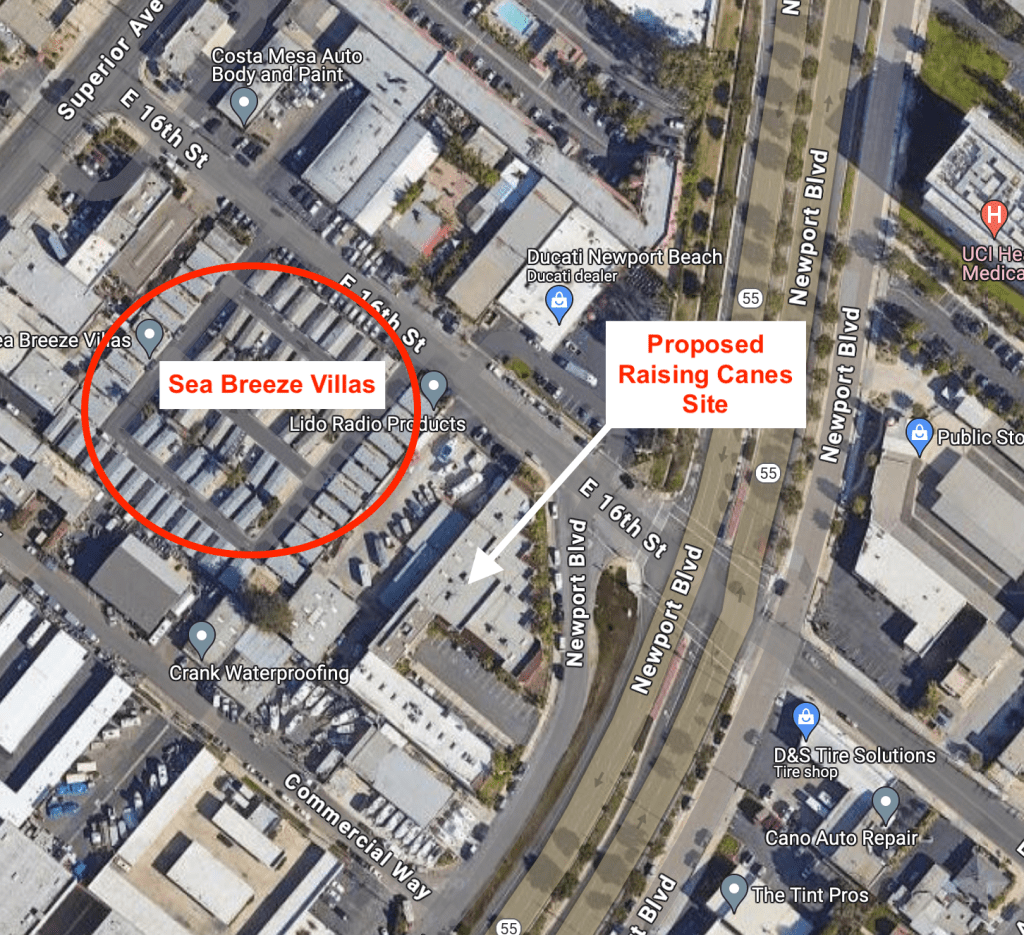
What the some of the Planning Commission was trying to do, and in very good faith, was to apply what they thought (and the General Plan thinks) should be the minimum standards for residential living — the same ones we would apply to projects near our toniest neighborhoods, such as Eastside or Mesa Verde — to this commercially-zoned parcel. If I can presume to guess at their motives, I’d assume that, ostensibly, they wanted Sea Breeze residents to have the same “quality of life” guaranteed to our other residentially zoned parcels. So isn’t it only right for the Planning Commission to step up, to look through the words of the General Plan and find its spirit, and to protect these deserving residents from the nuisances that will inevitably accrue due to late hours of operation?
No.
And that is because this parcel’s zoning isn’t a mere accident, a loophole or a technicality: it might just be its super power. By being situated next to unattractive, but, crucially, not hazardous, commercial uses, the property value of this parcel remains low. This allows the owner to rent its units to lower income people and to take chances on more marginal renters. Take a look at the development’s (fairly middling) reviews on Yelp and see for yourself: “I’ve been looking for a place for my dad to live for a year or two while he remodels his home.” “I lived here with my ex after getting laid off and losing my house.” This is safety net housing, or at least what passes for safety net housing in an area that seems to abhor the concept.
And here is where I think the Planning Commission almost made a mistake. By trying to impose the higher standards of what they think minimum residential living should be, they misjudged why this mobile home park is there in the first place. That the Sea Breeze Villas manager was there to oppose the project should have been a clue: of course he would like the city to impose more protections, more privileges, more considerations to his units than zoning would otherwise grant to his property. By doing so, and by hoping and even more attractive tenant takes over the parcel instead, he would stand to benefit in the form of justification to raise rents.
Absent heavy handed government price controls, places are affordable and stay affordable precisely because they require significant compromises. For example, I once lived in a fifth floor walk-up in New York City. I hated lugging groceries up those dang stairs every week. I also rented a small house in Laguna Beach for a time for what I thought was a steal; what I didn’t know until much later was that the house was infested with ants and the bottom-floor garage routinely flooded in heavy rain. But despite these problems I was thankful for both places. They gave me a toe-hold where I wanted to be, at a price I could afford. And they also gave me the motivation to work hard so that I could move on to some place better.
In the end the Planning Commission did the right thing by sticking to the zoning and allowing the project to move forward. But I wish they would let go of this impulse towards soft paternalism. It’s ok for people to make informed compromises. The goal of planning isn’t, or at least shouldn’t be, to make every square inch of Costa Mesa the ideal of its typology. Rather we should be trying to empower our residents to get creative, be scrappy, and make something of themselves. Yes, some of those residents will accept living next to a busy, late-night restaurant for $200 off the rent. It might not be what the planner would choose. But, unless making this choice endangers their health or the health of the city, we should let them.
For more on this idea, I can’t recommend strongly enough The Poor Side of Town: And Why We Need It, by Howard Husock. He also did a shorter podcast for City Journal if you just want the jist. The punch line is this: in the name of lifting up the poor, in the name of treating them with dignity and respect, we effectively loved their housing right out of existence. And that is because we mistook “the poor side of town” for a permanent state in need of remedy, rather than what it often really is: a transient experience, where people filter in and out depending on their circumstances, their luck and their hard work. We need to rebuild the ladder that reaches from the lower class to the middle class and the upper class. And being thoughtful about why some of our housing remains stubbornly affordable, despite our best efforts, is a great place to start.
 Goat Hill Rodeo
Leave a comment