
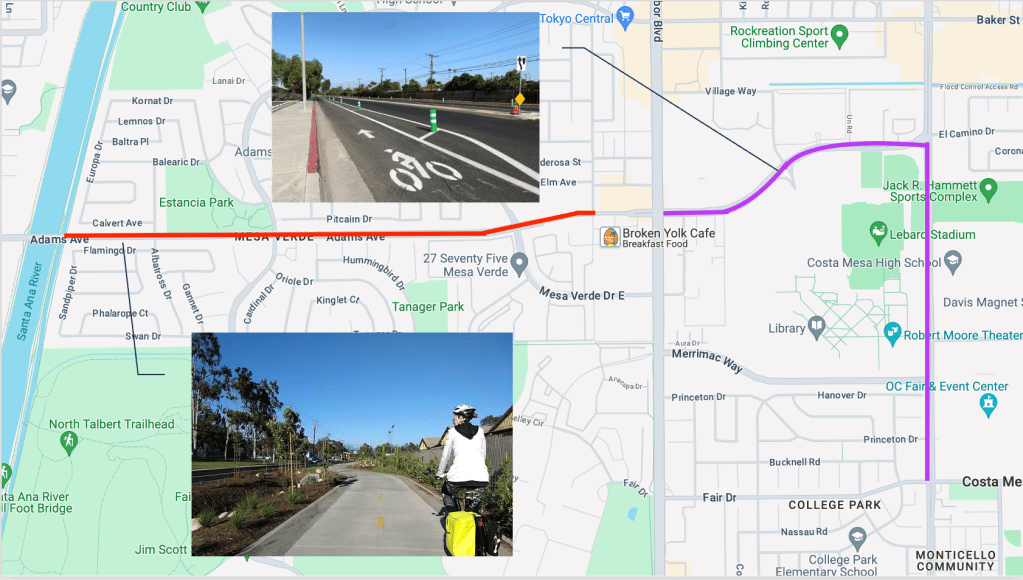
Well this is big news — yesterday, the City announced that it had been awarded $7,980,000 in grants from the Orange County Transportation Authority (OCTA) to aid in the construction of three separate active transportation projects: Class I bicycle paths along Adams Avenue from the Santa Ana River Trail to Royal Palm Drive, Class IV separated bike paths along Adams Avenue from Harbor Boulevard to Fairview Road, and Class IV separated bike paths on Fairview Road from Fair Drive to Adams Avenue.
Because bicycle facility classifications are as misleading as humanly possible, here is a nice little explainer from the Silicon Valley Bicycle Coalition. Basically: Class Is and Class IVs are the best you can get in terms of safety, separation and comfort.
So how big of a deal is this? A really big deal. First of all, getting from East to West in the city by bicycle is a huge pain. Most of our connector streets — Adams Avenue, Baker Street, Victoria Street, etc. — are harrowing stroads with painted gutters for bicycle lanes (if they have bicycle lanes at all). This relegates bicycles trying to get across the city to cutting through side streets and residential neighborhoods. While this doesn’t sound so bad, tacking on an extra 10-15 minutes to your ride, especially on a non-electric bicycle, is a huge pain. And that goes double if there is any kind of weather around. So adding huge swaths of protected East-West connections on a desirable route like Adams is a potential game changer:
I’d also add that these stroads — Adams Avenue in particular — are among our most dangerous, as they frequently feature speeding and reckless drivers that take advantage of their airstrip-like construction. Only a few months ago the intersection of Mesa Verde Drive East and Adams Avenue was taken over in a street demonstration full of cars doing late-night doughnuts while spectators positioned themselves dangerously close to take selfies and shoot TikTok videos. Adding narrowing infrastructure like bicycle facilities can only help to address these problems; narrower lanes and more restricted right of way has been repeatedly shown to slow down cars, and increasing protection for bicyclists just adds to the appeal.
Second, it continues to show that Costa Mesa is going to punch above its weight in terms of attractiveness for active transportation grants. The members of the City Council — all of them, as it was a unanimous vote back in 2021 — have to be patting themselves on the back today for adding the position of Active Transportation Coordinator to the Public Works roster. AT Coordinator Brett Atencio Thomas has been hitting it out of the park in terms of value added to the city through snagging these kinds of grants. And huge kudos to do-it-all Public Works Director Raja Sethuraman. That man just keeps winning in terms of grant funded capital projects and Costa Mesa is lucky to have him
Another notable feature of this grant is that Costa Mesa is also taking a disproportionate share of active transportation funds compared to other Orange County cities. This grant came out of a federal block grant of $55 million for complete streets; with a haul of over $7.9 million of these grants, Costa Mesa will be receiving over 14.5% of the total block. We are definitely not 14.5% of the population of Orange County, so we are crushing it in terms of clawing back funds from our federal tax dollars and dumping it into local projects.
Now before I get too starry-eyed about these projects, there are a few caveats.
First, I’m going to guess the grant amounts do not cover the full cost of these projects. Building a grade-separated bicycle path on Adams Avenue all the way from the SART to Royal Palm Drive is going to cost way more than the $1.76 million of the grant allotted to that project. That stretch of road also desperately needs basic road maintenance — the asphalt is in rough shape — which I’m sure will balloon the cost if that work gets folded in as well. That money has to come from somewhere and I suspect it will be the city’s capital improvement budget. That means less money for other projects, including other road improvements, park improvements, etc. As we saw recently with the Lions Park Cafe project, it is really hard to let go of a grant opportunity because we aren’t willing to pony up our share of the cost, even when the cost is pretty high.
Second, so, what’s happening between Royal Palm Drive and Harbor Boulevard? If you look at the map above, there is conspicuous gap in the proposed connection. Adams Avenue and Harbor Boulevard is one of our biggest, nastiest and scariest intersections in the city to cross on bicycle. All too often cities look at these intersections and only see insurmountable engineering and through-put trade off barriers. This has led to the named phenomenon of “giving up at the intersection“, even though intersections are where a large plurality of the collisions between cars and bicycles occur. As an occasional urban bicyclist I can’t tell you how frustrating and demoralizing it is to be zipping along a lovely, comfortable street only to be dumped into a terrible intersection with no warning or guidance.
And finally, this is going to be an incredible test for the City Council. Green bollards showing up on little used streets like Merrimac Way were one thing. But when they started showing up on bigger streets like Placentia Avenue and W. 19th Street, people definitely started noticing. What will residents who didn’t like those changes think when those green bollards start showing up on huge arterials like Adams and Fairview? Adams Avenue between the SART and Royal Palm Drive already runs right to the edge of the city’s right-of-way; where will they fit in a separated bicycle path?
Most likely these physical changes won’t happen until after the dust has settled on the 2024 election. I suspect most residents will understand that these projects are a huge boon to the city and that we should take every dollar we can get to future-proof our transportation grid. But I’m sure we’re in for a bumpy conversation nonetheless.
 Goat Hill Rodeo
Leave a comment