
… and it’s kinda lame. Sorry.
The ordinance updates were presented on Wednesday, March 6 to the Active Transportation Committee by Active Transportation Coordinator Brett Atencio Thomas. Since the language remains in flux I’ll hold off posting the full redline until we get the final draft.
Despite Mr. Thomas being at the helm, it is impossible not to see the hand of the Costa Mesa Police Department behind these changes, especially when they also were in attendance at the ATC meeting and came armed with sobering statistics about bicycle crashes in Costa Mesa. I wasn’t there but my understanding was that it was made pretty clear these statistics were the “why” behind the proposed changes:

Obviously those statistics are troubling at first glance. But I’ve cautioned before that police statistics aren’t perfect and the same goes for these data. So before we evaluate the proposed ordinance, there are at least three things to consider about these motivating statistics:
- The statistics don’t report the overall increase in bicycle riding in Costa Mesa since the pandemic. Thanks in part to COVID and other longer run trends like working from home, bicycle use is up overall in the last few years. It stands to reason that more people may be bicycling in Costa Mesa, too. If we have more bicyclists, we might also have more bicycle crashes without any other aggravating factor. Is bicycling up overall in the city?
- The statistics don’t report the age or other demographic information of the bicyclist involved. How many of these crashes involved school-age kids? Adults? It would be helpful to understand this as we craft policy.
- The statistics don’t report where these crashes are occurring. It would be interesting to know if these crashes are clustered geographically, such as on the Westside (where we already police more than other neighborhoods, meaning there might be some reporting bias in the data), on our so-called “safe routes to school” (which would suggest they aren’t that safe), at our huge intersections, or on our major arterial roads that lack safe bicycle infrastructure, such as E. 17th Street, Harbor Boulevard, Adams Avenue, and others.
So keeping in mind these issues, let’s move on to the proposed ordinance. The good news is that most of the changes to both Title 4 and Title 10 look to be attempts to conform the Costa Mesa Municipal Code to AB 1909, the “omnibus bike bill”, AB 413, the “crosswalk daylighting” bill that prohibits parking within 20 feet of the approach to any crosswalk, and AB 2147, the “freedom to walk” bill that ended criminal prohibitions of reasonable “jaywalking”. These are all good bills and well worth your time to review, but I won’t belabor those changes here.
Here is what jumped out to me:
Banning e-bikes from all sidewalks?

This would be a full ban of any e-bike — whether the motor is operating or not, whether speeding or not, whether very light and portable or heavy and massive — from riding on any sidewalk in Costa Mesa, full stop. Now, I’m sure the statistics above highlighting 20% of our bicycle crashes occurring on the sidewalk likely contributed to this idea. I’m sure also front of mind is that sidewalks are for walking, and the presence of vehicles that can go much faster than a pedestrian on its own power causes all kinds of problems. Not only are collisions with pedestrians likely, placing fast-moving vehicles on sidewalks places them out of the normal scanning range of drivers, and therefore makes collisions at intersections and driveways more likely.
But I can stipulate that all of those are valid concerns while also saying a blanket ban is a bad idea, for at least three reasons:
- It isn’t (equitably) enforceable. There are many, MANY types of e-bikes out there, especially more expensive e-bikes, that cannot be distinguished by the naked eye from regular “acoustic” bikes. I mean, look at this beauty: is there any chance the CMPD is going to be able to guess this is an e-bike, especially from inside a moving police car? As it stands, the ordinance would still permit acoustic bikes to ride on the sidewalk, as it should. But if only “scary looking e-bikes” will be ticketed, while folks riding these sleek ones will slip through, it isn’t really a ban in service of safety; it is an aesthetic choice designed to quell grumbling rather than improve the sidewalk environment. And the risk that only riders without the means to select an e-bike that “passes” as a regular bike will get ticketed seems pretty unfair.

- Just because collisions are occurring on the sidewalk doesn’t mean the sidewalk is the problem. By looking only at the statistics above, one would be forgiven for assuming that, if we eliminate e-bikes from the sidewalk, we can put a big dent in the statistic that stated 20% of all collisions occurred on sidewalks. But why the e-bikes there in the first place? As a bicyclist (both e-bike and acoustic) myself, I can assure you that the sidewalk is not a fun place to ride; it is full of obstructions, curb ramps, pedestrians and other obstacles that make them not nearly as pleasant to bike on compared to flat pavement. So why would I do it? Safety or the perception of safety. In theory one can ride their bicycle with traffic on Harbor Boulevard, a 6-8 lane super-stroad with prevailing vehicle speeds greater than 45 or even 50 mph in some stretches. But would you? Not without a lot of life insurance. Statistics like “20% of bicycle collisions occur on the sidewalk” is not justification to ban bicycles from sidewalks, but an alarm bell signalling our roads are not sufficiently safe for bicyclists to use. Which brings me to the last problem:
- So, uh, what about the huge numbers of people using e-bikes to get to attractive locations like E. 17th Street, Harbor Boulevard, the shops off of Adams Avenue, and other places in town where we don’t have bicycle lanes (or at least, safe bicycle lanes)? I should also add schools in this list, too, as young people behaving badly on e-bikes is the impetus for regulation in the first place. We can’t just ignore the fact that huge numbers of people already have e-bikes (at great personal expense) and this ban will make large parts of the city effectively impassible to them. Many kids who rely on e-bikes to get to school will have to break the law to use them, or, in order to continue using them, will need to get out into the street with the traffic and take their chances. Is that what the city is going for? More bicyclists than ever, in an effort to get their money’s worth out of their purchases, taking the lane on E. 17th Street and tangling with traffic instead?
So what should we do instead? Rather than using a blanket ban, we should prohibit the obnoxious acts too often associated with e-bikes, rather than the e-bikes themselves. There is already new language in the proposed ordinance that states that “no person should operate a bicycle upon a roadway or sidewalk at a speed greater than is reasonable or prudent having due regard for weather, visibility, the traffic on, and the surface and width of, the roadway or sidewalk, and in no event at a speed which endangers the safety of persons, property, or the rider” (emphasis mine), which is language adapted from the responsibilities of drivers under the California Vehicle Code. The problem isn’t e-bikes themselves; the problem is e-bike riders acting without due care for those on sidewalks or anyone else. This new language alone should give the CMPD leave to ticket offenders. Now, I’ve written before that relying on enforcement to solve our e-bike problems is likely not going to work, and I stand by that. But if we want the stray ticket to be issued, this will certainly allow the CMPD to do that.
Quibbling about bike parking is back!

Ah, the old “where can I lock my bike” problem. Several years ago the city decided to go to war with bicyclists that chained their bicycles to sign posts, lamp-poles and other vertical objects in the public right-of-way, with an explicit intent to target the homeless population. Accordingly the rule has been enforced (or threatened to be enforced) almost exclusively in our parks, and it wouldn’t surprise me if that approach meant enforcement has fallen disproportionately on the unhoused population. While the current City Council doesn’t share past administrations’ zeal for dealing with “quality of life” issues by banning them out of existence, this new language isn’t really an improvement. Not only is the prohibition still there, it goes further and states that unenumerated ways of securing your bicycle that “interferes with the flow of pedestrian or vehicular traffic” — even if you secured your bicycle to private property — is also now prohibited. So if I chain my bicycle to my own mailbox in front of my house and a pedestrian has to step around it, even an inch, then theoretically I’ve run afoul of this rule.
I get it. The city just spent thousands of dollars to install very nice and colorful bike racks throughout the city, and has also set up a bicycle rack request program to place more of them at public request. So I understand that the city feels like it’s done its bit to set up bike parking we can all agree on.
But honestly? The whole rule is silly. The paragraph would be substantially improved if it simply replaced “or in any location that” with the phrase “in such a manner that“, so as to clarify that you could secure your bicycle to any of these things as long as it doesn’t become a nuisance (we could also specifically call out things you can’t use under any circumstance, like trees, handicap parking poles, etc.). This “rule of reason” is how Hoboken, New Jersey does it, and they have a lot more pedestrians than we do. We would also do well to require private property owners to install bicycle parking when they pull a permit, even if it is just a post here and there. Oh well. At least they struck the references to bicycles as “visual blight” (ouch).
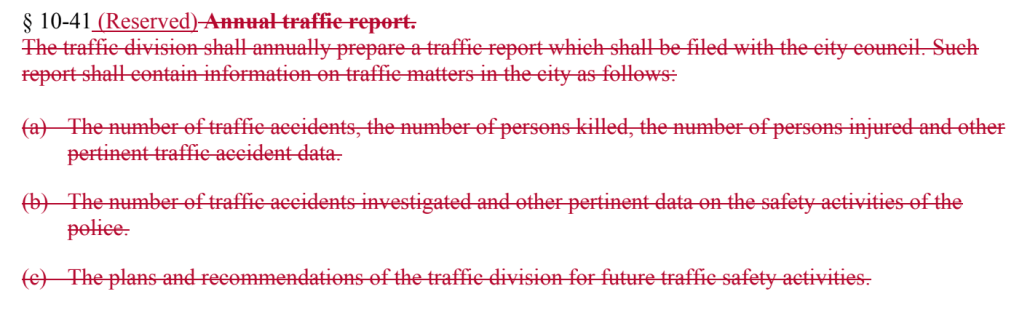
Where has this “annual traffic report” been all my life?!?
🎶 Don’t it always seem to go, that you don’t know what you got ’til it’s gone…🎶
As I’ve written before, I am a big believer in transparency, particularly data transparency around problems occurring in our community. And now you are telling me that our ordinances previously required the traffic division to annually prepare a traffic report detailing the number of traffic accidents, the number of persons killed and injured on our streets, the results of our traffic collision investigations and the recommendations of our traffic division for future interventions?? If these have been required in the past, it is the first I’m hearing of it.
But in any event, we absolutely should not strike this requirement. Rather, we should enforce it! I would love to see such an “annual traffic report” presented to the City Council. It would underscore just how far we have to go in terms of traffic safety (regrettably, two pedestrians were killed on our streets just this past weekend), and the limits of traffic enforcement to fix those problems. So I hope this language comes back!
So that’s what’s in the ordinance — but what is missing?
Well, folks who were hoping for a more aggressive “anti-e-bike ordinance” will be disappointed. My trepidations about regulating sidewalk use aside, this is a very light touch in terms of rules aimed at e-bike usage specifically. There are no specific regulations about age, helmet use, contra-flow or “wrong way” riding (though riding against traffic may be cited as being de facto “unreasonable” per the new language above), or, sidewalks excepted, any time or place restrictions on e-bikes. I was also disappointment to not see a renewed emphasis on pulling truly illegal e-bikes off the streets (specifically the ones that are actually dirt bikes or electric motorcycles, which are not street legal).
But I think the biggest piece missing here is that the root cause of all of these problems is grossly inadequate bicycle infrastructure. As alluded to above, when I see startling statistics like “20% of all bicycle injuries occur on the sidewalk”, I think, gee, that must be where the bicyclists are, and then wonder why that might be. So those statistics should trigger alarms, but not over the CMPD’s lack of bicycle enforcement. Not only are we not in a position to “let the CMPD lose” on e-bicyclists — we can’t even ticket drunk people driving cars at a certain enough clip to measurably bring down our DUIs, which trended way up post-pandemic — we shouldn’t want that. Last time I checked, the city still had a goal of 10% bicycle mode share in its General Plan. We won’t get there without e-bikes. Period. So yes, we should be alarmed that so many bicyclists are being injured on our roads. But that should light a fire under us to make the roads safer, not beat down on riders.
 Goat Hill Rodeo
Leave a comment