
The mainstream Costa Mesa media has provided its write up on the City’s adoption of an inclusionary housing ordinance, and reading the story has caused me to reflect a bit on how we got to this policy and why I (and many others) care so much about it.
The story highlights an anecdote brought up by Council Member Andrea Marr at Tuesday’s meeting about the Costa Mesa Motor Inn. It’s a story worth dwelling on a bit. The Costa Mesa Motor Inn was a low-cost motel on Harbor Boulevard that, in addition to providing cheap accommodations for travelers, had become permanent homes for many families with small children. Squeezed in among typical motel guests and an increasingly seedy undercurrent of crime and drug use, children were growing up and going to school while their parents struggled to keep a roof over their heads. Council Member Marr emotionally recalled seeing school buses stop at the Costa Mesa Motor Inn to pick up scores of children who were living there. If I saw that I’d be emotional, too.
So what became of the Costa Mesa Motor Inn? It was torn down, after former Costa Mesa Mayor Jim Righeimer called it a “cancer in the middle of the city”, to make way for a luxury apartment complex that wouldn’t generate so many calls for service. So now in its place we have the nauseatingly named “Lux Apartments”. As for the former residents, they were supposed to receive “relocation packages” worth about $5,500, but whether this actually happened, I don’t know. What I do know is that, despite outcries from the public, the new development did not contain any deed-restricted affordable housing.*
Set against this backdrop, activists’ recent calls for a high inclusionary requirement make a lot of sense. In fact, they feel like a moral imperative. Poor families with nowhere else to go were being victimized by modern-day “slum clearance“, and the developer who benefited from such activity saw no need to accommodate or provide for the people — including young children — being thrown out on the street. Mandating that at least some of the new apartments be affordable housing seems like the absolute least the City could ask. And it makes total sense that arguments such as, “well, these new luxury apartments increase the overall supply of housing, which eventually will trickle down to lowering prices for poor working families!” don’t just sound absurd: they sound insulting.
But I wonder if this conclusion misses the forest for the trees. I think it fails to interrogate why families were crowding into the Costa Mesa Motor Inn in the first place, and why they are still doing so in similar motels today**. The Daily Pilot story provides us with some clues. Interviewed residents recall facing some major life disruption — a divorce, financial setbacks — and having their former housing situation fall apart. But circumstances compelled them to stay in the area. Some had jobs that were difficult to leave. Others had children who were thriving in local schools. Our housing situation is obviously unstable, they surely reasoned. I must ensure my children have some stability at school. So instead of packing up and “moving to where they can afford” — an uncharitable refrain constantly repeated by housing crisis skeptics — they chose to live in a local motel. And I can’t blame them. I’d probably do the same.
Families were living in a crime-ridden, seedy motel because this is what passes for “safety net” housing in Costa Mesa. While former “leaders” insulting deride such housing as “cancerous”, safety net housing is a critical component of our housing market. It is the last stop before families find themselves homeless and on the street. And the most important aspect of safety net housing is that it is immediately available. Life crises like being evicted, getting divorced or leaving an abusive relationship are devastating but above all they are sudden. You don’t just need affordable housing; you need housing now.
And that is (another reason) why replacing safety net housing like this with market-rate-housing-sprinkled-with-affordable-housing isn’t as good of an idea as it sounds. Yes, the lucky recipients of affordable units will be granted a modicum of rent stability. But it will not help the vast, vast majority of people who will not receive an affordable unit, who must still fend for themselves in the open market. And it will not even help those who received such affordable units in the event they have to move. Once they leave they aren’t entitled to another affordable unit; they’re back in the regular market like anyone else. Mandatory inclusionary zoning can’t guarantee an affordable unit is available when someone needs it. Only abundant supply can do that.
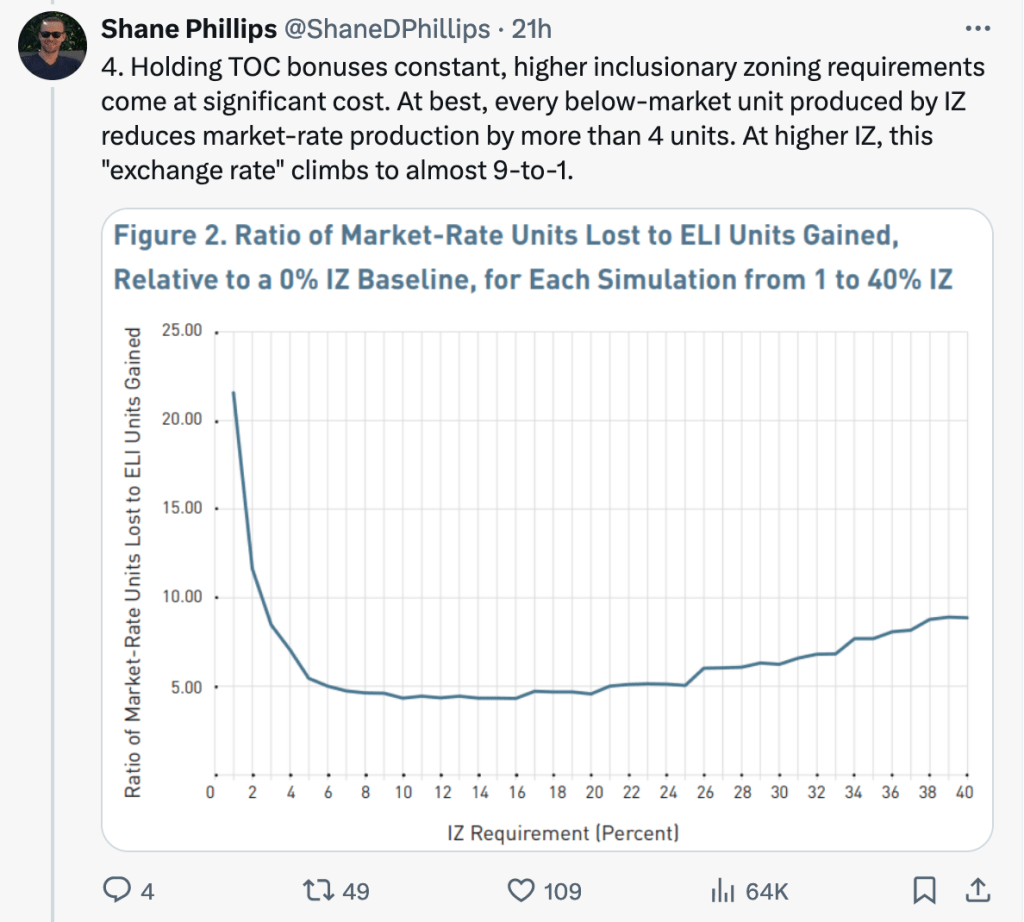
Shane Phillips, who wrote the book The Affordable City, just released research through the Terner Center for Housing Innovation at UC Berkeley that theoretically confirms that inclusionary zoning creates diminishing returns to the housing market by depressing overall supply over time. As you can see in the figure below, for each additional percentage increment of inclusionary zoning, the number of market rate housing produced disproportionately falls compared to the number of affordable units (labeled “ELI units”) produced:

What this means is that, for each inclusionary unit built, we are foregoing building many more market rate units. In fact, even small inclusionary requirements radically reduce the number of market rate units built compared to the number of inclusionary units built (look at the steep, steep curve on the left), until the trade off levels off around the 10% inclusionary mark. But even then, you are still giving up ~4 market rate units for every inclusionary unit:
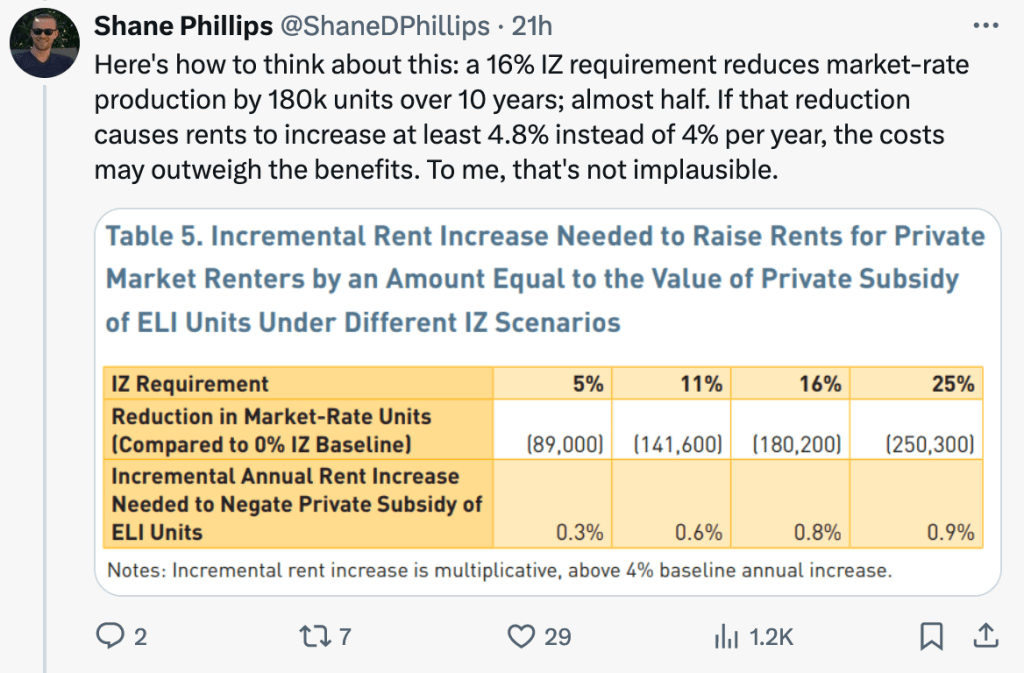
And here is the analysis that is the most salient for Costa Mesa. By reducing the number of market rate units produced in exchange for producing inclusionary units, the overall supply of housing will grow more slowly than it would without inclusionary zoning. Phillips modeled what that would mean for a hypothetical neighborhood in Los Angeles in terms of incremental rent inflation caused by lower housing supply growth. While he found annual rent inflation would be increased by less than 1% at almost all levels of affordability, this was in addition to assumed year-over-year rent inflation of +4%. So if you look at imposing, say a 16% inclusionary requirement (not that unlike the 15% requirement proposed by Costa Mesa affordable housing activists), the costs to the overall market likely outweigh the private benefits of the inclusionary units:
And this is why I care so dang much about inclusionary zoning and the minutia of affordability percentages. It’s not that I think we should be “cleaning up” Costa Mesa by effectively making it illegal to live here while poor or even working class (yeeesh). It’s not because I think people should just “move to where they can afford”. And it’s not because I’m some hardcore freemarketer that thinks greed is good and that developers are some kind of capitalist hero class.
It’s because high rents and low vacancies are crushing people and our community, and I want the City to follow the surest path to fix that. I too am horrified by the mix of public policy decisions that lead to the reality of the Costa Mesa Motor Inn and its ultimate destruction. And while it feels good and right to try and clawback restitution from high-end developers, every piece of research I’ve read on the topic and every insight I’ve gleaned from ten years working in financial markets tells me aggressive inclusionary zoning will not fix our problems. As I wrote in my written public comments for last Tuesday’s meeting (skip to p. 46) , if I thought a 100% inclusionary requirement would get housing built and address our structural housing deficit, I would support it. But I know it won’t, and I know other “aggressive” approaches won’t. So I can’t.
“If you want to see the mechanisms by which ideas and good intentions become transmuted into law,” the Daily Pilot gushes today, “look no further than the city of Costa Mesa.” But the trick, it turns out, is to keep good intentions from getting in the way of good outcomes. Thankfully, I think the City Council’s adopted compromise keeps the tradeoffs of inclusionary zoning squarely in view. Hopefully it pays off.
* A more-clued in reader informed me that, thanks to a settlement of a lawsuit brought against the City by affordable housing advocates, the Lux Apartments now contain 9 units of deed-restricted affordable housing and a fund was set up to compensate former residents. In any event, I think this illustrates the passion ignited by this incident, and why deed-restricted affordable housing must have seemed like the preferred tool to fight displacement.
**I’ve seen this with my own eyes. Due to a water leak my family was forced to leave our house on short notice, and we ended up staying at an extended stay motel for a week or so. It was obvious that, not only were many of the other guests families with young children, they were clearly living there full time.
 Goat Hill Rodeo
Leave a comment