
I started Part I of this two-part essay by asking whether W. 19th Street was perfect before the changes, and I hope I convinced you that it wasn’t. But I think it’s equally fair to ask: is it perfect now?
No. It’s not a perfect street. It’s at best a “work in progress” street. And it’s still got two pretty big problems.
Problem 1: For Drivers, Noticeable Inconvenience without Noticeable Improvements (From a Car)
I think it’s fair to say that the City made driving a little worse on W. 19th Street but without making walking and bicycling (and transit) a lot better. There is no doubt that the new design introduces marginal inconvenience for drivers. How much of an inconvenience is unclear without data, but there are clear pain points. Getting into and out of one of the shopping centers without a dedicated turn pocket is harder. And the reduction from two lanes to one lane before rather than after Placentia does back up traffic during the busiest time of day because Placencia is such a popular destination.
Unfortunately the changes didn’t make the walking and bicycling experience disproportionally better. The new bollards are really nice for bicyclists. But their overall value has been blunted by the lanes’ lack of connectivity to popular destinations, especially east of Anaheim Avenue. And for walking there are great safety improvements, but not much in terms of desirability enhancements (think wider sidewalks, better landscaping, etc.). And transit hasn’t been touched at all, though of course that isn’t in the city’s control.
Counterpoint: significant improvements for all modes require significant changes, and cities don’t really work that way. Sometimes incremental changes are the only way forward.
So I get that, without really compelling improvements to other modes that move the needle and clearly increase desirability, it’s easy for motorists to feel they’re making compromises for no gain. But despite these issues I still think the City did the right thing in moving forward. As mentioned in the prior post there was a fundamental safety issue that needed to be addressed, and so far the data on pedestrian/bicyclist collisions is promising. But whether the did made the right choices in terms of approach and design is another matter. I think generally it did. And it left itself sufficient wiggle room to make adjustments as needed.
Critiques that the bicycle lanes aren’t used enough or that the pedestrian enhancements aren’t evident enough basically boil down to a complaint that, if you are going to inconvenience drivers even a little bit, you’ve got to go big or go home. But I find myself wondering if making sweeping changes is really better than the slow, incremental approach of small improvements. Yes, it would be wonderful if we could execute a bicycle lane blitz where we add connected lanes all at once throughout the city, and cities that have done that have found some success. Or perhaps the city should have commissioned and published a sweeping reimagining of W. 19th Street that showed how these improvements fit into a larger, grander plan.
But this approach can produce backlash, too, especially when those grand designs don’t live up to expectations. So I think there is value in an incremental approach. Cities are built over decades (even centuries), not over weeks or months. As I discussed in the prior post, if we want to achieve the city’s historical long term vision for W. 19th Street, narrowing the lanes and slowing down vehicle traffic is a necessary first step. And as improvements go paint and bollards are much easier to adjust than concrete or asphalt. In fact, there is evidence the city is doing just that: during the May 7th City Council meeting, Public Works Director Raja Sethuraman noted that the city was tweaking the signal timing to prevent backups and exploring options to reintroduce a center turn lane for that tricky shopping center I mentioned. And if that happens, so what? W. 19th Street isn’t done — in fact, it will never be “done”. It’s in the midst of finding out what its next phase will be. And in a free society organic growth isn’t always a straight line.
Problem 2: VOLUME!
At the end the day, a lot of motorists still need to use W. 19th Street. Placentia was, and still is, a major north/south thoroughfare serving many neighborhoods and connecting to important amenities like schools and Fairview Park. And the intersection of W. 19th Street and Newport Boulevard is the last one before Newport Boulevard officially becomes the 55 Freeway, making it the most direct option for Westside residents to access that key artery. Yes, traffic might move more slowly on W. 19th Street, and safety and desirability may improve. But without a way to meaningfully reduce vehicle trips, it’s a fact that those cars are likely to going to filter into alternate routes on other streets. And obviously if you live on those other streets you aren’t going to love that.
Counterpoint: The volume problem can’t be fixed by changing W. 19th Street alone, and leaving it as-is kicks the problem down the road without solving it.
Everyone with eyes can see that Caltrans’ decision to ram the 55 Freeway through the center of town has absolutely devastated Newport Boulevard and cut the heart out of Costa Mesa’s downtown. But what is more subtle and perhaps even more tragic is that the freeway dumps so much traffic onto W. 19th Street (and to some extent, E. 17th Street as well) that those streets are chained to the freeway, too. And worse, thanks to W. 19th Street’s inclusion on the Master Plan of Arterial Highways (MPAH) maintained by the Orange County Transportation Authority (OCTA), we’re not even allowed to include street improvements that would help control volume:
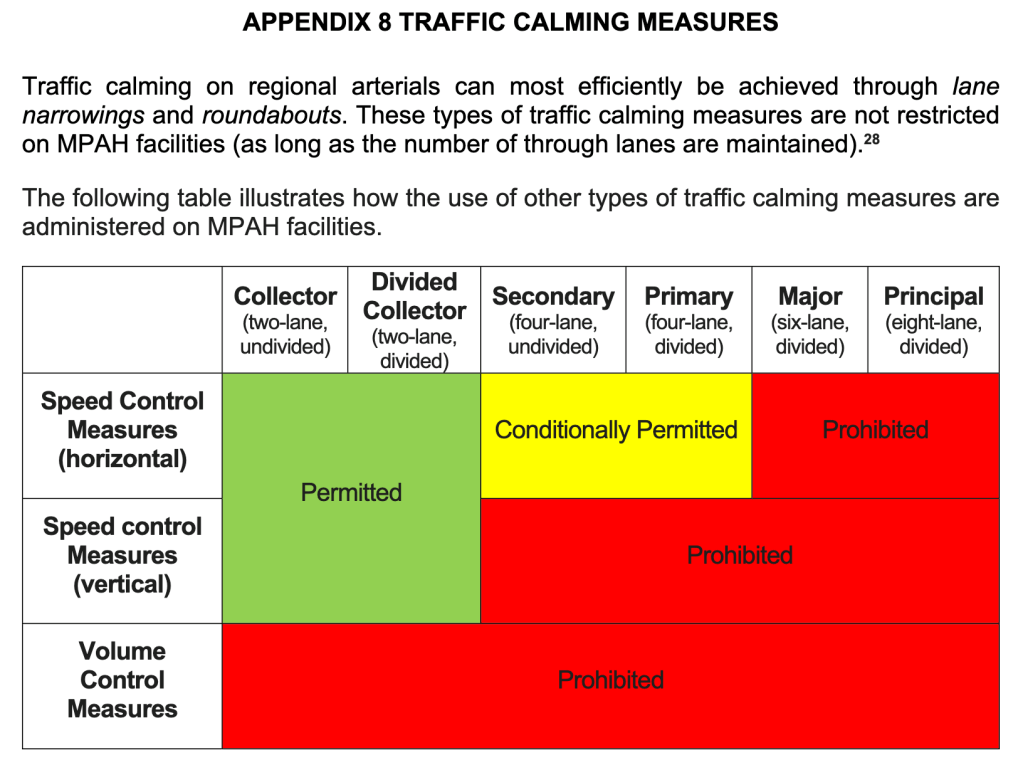
What can we do? That’s not an easy question. I know what we can’t do is let OCTA or Caltrans decide what W. 19th Street will look like. This is our city. Not Newport Beach’s, not Huntington Beach’s, not Irvine’s, not Orange County’s, not Sacramento’s.
So first, I don’t think we should get too hung up on the restrictions imposed by the MPAH. It is possible to amend the MPAH and, now that plans to connect W. 19th Street to Huntington Beach via a bridge over the Santa Ana River are pretty much well and truly dead, OCTA shouldn’t have much reason to object to any proposed changes. Therefore if we wanted to use “volume control measures” I think we could. Now, whether we want to use the volume control measures laid out in the MPAH Guidelines is another matter:
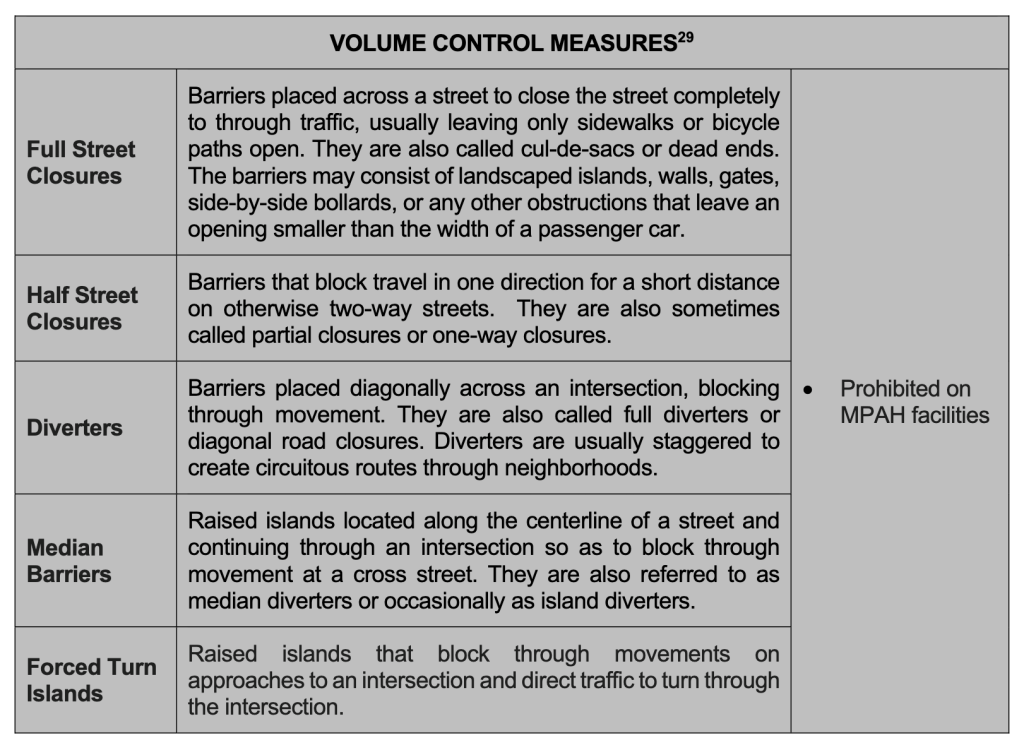
All of these changes are intended to divert traffic to alternative routes. But the problem with doing that on W. 19th Street is that, at least on the north side, there are no real alternative routes. For reasons that I’m sure lie deep, deep in the annals of Costa Mesa planning history, there is no parallel route to the north of W. 19th Street, leaving the many homes and apartments that lie north of the street with no other meaningful alternative to get to and from the 55 Freeway:
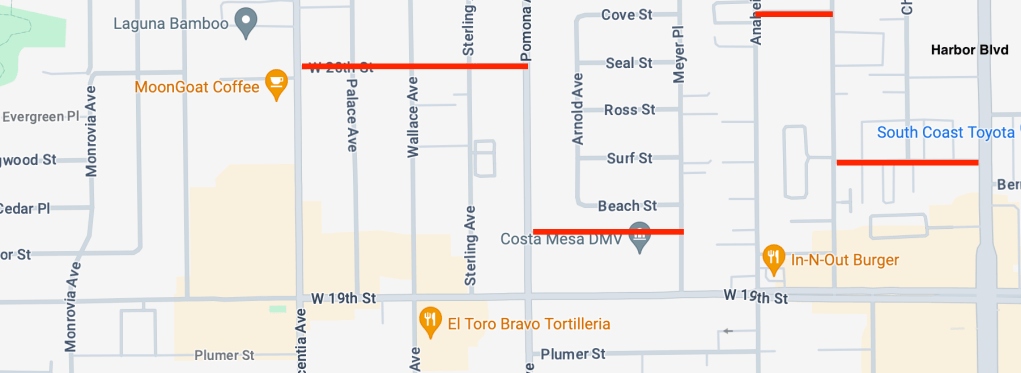
So does that mean we should have just left the street alone? Well, here’s the bad news: even if we revert the street to being devoted to vehicle throughput edge-to-edge, we will eventually run out of room for all the cars on W. 19th Street. This is almost certain to occur whether we add new developments along this stretch or not. If we permit some development to occur, we will definitely get more cars if we don’t do anything to address the high demand for them. And if we don’t permit development to occur, we will have to contend with the realities that high housing costs bring. Multiple households will continue to cram into the same unit to split housing costs, so you’ll get more cars per housing unit. And with persistent high housing costs, you’ll eventually get higher wages, too (most likely with higher earning households displacing lower earning ones). This means households will be more likely to have sufficient disposable income to purchase multiple cars. This is great for those families but that doesn’t change the spacial problem of too many cars in too small a space.
So if we leave the street as-is, the volume problem will only get worse, and the safety problem we already have will get worse along with it. More and more cars will cause the desirability of the commercial strip to continue to stagnate and its redevelopment prospects to stall. But kids, seniors and low-income adults will still walk and bicycle to necessities such as the grocery store and schools, so you’ll also continue to see life-changing (or ending) collisions between people and cars. That’s a bad future for this street and its residents and one we should do our best to avoid.
How to address volume in the long term: mode-shifting, parking, and Caltrans
Addressing volume is going to be a long, hard process that will have to touch far more of the city than just W. 19th Street. While the changes made don’t directly address the volume problem, we probably need to do something along the same lines in order to set the street up for a better future. Making it nicer to walk and bicycle will, over time, marginally increase the number of trips by those modes. But the real improvement would be to make transit a more desirable option, and that’s only going to happen if you see more street-facing development. Transit can’t function if all destinations are behind 50 feet of parked cars. So by enhancing the value of walking and bicycling, and by slowing down the cars, you’re setting the table for a better development pattern that will be more supportive of transit. There is even a case to be made that, in the long run, the bicycle lanes should be replaced by bus/bike lanes. No mode should be immune from change.
But that kind of process will likely take decades. On a shorter time horizon, we could also tackle volume by looking at parking. Parking will become scarcer over time because, if left unaddressed, the number of cars accessing the area will grow over time. But we can do something about that before we find ourselves in a congestion crisis. The city could address parking now by reducing (or eliminating) parking minimums and introducing paid parking on the street. Doing so would change the incentives for people considering short trips such that more of them would choose to walk or bicycle. And for those who really need to drive — such as seniors, the disabled, families with little kids in tow, etc. — paid parking could help ensure that a parking spot is available for them when and where they need it, rather than having to cruise for 10 or 15 minutes looking for a “free” spot or parking far from their destinations. And to be clear, moving to such a system would still leave lots of free parking. For example, grocery stores even in the heart of big cities like Chicago still have wide open, free surface parking lots.
And finally, in the very long run, we need Caltrans’s and OCTA’s help to address the volume of cars coming into Costa Mesa, specifically via the 55 Freeway. These agencies’ insisting on widening the 55 Freeway at every opportunity certainly doesn’t help. We need a culture change at Caltrans and OCTA to not only to stop widening these freeways, but also to start valuing Costa Mesa and its streets as something more than car movers.
But how can we convince Caltrans and OCTA that our streets have value if we aren’t willing to place value on them ourselves? If we just roll over and decide that we’ll leave our streets at the mercy of Caltrans and OCTA and the vehicle throughput those agencies hold dear, they will never have a reason to change. If we act like the best thing we can ever be is a doormat for passthrough commuters, state and county agencies will assume that the city wants to be a doormat. But if we start taking the smallest steps towards putting our foot down and declaring that Costa Mesa is a city worth being in, not just driving over, then we give ourselves leverage. We might even get up the courage to tell Caltrans and OCTA that they, and not the city, need to change.
That’s why visible street improvements like green paint and bollards matter. They are a statement that we have a long-run vision for this street as a community asset. So am I going to go out and hug a bollard today? Probably not. But I might give one a pat on the head. It’s not perfect. But it’s going in the right direction.
 Goat Hill Rodeo
Leave a comment