
The City Council got its first crack at the draft of the 2024-2025 budget earlier this week. At 373 pages there was a lot to unpack. So instead of going through the whole thing, I’m just going to do a quick overview of what jumped out to me in the Agenda Report and in the City Council’s discussion. To me the consequences of rampant housing inflation look to be front and center.
The end of an era: American Rescue Plan Act (ARPA) money finally runs out
As we probably all recall all too well, the COVID-19 pandemic sent us — and our government — into a total panic, as both the virus and our mitigation responses closed businesses, schools and churches and overwhelmed local services. And one of the most far-reaching consequences of that time was the passage of the American Rescue Plan Act of 2021 (ARPA), which authorized $1.9 trillion (yes, trillion with a “T”) in federal stimulus spending.
In addition to putting money directly into the pockets of American workers and business owners, ARPA also airdropped millions onto local governments. Costa Mesa alone received $26.5 million, and we were also the beneficiaries of $3.2 million in reallocated Orange County ARPA funds, courtesy of OC Supervisor and former Costa Mesa mayor, Katrina Foley. For comparison the all funds city budget for 2021-2022 was about $197 million, just to give you a sense of scale.
So what did we get for our ARPA spending spree? Well, as far as I can tell, at least half of the money was used to replace lost city revenue and to backfill furloughed employees across city departments, as well as replenish our disaster relief fund. However, the city struggled a bit to find ways to spend the second half. The the economy recovered faster than anticipated and the city’s finance department (prudently) resisted the urge to fill holes in the operating budget with ARPA money. Furthermore, ARPA’s rules restricted they ways the money could be spent.
But one area where the city could spend ARPA funds was housing — and boy did we, as inflation pushed housing insecurity to the top of city priorities. We spent millions on affordable housing projects, including the Motel 6 conversion to permanent supportive housing and the affordable housing project deemed “the Bungalows” off of Pomona Avenue. But we also spent a significant amount of money on rental assistance, setting up the new anti-eviction ordinance and providing seed funding to the Housing Trust Fund, which was created as part of the grand compromise on the inclusionary housing ordinance. And with that last transfer, the current draft budget quietly announces that the last of ARPA funds have officially been spent.
So now that the federal spigot is officially off, where is the revenue?
While the city generally did a good job resisting the temptation to spend ARPA funds on recurring or operating expenses, that doesn’t mean the absence of ARPA won’t be felt. I fear that our rental assistance fund, for example, will struggle to find recurring revenue to support it. Similarly there are questions whether the newly created eviction ordinance program is sustainable. The program originally envisioned four new full time positions being allocated to this work; now, the current budget proposes only two positions.
And that’s partly because are not seeing an increase in revenue to replace the ARPA funds that have been funding our relatively generous social welfare spending on housing, especially when factoring in inflation. In a concerning turn, we are budgeting for a further reduction in our sales tax revenue, which is in addition to the lower-than-expected sale tax returns we experienced in 2023/2024. The reason? According to Finance Director Carol Molina, the city is seeing a noticeable drop off in home renovations and repairs thanks in part to high interest rates putting damper on home equity lines of credit and consumers spending money on experiences (vacations, eating out, etc.) rather than durable goods. And again, this is doubly concerning given that we are seeing our unadjusted sales tax numbers go down. Adjusting for inflation makes those numbers worse, not better.
But shouldn’t Costa Mesa — famous for its art galleries, shopping malls, performing art centers and restaurants — be benefiting from an “experience” driven economy? Although we’ve recovered somewhat from pandemic, our transient occupancy tax (TOT) — a tax levied on hotels and other temporary accommodations, which is a good barometer for our tourism industry — is also flatter than it should be. At first glance, the chart below makes it look like our TOT is up compared to the pre-pandemic period. But the ~$8.4 million in TOT revenue we were averaging before the pandemic would be worth about $10.5 million in today’s dollars, meaning we haven’t grown our TOT as a share of revenue at all for over 10 years:
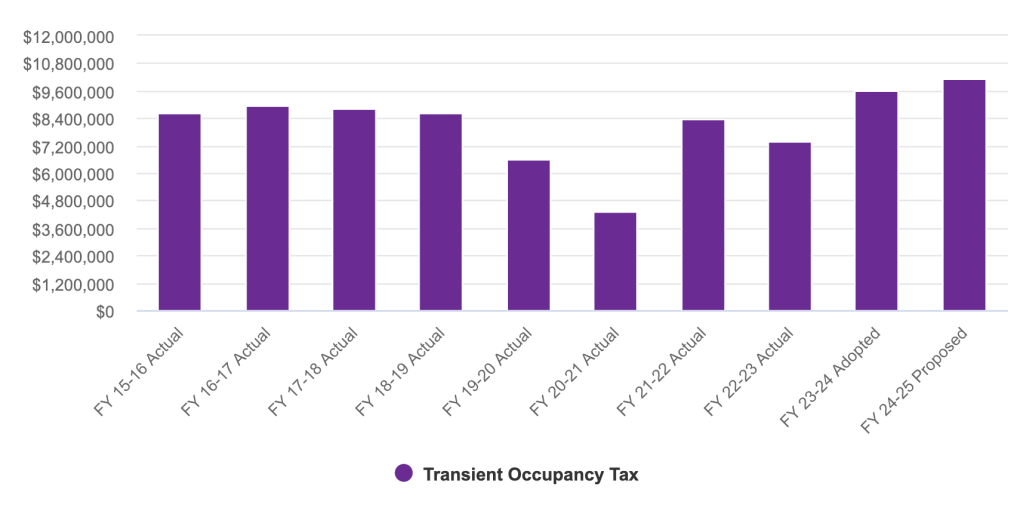
Stagnation in our TOT and sales tax revenue should be a grave concern. For better or for worse, we are a sales tax-driven city, deriving almost 43% of our total revenue (compare that to most Orange County cities, which are heavily weighted towards property tax rather than sales tax). And while our TOT take has always been comparatively modest, there’s no doubt tourism in turn helps drive sales tax revenues. Besides, I’d rather be filling up our sales tax coffers with levies on tourists than levies on residents.
What is going on? My fearful guess, without going too much on a housing tangent: housing and rent price inflation, coupled with high interest rates, have people locked in place and anxious about making big changes. Yes, unfavorable HELOC rates might be putting a damper in home improvements. But do you know what else would put a damper in home improvement spending? Very few people buying and selling homes, and fewer renters moving, too. Moving always spurs significant spending on construction and related customization, as well as home furnishings and decor. But many homeowners are stuck with low interest rate mortgages and astronomical market prices. And renters, too, increasingly find themselves in significantly below-market rentals thanks to statewide rent control coupled with market rents continuing to climb locally. Fewer people being willing to move means there are fewer available units on the market, which causes supply to dwindle and prices to continue to climb. Want to know how Costa Mesa has lost about 3,000 people from its population since 2018 while its real estate values continue to rise? This chart helps to explain it:
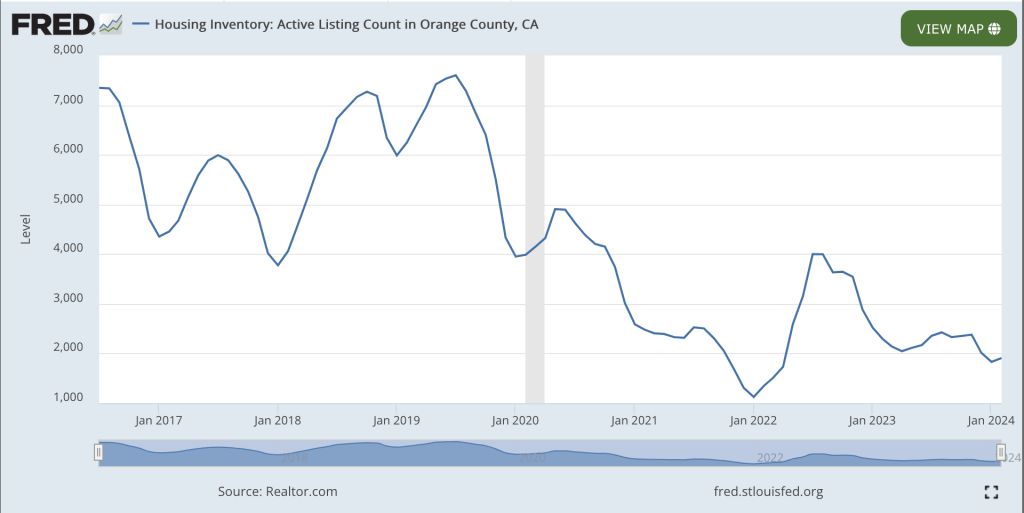
The housing “market” is not the number of units that have been constructed in the city. The housing market is the number of units available at the time you want to rent or buy. And number of units available has been absolutely crushed by the pandemic and our economic responses to it. So I’m not shocked to see we are seeing significant housing inflation. What is unfortunate is how this inflation is rippling into the rest of our economy, including by eroding home improvement spending.
One other observation: the fact that home improvement spending is enough of our sales tax base for its absence to be noticeable underscores the extent to which our city needs at least some development in order to balance its books in the long term. If we learn any lessons from this latest round of inflation, I hope it is that periods of inflation will steal directly from the city’s budget — and by implication, residents’ public policy priorities — if we aren’t also pursuing an agenda of persistent and steady economic expansion.
So with that in mind, where are the Development Services staff??
Measure K’s promised rezoning came up yet again in the budget discussions, because if what I said above is true, then that process really is Costa Mesa’s best shot to get its revenue back on track. But where is it? Measure K passed in the fall of 2022, and we are now almost to the summer of 2024. Yes, I understand that the loss of former Economic and Development Services Director Jennifer Le was likely a blow to the city’s planning efforts. But I don’t think that’s the only reason we haven’t seen much movement.
First, it’s pretty apparent at this point that City Hall has other priorities. When asked directly by Council Member Arlis Reynolds whether the city had sufficient staff to address the mountain of work rezoning would entail, City Manager Lori Farrell Harrison’s response was direct: we have the level of staff that we can afford at the moment. She then pointed to the several new staff positions we added to address homelessness and evictions in the last couple of months, effectively saying that the city already blew its development budget on addressing the symptoms of housing insecurity, and now we don’t have the resources to hire additional staff to address its causes. Besides, the City Manager intoned ominously, we don’t want to end up like the City of Orange, do we?
That’s all got to come as a bit of a blow to this Council. I do not recall any of the staff presentations during the discussion of the eviction ordinance mentioning that spending on personnel in that area would undermine the city’s ability to staff up to address rezoning.
The City Council should press hard to get to the bottom of this. We’re already far, far behind on getting the ball rolling on the rezoning. It’s time to get moving. Pushing rezoning into the Fall — when the nation will likely be gripped by one of the most vicious and emotional elections in recent memory — feels like a really bad and counterproductive idea. But that seems to be where we are heading.
“It creates a lot of costs, and it creates a lot of pain”
At the end of the study session, Mayor John Stephens used some of his time to go off on a short tangent about housing, and I’m glad that he did. What he said encapsulates the anxiety that have been feeling about city revenues, development and housing for several years now, which is evident all over the pages of this blog. Go take a listen for yourself. He points out that the city, full of compassionate people representing compassionate residents, has responded to our housing crisis in a very human way, which is to address the symptoms of housing inflation with direct programming (homelessness outreach, eviction counseling, rental assistance, etc.). But these programs have significant costs, and none of them strike at the root of the problem, which is that housing prices are running away from wages.
This is the dark side of improving property values. Yes, high housing prices can fill up our property tax coffers, but as Mayor Stephens pointed out, they also create many costs (in the form of addressing the symptoms of housing inflation) and, more importantly, they inflict real pain on residents exposed to high housing prices. I’m glad Costa Mesa is at least conceptually on board with addressing the root causes of this pain. But I’m not so convinced that it’s following through on that idea. At least not yet.
 Goat Hill Rodeo
Leave a comment