
Last Sunday in church one of my pastors was preaching on Matthew 7:24-27 (the parable of the wise and foolish builders) and he told a story about his final assignment in seminary school. It was a term paper and he really poured his heart and soul into it. He researched it for hours, meticulously edited it, and when he turned it in, he thought he had produced something special. But when he got his grade back, his instructor had given him a 53/100. Shocked and dejected, he asked his instructor why she had given him a failing grade.
“Well, it doesn’t have anything to do with the quality of your work,” she said, going on to say that it was so good that my pastor should try and get it published.
“You did the wrong assignment.”
I got flashbacks to this sermon story when I was watching the Study Sess- I mean, “Special Meeting” of the City Council this last Tuesday. The topic was to discuss the draft Strategic Plan that Staff had put together following the day-long long Strategic Plan Workshop held back on April 19, 2024. One of the very reasonable requests that came out of that meeting was for City Manager Lori Ann Farrell Harrison to come up with some performance metrics, key performance indicators (KPIs), benchmarks, etc. to measure the city’s progress towards achieving its goals. In response, the City Manager Farrell Harrison produced this document.
Hrm.
Unlike the City Council, I am under no obligation to sugarcoat Staff’s efforts. So I’m going to give them a solid 53/100, because it’s clear they did the wrong assignment.
“Performance metrics” that don’t measure performance
Take, for example, the City Council’s strategic plan goal to “diversify, stabilize and increase housing to reflect community needs.” If you look at the Performance Metrics produced by the City Manager, you’d find this table:
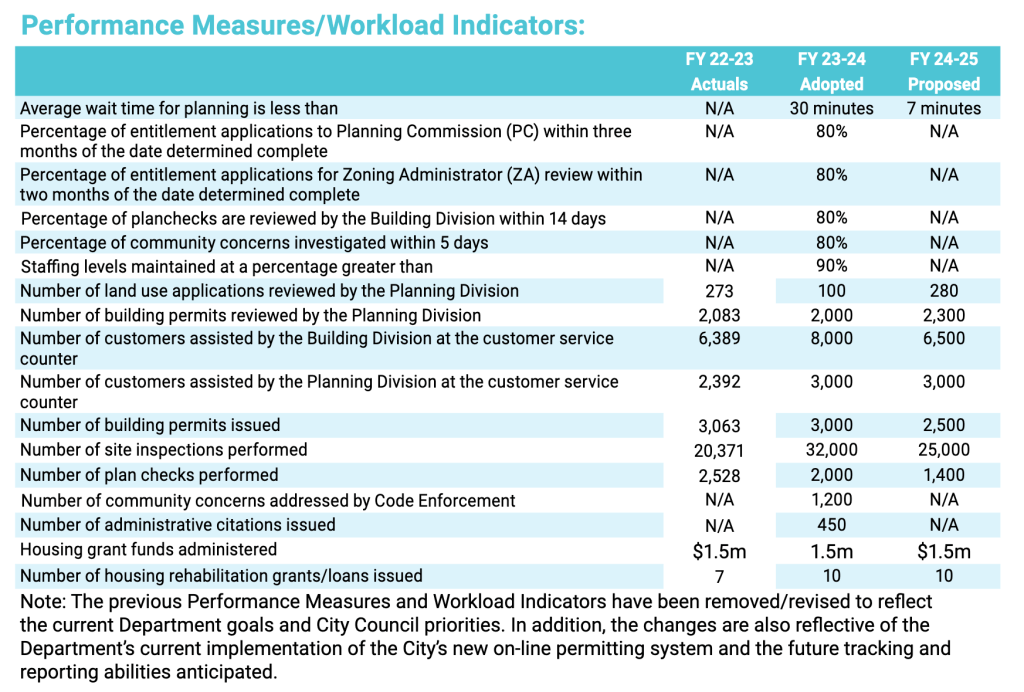
So… how can you possibly judge the City’s performance with respect to that strategic goal by looking at this table?
These metrics are remarkably unconnected to the experience of residents in the City with housing. Nowhere is there a report about the cost of housing year over year, either in terms of median rent or median home prices. There is no report on the availability of housing in the market, such as the month-to-month vacancy rate or the housing sale volume. There is nothing measuring the level of satisfaction experienced by customers using our planning department. And there is no context to the numbers that we do have that could help explain whether they are good or bad. For example, we administered $1.5 million of housing grant funds in FY 2022-2023. How many people did those fund help stay in housing? Are those dollars expected to help more or fewer people in the coming years? It doesn’t say.
Instead, these kinds of metrics measure spending and activity, not progress, which is a fundamental problem across pretty much all levels of California government. This fatal flaw was highlighted recently by stories about State Auditor’s report finding that California has spent billions on combating homelessness without tracking whether any of this spending was effective. Obviously this strikes anyone actually interested in solving problems as completely backward, and leads to some of our most frustrating public policy outcomes.
Closer to home, homelessness specifically came up in the Special Meeting. Mayor John Stephens lamented that, in light of the recent point in time count that noted a considerable uptick in the observed homeless population in Costa Mesa, the city itself had no internal metrics to which to compare the count:
“When we get a point in time count,” Mayor Stephens commented, “that says, ‘this is what we see,’ because I don’t think we really have [an internal] metric pertaining to homelessness, we can’t say whether we hit the target, missed the target, by how much.”
In other words, the Mayor was rightly concerned that, without objective measurement of the problems the city faces, there is no way to hold the anyone accountable. And in fact, when City Manager Farrell Harrison addressed homelessness metrics specifically later in the meeting, she said not tracking these metrics was justified because the percentage of unhoused residents we have is something over which “we” have zero control:
Come again?
Thus is exposed what I think is the essential disconnect between this City Council (and the residents they represent) and the City Manager’s office.
City problems are not (always) acts of God
The City Manager seems to be approaching her job as if the things that happen in the city — traffic injuries, homelessness, crazy housing inflation, crime, etc. — are things that just happen, like natural disasters. Her job, and by extension, the City’s job, therefore is to react to those trends by treating their symptoms. In other words, the city like a hospital. It’s not a hospital’s job to reduce sickness, injury or infirmity in the community. So the hospital’s performance can’t be judged on whether it reduced the number of admissions year over year; it can only be judged on how it treated patients once they walked in the door.
Except that a city is not a hospital. In fact, it would only be like a hospital if that hospital was also funded by taxpayers and given the police power to manage city health policy, in which case it absolutely would be appropriate to hold that hospital accountable for the number of hospital admissions. So when the City Manager declares that the City shouldn’t measure its own performance with respect to homelessness or any other “indicator regarding whether things are getting better or getting worse” because the city can’t control if things are getting better or worse, it’s arresting. What she’s really saying is that solving these problems isn’t the City’s job, and the Staff shouldn’t be held accountable for not solving them. Moreover, it belies a particular lack of curiosity about the role of city policies in creating or exacerbating these problems. If problems simply arise on their own, it is easy to reason, then there is not need to review current city policies for potential causes.
But it is the City’s job to actively make progress addressing critical city problems, City policy may very well be at the root cause of some of our problems, and it absolutely should be held accountable by the residents for it. And someone will be held accountable, as everyone up on the dais surely sensed. There was a palpable sense of alarm among the members of the City Council that the City Manager not only didn’t produce the metrics they had asked for, but that she may not be willing to do so. If she did, it seemed, it might raise too many uncomfortable questions, like whether we needed to change our approach, change our personnel, or make other adjustments. So it’s one thing to do the wrong assignment by mistake. It’s another thing to do the wrong assignment by design.
The difference between a board of directors and a City Council
Which brings me to another intriguing little moment, this time brought to us by Council Member Andrea Marr, who seemed concerned about managing the expectations of the public in light of these disconnects. “There is an election coming,” Council Member Marr stated, addressing (in her refreshingly direct fashion) the elephant in the room:
So to the extent we can continue to be reiterating the role of Council versus the role of the City Manager… ultimately we are a board of directors, for example, right? I’m not directing Raja [Sethuraman, Director of Public Works] to fix my street. It would be helpful, I think, to keep enforcing those norms, stating those norms, perhaps at the beginning of [the Strategic Plan], perhaps, because I don’t we’ve got [those norms] articulated in a way that is impressionable on new council members or on the public.
Her analogy to a board of directors is interesting, and to some extent extremely apt. In a private company, management is divided into two entities: the board of directors, which sets the company’s strategic vision and has the final say over fundamental issues like executive compensation and capital investments, and the chief executive officer, which oversees day-to-day management and executes the vision of the board. Similarly, a city council can’t (and shouldn’t) be involved in day-to-day operations, like the hiring and firing of personnel or authorizing regular operating expenses (recall the testy exchange between Mayor Stephens and City Manager Farrell Harrison on this point). Instead, it should set the direction of the city and provide specific approvals of big ticket items like capital improvement projects and city policies, while the city manager addresses operations.
But there are many differences between a private company and a city that stresses this analogy, and here’s a big one: in a private company, each of the board of directors and the chief executive are held accountable by separate, outside forces. The board must answer to the shareholders in the form of board elections. But the chief executive, while formally answering to the board, will also be judged by the consumers of the company’s product, which manifests in the form of financial performance.
In the city context, the residents are both the shareholders of the city as well as its consumers. But unlike a private company, the residents are only able to hold the “board” directly accountable through voting; it cannot punish the chief executive like we would a private company, say, by boycotting the company’s product. We’re stuck here, and there is no “competition” for our “patronage” since we can’t choose a different city without moving. In addition, without consistent, relentless and comprehensive outreach and polling, there is no alternative way for the resident “consumers” to communicate whether they think the chief executive is doing a good job.
So, accordingly, we rely on elections to provide accountability for both bodies: directly for the city council, but only indirectly for the city manager. What’s worse, a city manager is not incentivized to seek out that direct accountability, either — which may be why City Manager Farrell Harrison was so reluctant to add real world data to her Staff’s performance metrics. And that’s a problem. But thankfully there is a workaround for this.
Enter: The Mayor’s pretty good idea to form a housing committee
Mayor Stephens once again floated the idea of a “housing committee,” stating that his vision for this committee would be one staffed by council members, planning commissioners and members of the public. The goal, Mayor Stephens suggested, would be to have a second set of eyes to critically evaluate our current housing policy and find innovative ways to achieve our housing goals.
While I have been very hard on the City Council for its treatment of its committees, this is a very good idea if done right. At the moment, our very best and most effective committee – the Active Transportation Committee — has worked so well in large part because Council Member Arlis Reynolds is effectively a member of that committee. Because she will always be attending an ATC meeting and it is very likely she will follow up on what is discussed, Staff is accountable to the ATC to show up and to bring real details of its active transportation plans. In turn, the residents on the ATC are able to directly access the staff and communicate resident needs to them without having to go through two layers of intermediaries (the City Council and the City Manager). This has resulted in active transportation policies and projects that, while not perfect, do at least reflect community concerns.
If a housing committee were to have members of the City Council as well as Planning Commissioners in its ranks, I would expect it would garner the same level of consideration from Staff. And residents on this committee would be able to communicate their housing concerns directly to the Staff responsible for city housing policy. This would help close the gap in accountability that exists between the residents, on the one hand, and the Staff on the other. It isn’t a direct path of accountability like a vote, but at least it is harder to ignore someone when they say something to your face, with members of the City Council and the Planning Commission watching on. It would also help to bridge the “imagination gap” I mentioned above — residents, unlike Staff, aren’t so protective of existing city policy and happy to interrogate it for weaknesses.
Unfortunately Council Members Marr and Reynolds both expressed serious doubts about forming such a committee, though I hope they will reconsider. While their concern that it would slow down the Staff’s progress on its already outrageous workload is valid on its face, I wonder if this was masking a fear of being politically marginalized (recall that the recent inclusionary housing ordinance discussion ended up, in substance, breaking against them 5-2, with the majority favoring more market approaches while Marr and Reynolds wanted stronger policies around affordability). If Mayor Stephens wants to cut to the chase, he should suggest putting one them on the proposed committee to alleviate these concerns.
Meanwhile, I hope they all continue to push the City Manager on more relevant and useful real world metrics, even if she doesn’t like the sound of that. Which brings us back to Matthew 7:24-27. If you don’t know what’s happening in the city, building city policy on intuition or ideological preference instead is like building a house on sand. But building policy on hard data is like building a house on solid rock. Guess which one will fare better when the storm comes.
 Goat Hill Rodeo
Leave a comment