
Well, now that the City Council has decided to take their traditional August break also in July, and now that my nightmare of a quarter is over (I still have an actual job, you know), we have a nice quiet summer ahead of us. Which means I get to talk about fun stuff instead of having to react to all these agendas.
A couple of weeks ago I complained that the City seems somewhat allergic to data that measured tangible conditions in the City, such as the number of unhoused residents or the relationship between median income and median rents. And frankly I was probably being a bit unfair, because the City does publish a lot of demographic numbers. For example, if you crack open the Community Economic Profile section of the City’s annual budget, you’ll get lots of really great information about that year’s estimated median income, cost of for-purchase and rental housing, demographic data, etc. So it’s not like the City doesn’t have any data or doesn’t have a clue where to get it.
What I think is the bigger problem is that this raw data is rarely distilled into something intelligible. Yes, it is good that the City is getting a snapshot each year of housing costs, demographics and even climate information. But to determine if policies are working or not, you need trends, not just snapshots. So let’s take a look.
Bad news: they’re not great.
Population and Age: Smaller and Older
First off: Costa Mesa has gotten smaller and a lot older just since 2016. We’ve lost nearly 5,000 residents from 2017-2022 using the American Communities Survey numbers, and more than 6,000 if you use the 2023 estimated population (which has fallen all the way to 108,354). The number of residents under 20 years old in particular has plummeted, while the number of residents over 65 has steadily risen since 2010, with no break for the Pandemic:
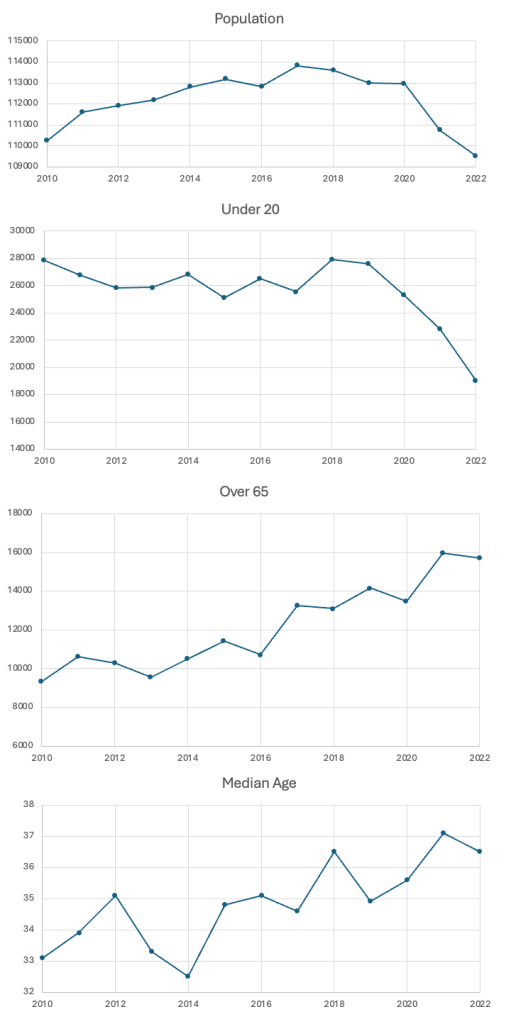
Unsurprisingly our median age has gone up, and the results are pretty crazy. It may not seem like a very big deal to go from a median age of about 33 in 2010 to just over 37 in 2021, but let me assure you, it is. The national median age went from 37.2 in 2010 to 38.9 in 2022, rising about 4.6%. But in Costa Mesa, our median age increased a whopping ~12.1% — meaning we are aging almost 3 times as fast as the national average. The same phenomenon has played out in neighboring Los Angeles, which caught the eye of the Los Angeles Times.
Why is this happening?
Well, we can break this into proximate and ultimate causes.
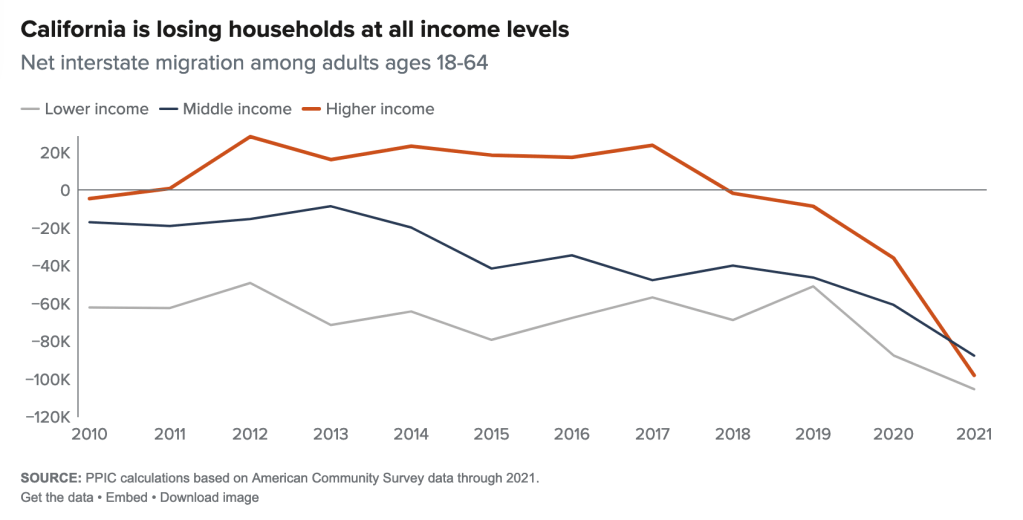
Most directly, populations rise when: (births + migration inflows) > (deaths + migration outflows), and of course decline when the opposite is true. California has famously been losing residents at all income levels to other states pretty steadily for the last 12 years, with wealthier residents recently catching up with the lower classes in terms of rate of flight:
But it’s not just migration outflows. Our birthrates are pretty awful, too. Here’s Orange County’s tally of live births since 1990:
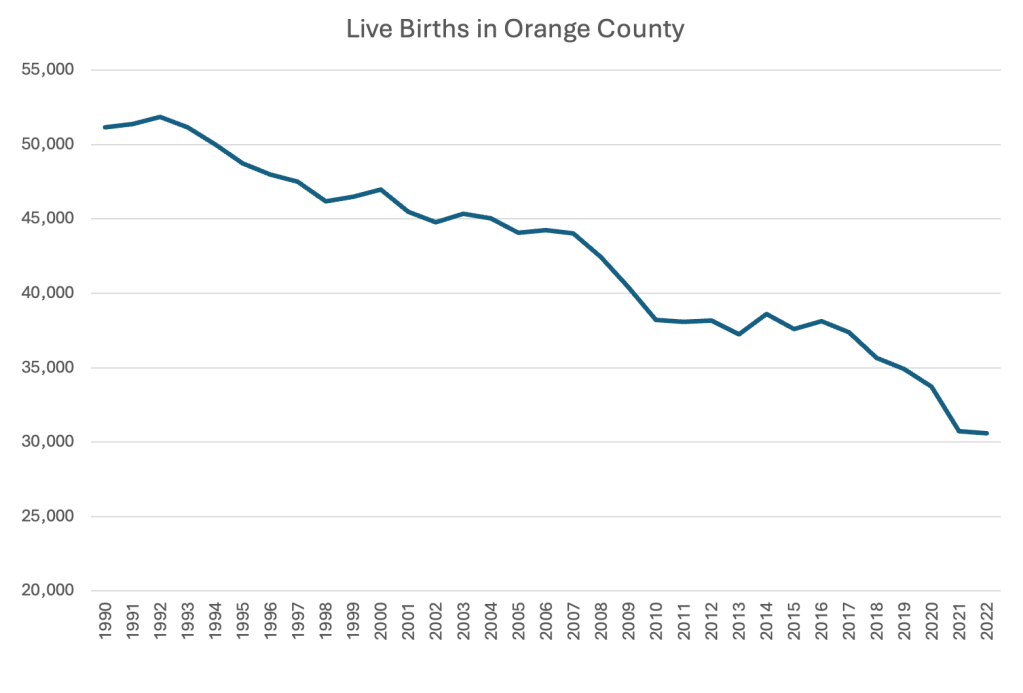
And those are gross live births, not the birth rate. So we’ve been shedding newborns even as our population has risen over the same period of time. Yeeeeeesh.
So if we’re losing adults on net to emigration and losing kiddos thanks a tanking birth rate, we at least have a compelling immediate explanation for our population decline. But why are those things happening?
Oh yeah. We’re back to the housing theory of everything.
High housing prices that are not offset with high wages will absolutely encourage emigration and might contribute to falling birth rates. As noted in one of the studies linked above, high housing prices make people feel very anxious about the future and itchy to look for greener pastures, especially if wages aren’t keeping pace:

… And guess what: wages are not keeping pace with housing prices. The Orange County Register just today took notice of a recent Harvard University Joint Center for Housing Studies publication that sounded the alarm on the ratio of median household incomes to median home prices, noting that, in Southern California, that ratio now exceeded 10:1, where only 20 years ago, it was closer to 5:1:
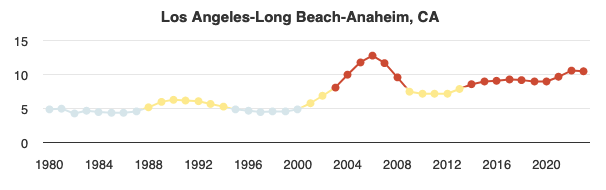
Red dots mean bad. Right around 2015 — when our area re-entered the “red zone” in the graph above – the Legislative Analyst’s Office of the California Legislature put out a report that outlined the consequences of extremely high housing unaffordability: it warned that such a condition would likely reduce overall economic activity as residents spend more and more on housing costs, increase crowding (as the negative consequences that come with that, such as crime, higher burdens on municipal services and lower educational achievement), reduce home ownership rates, increase commute times, and undermine recruitment for both the private and public sector. Now, with more recent research, we can likely add increased rates of homelessness to the parade of horribles as well.
So it makes sense why people — especially young people who are just beginning to build up their salary levels — might be driven out by high housing costs. And while the birth rate question definitely keeps me up at night, the near-constant decline of that factor regardless of state of the economy or housing affordability makes me think there is a lot more going on with that number than just sky-high rents. But the reason I bring it up is that our declining birth rate means Costa Mesa is even more dependent on net-inflows of migrating residents than a more fecund city like Salt Lake City might be. And that makes our population decline even more troubling.
BUT…
I can hear the counterarguments now: well, if our population is shrinking, great! That means the number of dwelling units per capita should be going up, and that should drop rents and housing prices, right? Supply and demand?
Sadly – that’s probably wrong. And that’s because housing price/gross population story is more complicated than one might think.
Reason #1 Dropping Population Doesn’t Help Home Prices: Volume Matters
First, we have to ask ourselves: is supply constant over this time period? Well, kind of. The number of overall housing units have grown by about 1,200 units since 2016 (mostly in the form of ADUs and a few larger projects north of the 405 Freeway that came online since that time). But an occupied unit does little good to someone looking for a new rental or home to purchase. In that case you need to look at the number of units available, which can be inferred from sales volume. And that, friends, looks pretty bad:

If that rainbow cascade is a bit much to interpret, I’ll put it plainly: the number of home sales in the trailing 24-month period are at the lowest point in the last 30 years. It’s lower than during the Orange County bankruptcy of 1994. It’s lower than the Dot-Com bust of the late 1990s. It’s lower than the Great Financial Crisis of 2007-2009. It’s lower than during a global pandemic that killed over a million people in this country alone. In other words, there are fewer houses on the market for people to buy today than at any point since CoreLogic started tracking that statistic in the early 1990s.
Why is the volume so low despite demand being so high? Well, there are two likely culprits. First, pro-stability property tax policies like Proposition 13 have long been understood to “lock-in” homebuyers, reducing the number of times they are willing to move by incentivizing them to stay put. But Proposition 13 has been around since the 1970s. What is new is the layer of near-zero interest rates we had for a long, long time thanks to the Great Financial Crisis and its unholy demon spawn, the Great Recession. Folks hanging onto 3% or even 2% mortgages are not likely to want to move anytime soon, now that housing costs are up 40-50% and interest rates are hovering around the 7% mark. So now Southern Californians are doubly “locked in” to their existing homes. Super great.
And I wish the news was better for renters, but it isn’t. Rental volume went from seeing 25%+ of units turning over in a given year in the early 2010s to closer to 18% today, meaning you are seeing a much tighter rental market, too. Why might that be the case? Well, I’m putting my money on statewide rent control coming online in 2019, and its follow up attempts to further increase tenant rights just last year. Yes, protecting tenants is good, and yes, it seems only fair that if homeowners get Prop 13, tenants should get their version of it as well. But if it has the same effects, it has the same effects. Including all the bad ones.
Reason #2 Dropping Population Doesn’t Help Home Prices: It’s Not Who Stays, It’s Who Leaves and Who Replaces Them
This one is pretty easy to understand if you look at the negative birth rate and the people-under-20 graphs above. Kids generally live with their parents. Therefore households with kids will contribute more to the overall gross population than households without kids. So when families with young kids are replaced with a couple with no kids (either young DINKS or older folks with grown/flown the coop children), the overall population goes down while the demand for housing remains high.
Another possibility is that we’re seeing the ugly consequences of the so-called “failure to launch” period of the Great Recession. While the recovery from the Great Recession wasn’t exactly “jobless”, employment during this period was hard to come by and student debt ballooned as students tried to delay job market entry during a period of rampant education cost inflation. This pushed a number of millennials to live at home with their parents and delay household formation. However, by the late 2010s, the household formation pressure (economics slang for “I’ve got to get out of my parents basement if I’m going to start a family or do anything with my life”) for this group was pretty extreme, and COVID-19 likely was the spark that pushed many out of their parents’ basements for good. But what is clear is that, with housing prices sky high, few of these basement refugees landed nearby in Costa Mesa.
Reason #3 Dropping Population Doesn’t Help Home Prices: We’re in a Vicious Cycle
I’ll be brief with this one: when desirability increases — usually due to robust job growth — wages will increase to attract workers. When wages rise, demand to live close to those jobs will rise, and therefore housing prices near those jobs will rise. If no new supply of homes is built, then higher wage workers will start to displace lower wage workers as they outbid lower wage workers for housing. To adjust, lower wage workers will either start splitting the cost of housing with roommates/relatives, increasing their purchasing power, or move farther away and trade commuting time for rent. Bunking up will further increase the price of housing by improving each combined household’s “buying power”, while those who choose to commute will increase prices in their new communities. And so on, until the maximum commuting distance is reached (economists think it’s about an hour by car).
No wonder central Orange County is pretty much the same (relatively high) density for miles and miles, as far as the eye can see.
Now, over time, these persistent high housing prices are going to further push up wages. Why? Well, first: employers will recognize that in order to lure talent to the area, they will have to offset the high cost of living with high wages. And second: higher housing prices repel middle and lower income workers, increasing demand for those who stick it out and stay. Once again, higher wages beget higher housing prices. And so on.
The only way to cut this gordian knot is to build more homes near high paying jobs.
So why is this all keeping me up at night? Frankly, I think the equilibrium of a richer, older, shrinking city simply will not produce the same quality of life as growing city that is more economically and demographically diverse. And no, that is not some liberal aesthetic preference. That’s grounded in my belief that cities need young people who are willing to take risks and breathe life into new institutions, and that the best way to reward them for this is to provide a path to achieve their ambitious goals. A world where a young person will never, ever own a home or even rent an apartment large enough to raise a family, or where to even get started she must move states away from everything she knows and loves, is one destined to depress, demoralize, and dispirit. It’s a world with fewer young people in it. And in that world, the purpose of the city will diminish. It will no longer be an engine for cultural and economic growth, but a collective cost center in managed decline.
And it’s not a world I want, for anyone.
 Goat Hill Rodeo
Leave a comment