
We’re back from a long vacation in the United Kingdom and I’m just now starting to recover from the jetlag, so it’s time to crack open the local papers and see what I missed.
I don’t know about you but I’m sensing a definite theme with these Voice of OC headlines:
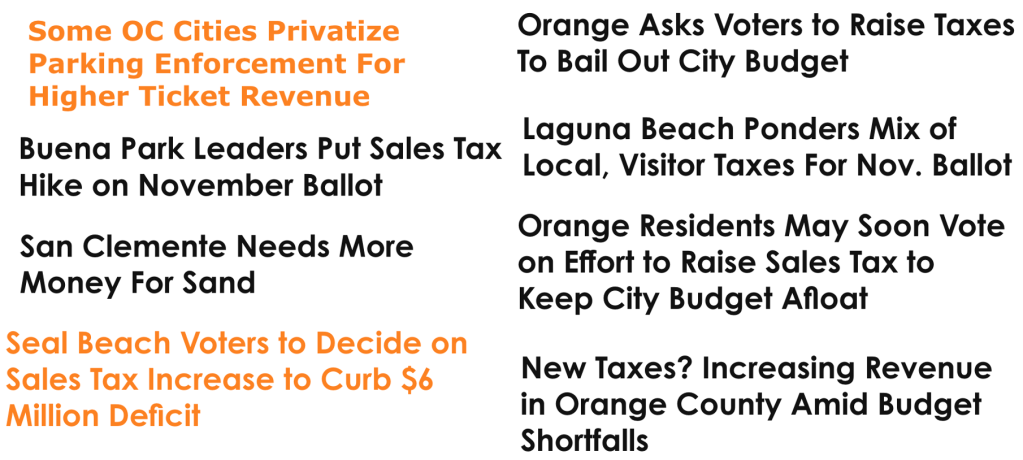
Huh. Why would all these Orange County cities be hunting for revenue? It’s seems a bit odd. We’ve been experiencing several years of persistent high inflation. Shouldn’t that be pushing up sales tax revenue? Additionally, the red hot real estate market of 2021-2022 saw a huge number of homes turn over, which should have reset their property tax bases to our present sky high prices under Proposition 13. And besides: didn’t cities just have millions of dollars airdropped onto them by federal COVID relief? Costa Mesa was still trying to spend this money as recently as last year. So what gives?
Did into these stories and the cities provide a few different explanations, from fiscal mismanagement to increases in operating costs to demographic shifts. But one thing is consistent among all of the stories: sales tax revenue, which really should be increasing during this time, has remained stubbornly flat. Why?
So… what about Costa Mesa? Do we have a sales tax revenue problem?
I already wrote a bit about some revenue concerns we’re having in Costa Mesa around our flat sales tax revenue. Looking at the data, there is some evidence that, in the short run, our housing price inflation is cannibalizing our sales tax revenue. One mechanism is that high cost of living undermines residents’ budgets, causing them to spend less on big ticket items like cars and appliances. Another mechanism is that, as for-sale property becomes financially out of reach for more and more residents, more residents will choose to rent rather than own. As rentals pay no sales tax and only indirectly pay the landlord’s property tax, it is possible that, on the margins, a renting household may not fully replace the property tax revenue it would have generated if it decided to own.
But there are likely other drags on our sales tax revenue. Online shopping is supposed to generate sales tax for the localities where the buyers are located, meaning that internet sales shouldn’t necessarily cause a local revenue impact.
But dig into the way these taxes work in practice and it is a bit more complicated. In fact, they’re kinda a scandal unto themselves.
Basically, the State of California levies sales tax on every online sale originating in the State. But then 1% of the revenue from that sales tax is supposed to be sent back to the local governments. But how is it apportioned among those governments? Well, as CalMatters puts it, “for decades, the local share went to the jurisdiction in which the sale occurred, a doctrine known as “situs.” It encouraged local officials to maximize retail businesses, such as auto malls and shopping centers, often using — or misusing — their redevelopment powers to subsidize revenue-generating developments.”
This should sound familiar to long time residents of Costa Mesa. If you are curious why Harbor Boulevard is crammed with car dealerships, or why the SoCo collection is filled with durable goods retailers like furniture stores or appliance stores, or why we cling onto South Coast Plaza for dear life, look no further: revenue enhancement by generating lots of big-ticket local sales used to be the way to maximize a city’s share of sales tax revenue.
But it turns out, thanks to a very ugly interaction between an obscure 2018 Supreme Court tax ruling and an equally obscure 2021 California Department of Tax and Fee Administration (CDTFA) ruling, online retailers can now unilaterally choose the “situs” of its sales by declaring that the location of its fulfillment warehouses, rather than the end consumer, is the point of sale, which means that the cities hosting these warehouses capture the all sales tax revenue that would otherwise go to the end-consumers’ cities.
So is this a big deal? According to the League of California Cities, it’s a huge deal:
This change has created a situation where most cities in California – more than 90%, in fact – are experiencing a sales tax revenue loss that began in the fourth quarter of calendar year 2021. Many cities may not be aware of this impact, as the fluctuations in sales tax following the pandemic shutdowns have masked the issue. But this change will have long-term impacts on revenues for all California cities as all these revenues benefiting all cities have shifted to just a handful of cities and counties that are home to this retailer’s fulfillment centers.
Well shoot. Unsurprisingly, this situation has led to some absolutely ridiculous gamesmanship (and likely corruption) by certain Californian cities that have space for massive warehousing operations. Take, for example, this tidy little arrangement by the City of Dinuba with Best Buy, as reported on in Bloomberg:

To explain the deal above with a concrete local example: Let’s say I go online and buy a $100 e-reader from Best Buy’s website, and pay the 7.75% sales tax on that item, or $7.75. 50 cents of my sales tax will go to the County of Orange for reasons we won’t get into. The remaining $7.25 will go to the State of California. Of that take, $1.00 will not go to the City of Costa Mesa, but will instead be intercepted by the City of Dinuba — the city where the warehouse that fulfills my online order is located. In order to compensate Best Buy for choosing to locate in Dinuba, the city then takes 50 cents of my $1.00 and sends it back to Best Buy as a straight kickback. 10 cents of my $1.00 is also kicked back to a single person — Robert Cendejas — who brokered the deal. The remaining 40 cents goes to the City of Dinuba’s coffers. Costa Mesa doesn’t see a dime.
And this is totally legal. In fact, when these kinds of deals were brought to Governor Gavin Newsom’s attention via a bill aimed at outlawing these schemes, Newsom vetoed the bill stating that such schemes are “an important local tool that captures additional economic activity, particularly in rural and inland California cities that continue to face significant economic challenges like high unemployment rates.”
All due respect Gov. Newsom, but it’s capturing our economic activity. And kicking half it back to Best Buy.
So what does Costa Mesa do about it?
Maybe we should look into turning Fairview Development Center into a giant Amazon warehouse. I mean, if you can’t beat them, join them, right? KIDDING.
But seriously, we probably should have our lobbyists look into how this sales tax issue affects us, since so much of our local revenue depends on sales tax. If (as seems likely) car sales, major appliance sales and all other big ticket sales move online, we’re going to be in a world of hurt even if we don’t re-develop Harbor Boulevard with a bunch of condos. The current system seems unfair and ripe for corruption on its face, so I think supporting any bill that would either require disclosure of these kickback contracts or outlaw them all together would be a good thing to do.
 Goat Hill Rodeo
Leave a comment