
UPDATE: Looks like the Daily Pilot has picked up the trail. Good! That significantly increases the likelihood this one gets in front of the City Council.
(Original story continues below)
***
In my eagerness to discuss the commission appointments, I left out of my City Council round up this week that the second reading of the Costa Mesa beekeeping ordinance sailed through on a 7-0 vote. That’s pretty impressive: it’s only been fifteen months since the Animal Services Committee sent the model ordinance to the City Council. That’s lightning quick by municipal standards. Maybe moving ASC to the Police Department from the Parks and Community Services Department wasn’t such a bad idea.
Alas, not all ordinances have been so fortunate. There is another ordinance that, just like the beekeeping ordinance, was meticulously researched by the ASC, promoted by dedicated resident activists, drafted by ASC members, and vetted by city staff, only to languish for years on the shelf. And that is the Costa Mesa ordinance addressing so-called “trap-neuter-release”, or TNR. So what is it, and why is it taking so long? Before we get into that, let’s recap the problem the ASC has been trying to solve.
Here, kitty kitty
I bet you didn’t think I’d make you read about feral cats, did you. 🐈
In a nutshell: while cats are cute, colonies of feral cats are much less so. The American Bird Conservancy, for example, notes that there are more than 100 million outdoor and feral cats, and that these animals can devastate wild bird populations. They are also prolific breeders: one cat can have three or four litters in a season with 4-8 kittens each, meaning that a pair of cats and their progeny can produce up to 420,000 cats in seven years.
Yikes. So it’s no surprise that feral cat colonies can be a big municipal headache. Costa Mesa got a taste of this a couple of years ago when an abandoned property became home to a colony of dozens of feral cats. And given that the city borders a number of sensitive ecological sites such as Fairview Park, Talbert Regional Park, the new Randall Preserve and Newport Beach’s Upper Newport Bay Nature Preserve, we probably have a heightened responsibility to keep our feral cat population in check.
Unfortunately, the fecundity of feral cats means that there are simply too many cats for the shelter system to handle. Cats outnumber dogs in our shelter by almost two-to-one, they are returned to their owners at much lower rates than dogs, and many more cats than dogs die in the shelter (either from natural causes or health-related euthanasia). For example, take a look at our shelter statistics for the nine months between January 2024 and September 2024:
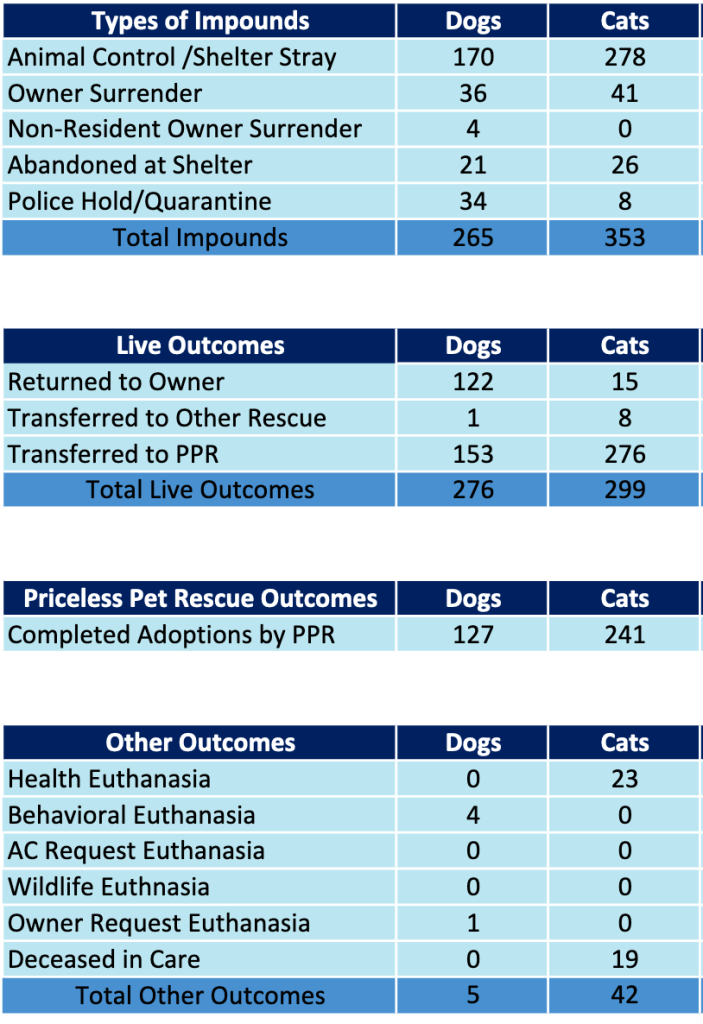
As you can see, our shelter contractor, Priceless Pet Rescue, is doing a heroic job of taking cats off of the street and either getting them adopted or transferring them to other jurisdictions. But it’s likely not sustainable. Shelter services countywide have been sounding the alarm for years about overcrowding, especially since the end of the COVID-19 pandemic, and cats are the primary contributor. And again, because feral cats multiply so rapidly, the more stray cats we have in the local population, the larger the problem becomes over time.
But trying to control the feral cat population with impounds, adoptions and transfers, which are more animal control and less pet rescue, comes with costs. Becca Walls, a long time member of the ASC, estimates that it costs Priceless Pets about $10 a day to care for a healthy cat, and that each feral cat must be held for at least 7 days under city rules. It also costs $70 to either spay or neuter a single cat, or, in more unfortunate circumstances, to euthanize one.
So no matter the outcome, the city’s shelter will pay at least $140 per cat. And that adds up: using those estimates and conservatively assuming only half of the 278 cats processed were strays, processing feral cats cost $20,000 or over $2,200 a month. And setting aside the costs, these cats also take up valuable shelter space, undermining the shelter’s ability to serve more adoptable pets.
So, is there a better way to manage our feral cat population?
The solution (?): trap, neuter, release
The environmental and sanitation risks posed by feral cat colonies, as well as the burdens they place on the shelter system, have been a concern for the ASC from the committee’s inception — in fact, addressing this problem was one of its first adopted goals. The solution that the ASC hit upon was “trap, neuter, release” — allow interested members of the public to trap feral cats, have them fixed, and then release them back into the wild. This approach allows feral cats to avoid the shelter system altogether while reducing the fertility of wild cat populations.
But if the ASC favors private individuals taking on this task, why doesn’t anyone do it? Because TNR isn’t expressly legal in Costa Mesa. But fixing that, the ASC recently argued this week at its most recent meeting, is simple and cheap: just remove the legal barriers for interested residents to engage in TNR, and monitor the program by issuing these residents’ simple permits. That way, the city would only be on the hook for issuing the permits and tracking the number of feral cats processed by our shelter system over time. If it helps control our feral cat population, great. If it doesn’t, the permits can be revoked and the program terminated.
So what’s the hold up?
Shockingly, the ASC has been debating TNR off and on for almost 7 years, which is a severe indictment of the Costa Mesa committee system. Clearly, there is an implicit disagreement between Staff and the resident committee members about whether to proceed. And that’s fine: Staff and the ASC aren’t always going to agree. But instead of taking the disagreement to the City Council, the TNR proposals have been mired in requests for more data, more justification, more refinement, etc. So, either directly or indirectly, intentionally or unintentionally, the Staff running the ASC has decided to keep TNR in development hell.
And that’s just wrong. The purpose of the committees is not to absorb resident energy and ideas and kill them with bureaucracy. Alas, that seems to be what has happened here. Even if Staff has real concerns about the logistical challenges a policy might involve, it should make its case: first to the ASC, and if the ASC disagrees, then to City Council itself. Ultimately the decision on any policy, however, should lie with the people’s elected officials. But that doesn’t happen if resident proposals can be smothered with procedural vetoes.
So how did the beekeeping ordinance achieve escape velocity in record time, while TNR is stuck in the mud? My best guess: unlike TNR, resident beekeepers appealed directly to the public and created momentum outside of the ASC, which in turn put public pressure on the City Council to take notice and force the Staff to act. Good for them. But…
It shouldn’t be this way. The ASC’s members are some of the most devoted volunteer residents in the city, each of which was handpicked by the City Council itself to promote animal welfare. If they believe a policy should be pursued, that should be enough to get a hearing by the City Council — they shouldn’t be required to go through years of review and justification, nor should they need to resort to bringing outside pressure in the pages of the Daily Pilot. And responsibility falls on Staff (and, frankly, the City Council liasons) to make sure that committee proposals get to the City Council efficiently.
So I hope the City Council looks into TNR. It a policy that at least deserves a hearing. And in doing so, the City Council may discover how the committee process is failing to serve the city.


 Goat Hill Rodeo
Leave a comment