
We now have City Hall’s proposed plan to address the $3.6 million budget shortfall previewed in the Agenda Report for this past Tuesday’s study session. The good news is that a number of short-term fixes are at hand. The bad news is that we probably have a number of long-term problems, too.
Let’s start at the beginning. First, as previewed, the City is projecting a $6.4 million revenue shortfall, nearly all of which is attributable to missing the mark on sales tax revenue. And it’s a pretty big miss: compared to the forecasted sales tax revenue in the FY 2024-2025 adopted budget, it’s a 7.8% shortfall. Thankfully City Hall is also reporting that expenses are approximately $2.8 million lower than expected, leaving the City with a more manageable $3.6 million net general fund deficit.
$720,000 of this shortfall can be addressed by shifting street sweeping costs from the general fund over to the gas tax fund. But the big reveal was Staff’s recommendation to cover the remaining deficit with “deferrals” (we’ll come back to that) of capital improvement projects, specifically the ones listed below:

While all of these look important on the surface, the Staff’s presentation and some excellent questions from the City Council, particularly Mayor John Stephens, teased out important nuances. First, Public Works Director Raja Sethuraman disclosed that none of these projects are connected to any grants, meaning that no outside money will be put at risk if they are delayed. Second, Director Sethuraman also noted that none of these projects have been initiated, so equally no work will go to waste.
If that’s the case, Mayor Stephens asked, “of these projects, how many of them would we start… if we didn’t give direction to not use the funds?” This question elicited an admission from Director Sethuraman that, based on the Public Works Department’s already significant workload and the fact we are already almost 75% of the way through the City’s fiscal year (its year end is June 30), these projects weren’t going to be completed in any event. So truly, deferring these projects will have no real-world impact: we don’t have the Staff bandwidth to do them anyway.
So, sleeves-off-our-vest, right? Easy solution? We’re done here? Not so fast.
Problem 1: Can or can’t you can the CAN?
That said, I think a lot of City Council members (and members of the public) started scratching their heads when presented by the proposed project deferral list. “City Hall Breezeway Roof”? “City Hall Cast Iron Drain Re-pipe”? “City Hall Heater(s) Replacement”? What the heck are these projects?
If you head over the 2024-2025 Fiscal Year Adopted Budget, a document I have, sadly, read more than once, you’ll see that these projects are not in there, and neither are a number of other projects proposed to be cut. So… where are these projects coming from? [CORRECTION: these projects are listed in the budget, and I missed them because my search function doesn’t work on some tables. Clearly I need to read it again! That said, the analysis below stands because the disclosure even more clearly states these projects are relying on the Capital Improvement Fund, which is Fund 401/the CAN fund.]
Comments from City Manager Lori Ann Farrell Harrison provide an essential clue. “There is a nuance here,” she broke in during a key exchange between Mayor Stephens and Director Sethuraman. “If you agree to any combination of these programs [referring to the list above], then that money gets refunded to the general fund. So there are two things that happen: one, the projects will not take place, but the money is going back to the general fund to reimburse the general fund because it went into [Fund] 401 as part of the CAN. So we are undoing a portion of the CAN.“
Aha. So in other words, these smaller projects aren’t line items in the budget because they don’t amount to full-blown capital improvement projects. Instead, they would have been covered by Fund 401, or the “Capital Asset Needs” (CAN) Fund.
Now, this fund was established by an ordinance that requires that at least 5% of the general fund budget be set aside for capital asset investments and maintenance, and that ordinance (with some later revisions) was later consolidated into the Costa Mesa Municipal Code. What is interesting is that the city reported dutifully funding the CAN in the 2024-2025 FY Budget, but only just enough to comply with 5% set aside requirement.
And that brings us to the first big issue with the Staff’s proposal: will the City Council need to waive the CAN ordinance? The last time they did that was in May 2020, when the City was faced with a much larger hole blown in its budget by the COVID-19 shutdowns. However, as the Agenda Report from back then states, waiver of the CAN requires a supermajority vote. The CAN ordinance also requires the City to “develop a plan to replenish the capital asset needs fund for the amount exempted.”
Maybe the reduction in expected revenue also reduces the 5% target (which is based on total general fund revenue) enough such that the waiver requirement isn’t triggered? I don’t immediately see how that adds up, but perhaps it’s a matter of how the projects are characterized and slotted into the City’s various funds.
Whether the 5% threshold will be breached or not, City Council will still need to figure out how to put that money back after this present storm passes. And that’s because, based on the aforementioned exchange between Mayor Stephens, Director Sethuraman and City Manager Farrell Harrison, which I encourage you to watch in full yourself, it turns out that these projects aren’t really being “deferred”. They are being cancelled, and someone (the City Council? City Hall?) will need to advocate to put them back in a future budget. They won’t be automatically rolled over to FY 2025-2026.
So, if deferring some of these projects means also “undoing a portion of the CAN”, then this isn’t a simple fix. And even if the City Council can avoid the CAN issue altogether (maybe Staff has a plan for that?), there are other issues to consider.
Problem 2: Are we confident that there aren’t more headwinds to come?
Speaking of putting the money back once we “defer” it, are we really, really confident that we are only expecting to be short $6.4 million in sales tax revenue once we close the books on FY 2024/2025? An exchange towards the end of the Study Session between Mayor Stephens and Finance Director Carol Molina wasn’t encouraging. After Stephens wondered how much of the shortfall was based on actual returns and how much of it was projection, Director Molina responded that “more than half” of the total projected shortfall of $6.4 million was based on the actual sales tax returns received from June-December 2024.
Which, conversely, means that less than half of the total shortfall is projected to accrue in the upcoming six months between January and June 2025. But is that a reasonable assumption?
I think there a couple of reasons to believe that it is not. First, as Director Molina noted in the same exchange, our December 2024 sales tax numbers were really strong, but not strong enough to offset the overall downturn during the full six month period. The next six months do not have a big holiday sales bump waiting in the wings to potentially offset additional softness. So that’s one issue.
Second, economic observers are expecting sales tax to be flat in Orange County in the coming year. Champan University, which presents an economic forecast for the region each year, estimated that taxable sales in Orange County contracted about 2.4% in 2024, and projected that those taxable sales would rebound only 0.2% in 2025:

Even more depressing than that forecast is Chapman’s reasoning for these flat taxable sales numbers. “Why is [the forecast] “no growth”?” Chapman Economics Professor Jim Doti asked rhetorically. Because, he said, “population, and the decline in population is disproportionately greater [in Orange County] than other areas and it’s rearing its head”:
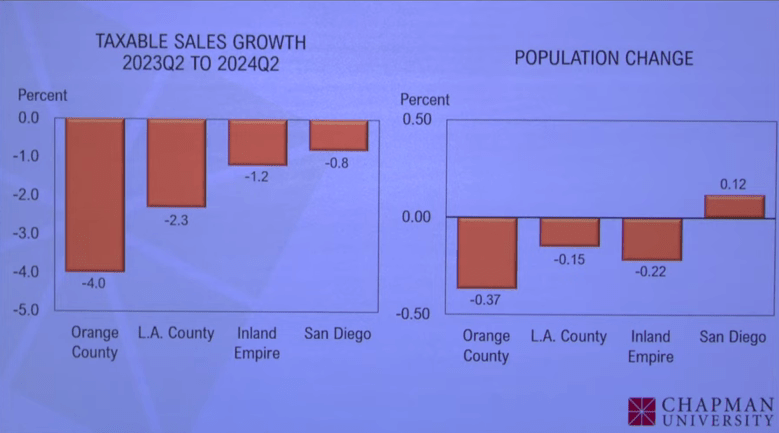
In other words: it’s the population contraction, stupid. Not to toot my own horn too much, but remember back last summer when I penned a little essay about how our population numbers were keeping me up at night? Although that essay was more about housing prices, it easily could have been about economic activity, which real reason we are all here in the first place. And Costa Mesa is in a bit of a population tailspin:

Fewer people, especially fewer middle class people, mean less buying and selling in your city. Rich people juice property values and on the margins create jobs, but they have a habit of saving their cash or plowing it in non-transacting assets (like houses). So as we bleed out lower and middle class wage earners, we’re losing their tax dollars as well. And don’t forget: even if sales tax receipts are flat, inflation is not. While inflation has slowed quite a bit, we are still experiencing 2-3% YOY inflation. So expanding taxable sales by only 0.2% annually isn’t going to keep up. Lovely.
Population decline is a structural problem, not a “headwinds” problem. We will have a smaller taxable base, period. That is going to drag down our sales tax revenue. And in a majority-sales-tax city, that’s a big issue.
It get’s worse. These structural weaknesses are on top of whatever upheaval the Trump Administration is inevitably going to throw at the City in the next six months. While City Hall itself may be spared the direct wrath of the Department of Governmental Efficiency (DOGE) and President Trump’s evident wish to remake American government, there is no doubt these policies are going to really hurt our local economy. Workers afraid of ICE raids at their businesses won’t go to work. Federal workers laid off by DOGE cuts aren’t going to remodel their houses or buy new cars. If proposed cuts to Medicaid trickle down through the health system and result in lower reimbursement rates for hospitals, that may result in less care and more layoffs. And of course, being located near two of the nation’s largest ports, Costa Mesa is going to feel the effects of substantial tariffs. So much for Staff’s hoped-for “resilient consumer”.
In sum, I’m not particularly confident that this is a “blip”, as Council Member Andrea Marr was eager to frame our revenue estimate miss on Tuesday. There are plenty of reasons to worry that revenue contraction is an endemic, region-wide problem — I am certainly am worried. The City Council may want to err on the side of cutting more rather than less. Just in case.
Problem 3: Is Trump’s Golden Age about to blow a ~$13.5 million hole in our CIP?
Finally, the Study Session wrapped up with the long-awaited assessment of the City’s exposure to Federal grant funding, which has been flipping between hot-and-cold faster than a Katy Perry hit. The good(ish) news: there isn’t a ton of exposure in terms of support for full-time employees. Only 4.1 full-time equivalent (FTE) positions are supported by grant funds originating from the Federal government, and the City has received sufficient funds to date to keep those positions afloat for a full year in the event that funding suddenly evaporated.
The bad news? The capital improvement side of things is scary. Here are the projects that are funded by Federal grants:
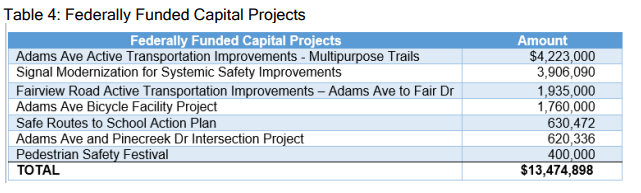
What do all of these projects have in common? They are all active transportation or active-transportation-adjacent projects.
As an aside, this is what I’ve been trying to tell active transportation skeptics in the City for years: BUT FOR the city’s aggressive pursuit of these grants, the City would be $13.5 million poorer. And when we upgrade, say, traffic signals to detect bicycles and pedestrians, we are also upgrading those signals to accept more sophisticated timing that helps keep car traffic flowing. That’s a win-win on the Fed’s dime, and more Costa Mesa taxpayer money returned to help all road users.
But I digress. In any event, this program is clearly in trouble. While the contract lawyer in me is somewhat skeptical that the Federal government will be able to claw-back awarded grants on which the receiving agency has now relied, I have learned not to underestimate the Trump Administration’s energy. And, unfortunately, the active transportation bubble has burst. The new Secretary of Transportation, Sean Duffy, has ordered a review of all Biden-era discretionary grants for “green” infrastructure, including active transportation, with an eye to striking them off the Federal books.
Unfortunately, we’ve already started on a lot of these projects, and Director Molina reported that, internally, it was full-steam ahead:
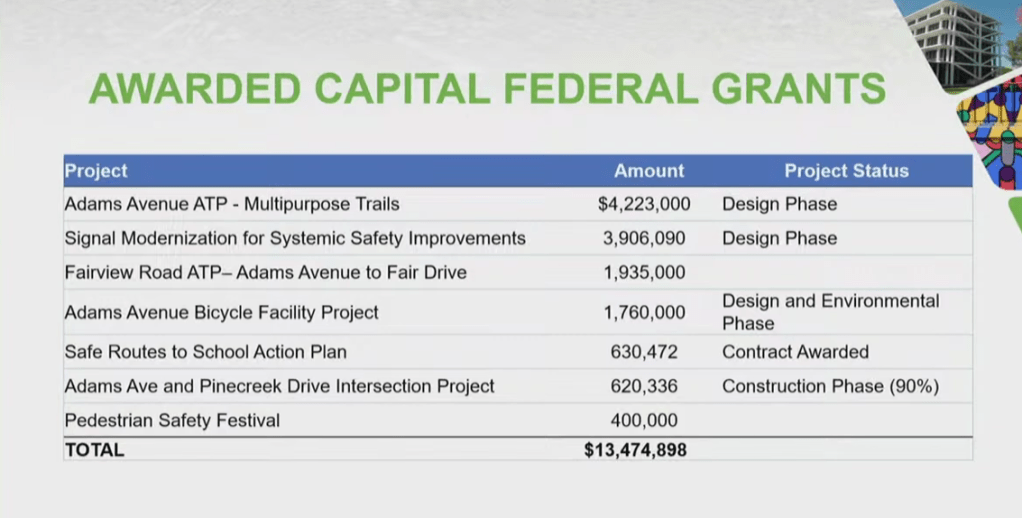
I have a terrible feeling we may end up like Wile E. Coyote, running off the cliff with no Federal support actually underneath us as we go forward. And as much as I love these projects, I think the City Council needs to realize that there is a real danger that the Feds may well cut them. If that happens, the City Council is going to have a real mess on their hands: they will have almost $13.5 million of work in various stages of completion, with no clear exit strategy other than to cover the shortfall with the City’s general fund. Which, as we have been discussing, isn’t in the best of shape as it is.
So, now what?
In the short run, I expect the City Council is going to struggle a bit to clear this shortfall off the books. The new Council Members, Jeff Pettis and Mike Buley, repeatedly emphasized their “newness” (something I would encourage them to stop: new or not, you’re in the soup now) so they will likely continue to ask for more information before making a decision. Additionally, the other options presented by Staff to address the problem — cut other capital improvement projects, including ones related to public safety, or dip into the City’s reserves — seem so unpalatable as to almost be non-options.
In the medium and long run, structural fixes are in order. Economic activity is in part a function of city policy. City Hall must take ownership of this. It’s been really disappointing to see City Manager Farrell Harrison continually position City Hall as merely reactive, as if city policy is a prostrate victim of circumstances beyond its control. Unfortunately, Tuesday’s discussion of the City’s budget woes epitomized this weakness.
Where are the proposals to improve taxable sales (or revenue generally) in the future? The City Council was full of ideas: Raise the transient occupancy tax (TOT)! Prioritize upgrades to our income producing assets, like the Costa Mesa golf course! Get our permitting process on track so that new restaurants don’t take two years to open! Create a “buy local” program! Reevaluate our business license fees!
All worthy ideas. But without the City Manager buying into the notion that it is her job to grow the City’s’ tax base, they might as well have been talking to themselves. I see so little energy coming from City Hall to actually fix problems in the community. Instead, I see a lot of concern about fixing problems for City Hall. If the City Council can’t get control of their agendas, then at least they should try and get the City Manager’s priorities straight.
Equally, where is the discussion of reducing our structural expenses? Director Molina mentioned in her presentation that, unfortunately, the City’s budget flexibility is somewhat limited by the fact that 75% of the City’s expenses are employee salaries and payments.
But if this new age should tell us anything, it is that everything is negotiable.
Mayor Stephens was the first on Tuesday to drop the “L” word — layoffs — by emphasizing how much he wanted to avoid layoffs. But once that seal was broken, Council Member Pettis saw an opening to suggest that layoffs should at least be an option presented to the City Council for consideration. The substantial layoff orders coming from the Trump Administration in his day job at the VA clearly on his mind, Council Member Pettis projected the same DOGE-like ethos into his role as a city council member: “In my current role, we have a full on reduction of force taking place, and we’re being asked to look at our departments and determine if we’re being efficient. And it’s possible we [in the City] don’t have 100% efficiency in place. And I want to be able see if we are being 100% efficient with the resources we have now. I don’t want somebody to just tell me that, I want to see it and I want it to be proven to me. And then I want to make a decision” (emphasis mine).
I could feel the chill running down the Staff’s spine as he spoke.
Setting aside how one “proves” they are being 100% efficient — perhaps Council Member Pettis has a weekly three-question survey in mind — it probably *is* fair to ask whether all of the FTEs that have been added in the past three or four years have panned out as expected.
But just asking this question sets the City Council on a collision course with the City Manager. And she has not historically taken kindly to being micromanaged in questions of personnel and hiring. So brace yourselves: this relatively small budget issue could balloon into a much bigger problem. And it certainly isn’t going away any time soon.
 Goat Hill Rodeo
Leave a comment