
Back on March 4, 2025, Council Member Mike Buley took the opportunity during his council member comments to address housing mandates placed on the City of Costa Mesa by the State of California, both in the form of its Regional Housing Needs Allocation (RHNA) assigned to the city as part of the 6th Cycle Housing Element process, and in the form of state legislation, such as SB-9 (which required localities to approve certain lot splits of parcels otherwise zoned for single-family residences).
“It occurs to me,” he opined as he ticked off the restrictions placed on the city’s enforcement of its zoning code by State law, “the State is overreaching to the extent that the city can’t control and mandate its most basic obligations: what does the city look like, and how do we allow development.” He then requested that the City Attorney look into “at what point” such “overreach” becomes unconstitutional (presumably with respect to the CA State Constitution), and to investigate the efforts of other cities to resist such State mandates.
Now, I think it is pretty arguable that dictating “what the city looks like” is the city’s “most basic obligation” to its residents. Personally, public health, safety and mobility all spring to mind as priorities that should be ahead of “what the city looks like”, though I’m sure reasonable people could disagree. And, sadly, many CA cities were in fact founded explicitly to control land use (or, implicitly and regrettably, who got to live nearby), so Council Member Buley likely isn’t wrong as a matter of historical record.
But oh boy, if Council Member Buley really believes that development controls are the primary obligation of local government, he’s going to love the agenda for this meeting.
But before we get to that…
A presentation worth checking out: Travel Costa Mesa
I was intrigued to see a presentation from Travel Costa Mesa (TCM) leading off the meeting. I presume this will be a fluffy advertisement for all the good things TCM does to bring visitors into the city.
That said, I wonder if the City Council will get a chance to converse with the TCM representatives. The unfortunate budget news delivered last week at the Study Session has to be top of mind, and both growing the city economically and ensuring city tax dollars are spent wisely must be top of mind.
It would be a good moment to remind my fair readers how exactly TCM is funded. TCM is almost exclusively funded by the so-called “business improvement assessment” levy, which is a 3% tax on Costa Mesa’s 11 partner hotels in addition to the transient occupancy tax. Although this levy nets TCM about $3 million a year, it is operating in the red: its financial report last year showed a small amount of operating expenses being pulled from reserves, and the report ominously warned that, “over the next two years, [the remaining] reserves are expected to be dramatically reduced as funding for hotel marketing and city sponsorships continues to be recommended.”
I’m sure the services TCM provides are of vital importance. But the bind is real: to maintain momentum and goodwill, the city has to spend on marketing. But tightening the belt makes it harder and harder to justify glitzy sponsorships or marketing campaigns. If the City Council is given an opportunity to ask questions, I would expect some.
Consent Calendar: Finally, we get the Housing Element update
I hope this one gets sprung from consent-calendar jail because it would be a shame to let City Hall bury this report amongst humdrum items like the minutes and the warrant reports.
Cities are required to provide annual updates to the California Department of Housing and Community Development (HCD) regarding their progress towards their Housing Element programs, including meeting their RHNA allocations in terms of actual, in-the-ground housing production. And let me tell you, the state of Costa Mesa housing production just sucks:
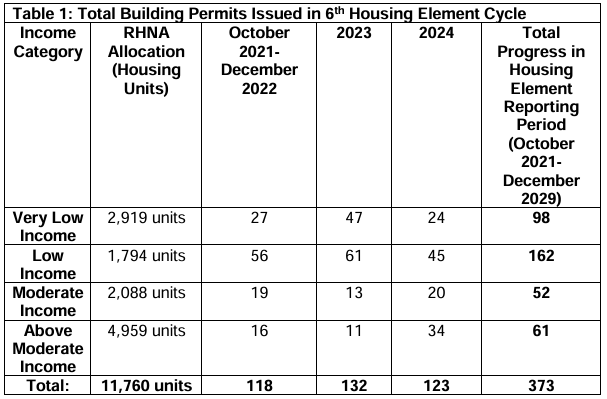
Building 373 housing units in 4 years is pitiful. And, critically, it would be pitiful even in the absence of a State mandate to build over 11,000 units. Remember: in an inflationary environment, the City’s costs to deliver services are ALWAYS going up. But Proposition 13 ensures property tax revenue does not pace inflation, leaving cities only with sales tax and fees to make up the difference. So how do you improve sales tax and fee revenue? More economic activity, and for that you need jobs.
If you aren’t building housing, it’s a pretty good indicator you aren’t adding jobs, either. The causality can go either way for this to be true: jobs could be avoiding Costa Mesa because it is too hard to find local labor at a price that pencils. OR population is falling because there aren’t enough jobs that pay enough for people to stay. Either way, cost of living, primarily driven by housing costs, is dragging down local economic growth. Which means that dollar-for-dollar, the city is going to simply deliver lesser and fewer services over time. And this report proves that, in the short run, that’s almost certainly baked in into Costa Mesa’s reality.
So while Council Member Buley might lament the remarkable weight being placed on Costa Mesa to comply with State housing mandates — and look, I agree with him, to the extent the critique is about the cumbersome and bureaucratic Housing Element process — it’s really hard to argue that Costa Mesa shouldn’t be doing anything about housing absent State pressure. We should be doing a lot of this ourselves, on our own initiative.
But since the State insists on leading the way, let’s check in on how that’s going. Helpfully the report breaks down the number of units generated in the past year by each of the major State-level housing reforms. Really big numbers you’re putting up there, Sacramento:

I honestly don’t see what Council Member Buley is so worried about. Even if *gasp* SB 9 allowing a resident to split her lot — that she owns, by the way — violates the letter and spirit of the California Constitution, it doesn’t matter. It doesn’t produce any housing anyway. What a joke.
More anarcho-socialism: State mandates edit Costa Mesa’s ADU laws, sorta
The first public hearing item of the evening brings forth Costa Mesa municipal code updates relating to the permitting of accessory dwelling units (ADUs) for the City Council’s approval. The updates are complicated but, in general, the city is effectively being forced to make them thanks to a nastygram “technical assistance” letter sent by HCD reporting that the City’s existing ADU laws don’t conform with State law. And this is related to the Housing Element report above because ADUs make up the bulk of the city’s new housing production in the last couple of years.
I want to only make two points here as getting into the weeds of what is and isn’t covered by the updates would strain the patience of even the most serene reader.
First, I find it somewhat interesting that the Agenda Report doesn’t contain any details about the deliberations of the Planning Commission, and in particular the reason for the “no” vote from Planning Commissioner Jon Zich. “I think very little of what I say matters on this topic matters. I think very little what anyone says in Costa Mesa about this topic matters, when all the direction and all the rules seem to be coming from Sacramento.” He then slammed adding ADUs as being an anti-affordability measure — an “abomination”, in his words — that drives up single-family home prices and reduces available parking. Given the vociferousness of the sole dissenting vote, I would have thought that would at least be due a mention.
Second, like the other State-level mandates referenced above, it’s not really all that clear this will have a lot of real-world impact once the codes are updated and the dust settles. My husband and I occasionally quip to each other that California isn’t really “liberal” or “leftist” as much as it is “anarcho-socialist”, by which we mean that the State seems very eager to micromanage all kinds of affairs of human life yet very reluctant to put any real teeth behind those regulations. Housing law is quintessential of this: yes, the state is “mandating” that we let property owners build ADUs a certain way.
But does that matter if our entitlement process takes over a year, or if our planning department tortures applicants with ever more comments during the permitting process? Honestly I think the answer is “no”, and it just goes to show how limited the State really is when it comes to projecting its will down to a city who, frankly, just doesn’t really see adding more housing in its interest. If it did, it would be moving Heaven and Earth to get the units they already have in the entitlement process through as expeditiously as possible, and it would be doing whatever it could to attract new applicants. But as anyone in the building trades knows — and I know because I’ve asked — Costa Mesa is the worst coastal OC city to work with in terms of entitlements and permits.
And this is why I think focusing on Commissioner Zich’s comments do matter, notwithstanding his commentary to the contrary. The city, including the City Council majority, is under the impression that it is a “pro-housing” city, and the Staff is sufficiently indulgent to even float pursuing a “Pro-Housing” designation with HCD a few meetings ago. The numbers above, which include ADUs, prove that’s nonsense. So what the City of Costa Mesa “says” about housing — or more specifically, what City Hall has to say about it — does matter a whole lot! A city who wanted to build would have done its rezoning a year ago. It would have hired plan checkers instead of tenant protection officers. It didn’t. that speaks volumes, and it is driving real-world results in direct opposition to the State’s purported goals.
And it’s not like the State is much better. I checked HCD’s website and it doesn’t have any data to track Costa Mesa’s time-to-completion for its housing permits, although many of our neighbors have reported on exactly these statistics. That suggests we don’t even submit it. And since HCD doesn’t seem to object to this, that implies that it doesn’t actually care, either. At least not enough to enforce anything meaningfully.
Enough about our failures. Let’s talk about one bit of housing that might yet be built. Maybe.
Jamboree’s senior housing development at the Costa Mesa Senior Center is back, again
I’ll admit I ran out of time to cover this one thoroughly, though it’s been covered enough here and in the local media I assume most people are fairly familiar with the proposal to build 70 units of affordable housing for seniors on the Costa Mesa Senior Center parking lot. In terms of brass tacks I expect this one to sail through, as the majority has been supportive of this project since it was first proposed. It has also suffered through another round of Planning Commission review so my guess is that the council members won’t be eager to second-guess badly needed affordable housing.
That said there are certainly quibbles to be had. Parking of course will be a hot topic given that it is building over the parking lot of one of Costa Mesa’s most popular amenities, which happens to sit along one of its trickiest streets. I also expect there to be hard questions about how Jamboree Housing Corp., the developer of the project, will maintain the community’s access to the Senior Center during construction.
I also wonder if there will be some eyebrows raised about the financial arrangement here in light of the City’s budget woes. The land is being leased to Jamboree for the obviously subsidized price of $1.00 per year, in addition to the deferral of up to $700,000 of development impact fees and access to the City’s HOME funds. While I don’t think the City Council can change the deal now I bet they wish they hadn’t had been so generous.
But on the other hand, if the city hadn’t shown such largesse the project may well never have been built at all. And given that it is likely relying on all manner of Federal housing subsidies that are suddenly not as certain as they once were, I would expect Jamboree to be very sensitive to costs. So perhaps the City Council will spend its time elsewhere.
So in all, this one is going to be a grand tour of all the good, bad and ugly of Costa Mesa housing reform — with one big exception.
WHERE IS FAIRVIEW DEVELOPMENTAL CENTER?
Sorry to shout but it’s getting nigh-on suspicious that the city hasn’t seen hide or hair of this project for months. It’s no big deal: it only accounts for over one quarter of our RHNA allocation, and a huge chunk of our low-income housing production. Scandalously the HCD report referenced above doesn’t even mention Fairview Developmental Center. And the Planning Commission, which should have gotten the update first, had both of its March meetings cancelled. What is going on?
 Goat Hill Rodeo
Leave a comment