
We have a Parks and Community Services (PACS) Commission meeting this Thursday, and its agenda contains one of the more remarkable items I’ve seen from that body in a while.
My goodness, what is this?

Now, if you haven’t been following along, my giddiness is likely making you scratch your head. What’s so exciting about some humdrum item about capital improvement “principles and values”?
Stay with me. This item cuts to the very heart of the imbalance between the City Council and its commissions and committees, on the one hand, and the City Manager and her staff, on the other, that has been putting the city off-balance for years. And it’s what ROBO-Goat was on about when he identified a crisis of “democratic responsiveness” at the heart of the DOGE craze. Let me explain.
Chair Brown and Vice Chair Wright agendize a reset
I skipped out on recapping the last PACS Commission meeting, and for that, dear readers, I owe you an apology: it was a great one. Not only did the Staff present an absolute banger of a plan for the Costa Mesa Skate Park expansion — if you haven’t checked out the renderings, you should: it’s gonna be rad — it also devoted an item to providing the long-overdue update on the status of the city’s other parks-related capital improvement projects.
And it was during this item that the conversation got very interesting. First, the Staff dutifully updated the PACS Commission on the status of each outstanding item.
But after this presentation, PACS Chair Kelly Brown challenged the Staff to allow the PACS Commission to be more proactive and to respond to calls from the City Council to provide advice on the city’s next budget cycle. “I feel the need to answer the call from City Council,” Chair Brown commented, referring to comments made by Council Member Arlis Reynolds at the March budget study session. “They called out our commission and commissions in general for some input and help prioritizing [the various CIP projects],” in light of the announced revenue shortfall.
Discussion then ensued amongst staff and commissioners, which refreshingly resulted in an action plan: for the April meeting, Staff would agendize two items: one that permitted the PACS Commission to review not just the ongoing CIP projects but the full five-year CIP project list, and another that would address the CIP project development program holistically so that the PACS Commission could be more involved in future budget discussions. And, true to its word, the Staff has placed both items on the April meeting agenda.
There are a couple of reasons to get excited about this. First, it represents a clear indication that Chair Brown’s and Vice Chair Wright’s PACS Commission is determined to be more proactive than prior PACS Commissions, as the agenda report makes clear that these two pushed for these items behind the scenes. I’ve been eager for exactly such a sea change in the PACS Commission and it is awesome to see it assert itself.
Second, the operational framework hinted at in the second item is exactly what the PACS Commission has been lacking. Because of the way the Brown Act, the law that governs public meeting transparency in California, works, public bodies like the PACS Commission cannot make motions to take actions that were not already on the agenda. But the Brown Act also prohibits PACS Commission members from conferring with one another other than in a public meeting, meaning that it can’t establish consensus and determine what action it wants to take as a body before such a public meeting takes place. So without the ability to discuss items in advance, the PACS Commission have found itself in a bind: if Staff’s agenda items do not contain affirmative actions for the PACS Commission to take, then it can’t take any action at all.
And, unfortunately, City Hall has capitalized — intentionally or unintentionally — on that conundrum by serving up one “receive and file” agenda item after another. Actually, the capital improvement plan discussion item is a perfect example of that: note that, despite Chair Brown’s explicit desire for the PACS Commission to opine on the 2025-2026 budget priorities, the staff has not provided her with an action to do so. Yes, the item informs the PACS Commission of the state of various parks projects. But for reasons I can only speculate, city staff have kept affirmative actions on that information, such as elevating concerns to the City Council or undertaking its own investigations, off the agenda. If those actions aren’t agendized then the Brown Act will bar the PACS Commission from even discussing them, let alone taking such actions on its own initiative.
The “principles and values workshop” item on the PACS Commission agenda for Thursday, though, represents one way to circumvent this impasse in future budget cycles. What if the PACS Commission establishes rules in advance that require Staff to agendize actions in the ordinary course? For example, imagine if, as part of this framework, the PACS Commission was required to make a presentation as a commission to the City Council at its main budget meeting. Then the Staff would need to agendize the content of that presentation in earlier PACS Commission meetings. The PACS Commissioners could weigh in on the substance of that presentation and then vote to approve or disapprove it.
We’ll see on Thursday how the discussion plays out. It will definitely be worth your time tuning in, though, even if you don’t have a special interest in parks. And that’s because I think this move may touch off a larger revolt in the city’s commissions and committees more broadly.
It’s not just PACS: The Arts Commission must assert itself, too
Although I usually skip meetings of the city’s Arts Commission, I tuned into the discussion last week as I was hoping to pick up some clues as to where the city’s budget for next year might be going. Instead, I was intrigued to hear that body circling around the same questions that have been bubbling up in PACS. For example, Arts Commissioner Fisher Derderian cracked open the Arts Commission’s city webpage and noticed that the Arts Commission’s fifth enumerated responsibility on that page was to “make recommendations to the city council or the city manager for the allocation of funds for the arts and culture in the city.”
“What exactly is [the Arts Commission’s] function within that?” Commissioner Derderian asked. “What would a process like that look like? Is there some formal recommendations this body could make? How would that work?”
“Well,” Parks and Community Services Director Brian Gruner replied:
Everybody here was appointed by a council member. Having a close relationship with your council members is important, and having those discussions and dialogue about what concerns you in regards to the Arts Master Plan [is important], so I think that would be an appropriate place to start.
Director Brian Gruner, Arts Commission meeting, April 4, 2025
My jaw hit the floor when I heard that. What Director Gruner appeared to be saying was that the Arts Commission was not to provide budgetary advice as a body: with respect to those questions, they were limited to appealing to the City Council as individuals. Which, of course, neuters the Arts Commission’s persuasive force, as the appeals of a single commissioner pales in comparison to the weight of the body taking a formal action by majority vote.
This was NOT the intent of the City Council when the Arts Commission was set up. In fact, the Arts Commission, which spun out from the PACS Commission, has nearly the same powers as the PACS Commission. They are not a body of artsy individuals that happen to meet together on Fridays for the sake of mutual convenience. It was designed to support the City Council as a body. So Director Gruner’s comments are WAY off-base here.
Now, I would be more inclined to give Director Gruner a pass, except for one thing: after Commissioner Derderian’s comments, the city scrubbed the Arts Commission website of the language he quoted implying the Arts Commission had a budgetary oversight role. Here is the website as it appeared on April 3, 2025, before the Arts Commission meeting:

Now look at it as it appears today:
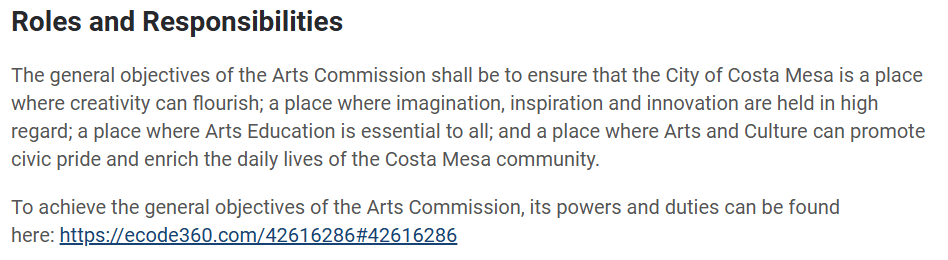
So instead of laying out the Arts Commission’s roles and responsibilities — including its responsibilities to oversee arts spending — the city webpage now directs the public to the municipal code.
Sneaky. But fine: then the Arts Commission should leverage the municipal code instead, and demand that it exercise some measure of agenda control, too — just like the PACS Commission is doing, using almost identical statutory language. In fact, I think at this point it has to do so. The staff has effectively said that when it wants the Arts Commission’s opinion, it will ask for it — a backwards interpretation of the Costa Mesa municipal code. Not only does the municipal code place significant authority in the Arts Commission’s own hands — it may “by its own motion… determine an action plan to pursue in implementing the city’s arts and culture master plan,” for example — it is not for the staff to determine the Arts Commission’s, or any commission’s or committee’s, authority to act. That is firmly in the hands of the delegating body: the City Council.
And they must act as well.
City Council: it’s time to dig in and direct your commissions and committees to act
Lost in all of this power-struggle between the commissions and the staff is that it is happening against the backdrop of City Council inattentiveness. Yes, thanks to quirks of the municipal code, there are steps for certain commissions to take on their own accord to wrest agenda control back into their own hands. But other commissions and committees aren’t so lucky: the committees, for example, are established by ordinance, and their powers are frequently cabined by requiring City Council direction to act.
For those bodies, the City Council simply doesn’t have the luxury of waiting around for them to give spontaneous advice that simply cannot come. For example, if the City Council wants the Finance and Pension Advisory Committee to provide a report or give a presentation of its collective thoughts on this year’s upcoming budget, it needs to direct it to do so. Individual council members opining from the dais that the FiPAC’s opinion would be valuable is not enough. It is clear that City Hall is perfectly content using the commissions and committees as sounding boards only. If the City Council wants more out of its committees, it needs to specifically give them direction.
And the City Council really working through the resident committees and commissions may be one of the keys to addressing ROBO-Goat’s democratic responsiveness problem. Remember when Council Member Mike Buley and Mayor John Stephens questioning the City Council’s ability to exercise sufficient agenda control? Well, here’s one way out of morass: express the City Council’s agenda priorities as investigatory tasks for the commissions and committees, and demand reports. Get the residents to work solving the problems they volunteered to help solve. Not only will that provide forward momentum for City Council priorities — it’s much easier to agendize an item on the City Council’s agenda when it has committee support, as both the beekeeping ordinance and the upcoming TNR ordinance originating out of the Animal Services Committee has shown — it will restore the agency of these bodies as true supplements to the City Council’s own deliberations and policy goals.
Otherwise: why do we have them in the first place?
 Goat Hill Rodeo
Leave a comment