
We’re so back, baby.
The Summer “break”, which was actually more lively than usual, is definitively over. We’ve got a packed City Council agenda for this coming Tuesday, September 2, which features three public hearings, four old business items, and three new business items — and that’s not even counting the consent calendar and the tantalizingly mysterious closed session agenda.
The good news is that a bunch of these will either be out of the public eye or very quick decisions. So let’s start with the easy bit first and scratch off the items that (I think) are (mostly) slam dunks:
- The closed session agenda contains discussions of seven (!) open litigations, two of which are anticipated to be filed against the city and one the city may itself initiate. Who we might be suing is not named. Spooky! The City Council will also discuss the Farrell Harrison case. What isn’t on there? The “Public Employee Appointment: City Manager” item, which has graced the last several agendas. If the City Council decided to give the nod to our current Interim City Manager, Cecilia Gallardo-Daly, I feel like they would have done so at this meeting. Did they decide to go with a search instead? Who knows — this discussion will, sadly, not be public. I’m also curious how long we’re going to be left with an “Interim” Police Chief.
- The consent calendar is mercifully routine, and I don’t expect anything to be pulled. However, I must point out: there is an item on there to budget $200,000 for routine HVAC services, which looks like has to be cobbled together from the capital assets needs fund (Fund 401), the General Fund (Fund 101) and the Behavioral Health Fund (Fund 229). I get Fund 229 being used for HVAC calls for the Bridge Shelter. But really, HVAC routine maintenance is exactly what the CAN Fund/Fund 401 is for; why are we also pulling from the General Fund? Oh wait. I bet I know why.
- Public Hearing Item #1 is interesting, just not that controversial: Costa Mesa is looking to join Santa Ana, as well as Orange County, in banning nitrous oxide (NOX or whippits to the kids). Although the agenda report is scandalously light on details (pssst hey CMPD: we notice when you don’t include gross numbers, only suspiciously round percentages. A “100%” increase in NOX-related incident reports could mean we went from 500 such reports to 1,000, or from 1 report to 2. The latter wouldn’t be that impressive would it?), it’s hard to argue for continued legalization here. The CMPD just cracked down on smoke shops selling NOX in violation of State law last February and I didn’t hear a peep of complaint from anyone. So my only question is: will we additionally move on synthetic kratom, as the County of Orange is also doing? Might as well get all of our code updates out of the way.
- Public Hearing Item #2 is yet another continuation request from the 3333 Susan Street/Hive Live mega development, which it will get without much discussion.
- Public Hearing Item #3 is an appeal by a cannabis store of a determination by the city that it has abandoned its permitted location due to the facts that (1) it can’t seem to remain open for more than a few weeks at a time, and (2) it just got evicted from its premises by the Sheriff. Seems reasonable. It does make me wonder, though: maybe cannabis isn’t the can’t-lose proposition it’s been made out to be.
- Old Business Item #1 is just the second reading of the Bear Street development approval, which passed unanimously (on a 6-0 vote, Council Member Mike Buley was on vacation) even as neighbors complained about density, traffic lights, and parking. There doesn’t appear to be any new information in the Agenda Report, so even if Buley decides to take this opportunity to weigh in, I don’t see the outcome changing.
- Old Business Item #3 is a real snoozer: an approval to install high speed internet lines in a bunch of public buildings. Yawn. This will get passed.
And just like that, we’re down to a much more manageable five items.
Old Business Item #2: The-Agreement-Which-Must-Not-Be-Named rips up the Tewinkle Lakes project
Ok I admit that’s dramatic. But there is a lot to unpack on this one, so if you are curious, head over to my dedicated post and decide for yourself if I am being unfair. The bottom line: after two rounds of bids, City Hall is throwing up its hands and proposing the Procrustean solution of chopping the scope of the TeWinkle lakes repair project in half while increasing the budget for the reduced project by more than 35%. Why is the City Council being asked to swallow such an egregiously bad deal? The Agenda Report won’t say, but I will: the Community Workforce Agreement has given monopoly power to a single bidder, and we’re at its mercy if we want to stop leaking 8 million gallons of water a year out of our lake system.
Hopefully the City Council will ask some hard questions here. The funding crunch alone is worth a mention: We barely had the funds to cover the original $2 million cost. How is Public Works now proposing to find $2.7 million?
Old Business Item #4: OCPA is back, hat-in-hand
I figured it was only a matter of time until we saw the Orange County Power Authority’s report get its day in City Council, and here we are. Like the TeWinkle lakes debacle, this one deserves its own post, which hopefully I’ll get around to before the meeting on Tuesday.
For now, I’ll say this. As expected, the Orange County Power Authority paints a very, very rosy picture of Costa Mesa’s future as an OCPA member. The City Council will have to decide if they are willing to rely on those representations and ask the Staff to continue moving forward with a potential OCPA membership. I, for one, would be highly skeptical of the impartiality and completeness of the claims made by an organization that is presently facing an existential threat to its existence, but perhaps reasonable people can disagree.
And maybe it’s just a lot simpler than that: the Agenda Report makes a lot of noise about the significant expense a comprehensive investigation of OCPA would entail. It doesn’t put a dollar amount on that work, and it doesn’t say where the money would come from. Money is pretty tight at the moment. So hopefully the financial burden this will create will be discussed.
New Business Item #1: Fairview Road project brings more bicycle and transit connectivity to Costa Mesa
Those of us close to the active transportation community have been waiting for this project for a while. While the Agenda Report here claims to describe the project, I have to point out that it really does not. You’d be better off reading the Agenda Report from back when the contract for this project’s design was awarded.
And maybe words aren’t even the right medium. Let’s try pictures.
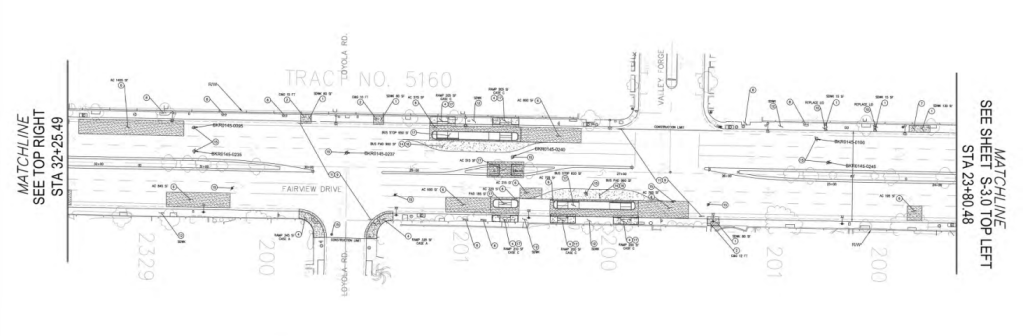
It’s hard to see but those big gray boxes taking up the (current) outside traffic lanes? Those are concrete bus boarding islands. This is consistent with the prior agenda report’s detail that this project will reduce Fairview Road from six to four lanes.
Now, before you freak out: This reduction has been studied repeatedly. Fairview Road was overbuilt intentionally to address future traffic to the Orange County Fair. But, thanks to the natural experiment that was COVID, the Orange County Fair has since realized that capping daily attendance significantly improves the fair-going experience and improves fair revenues.
Therefore no one believes Costa Mesa will ever need three lanes going in both directions. Additionally, although the extra space seems like a nice perk for drivers, the airstrip-esque appearance of the wide, relatively empty, and stick-straight street encourages speeding and even drag racing.
This is why the proposal intends to repurpose those outside lanes to accommodate better bus and bicycle facilities, while also adding a center median. These features add visual “drag” to a street, causing drivers to drive slower and more cautiously. This improves the overall safety and livability of the corridor. And given that Fairview Road connects to both Costa Mesa Middle/High School and Orange Coast College, that’s a lot of potential walkers, bicyclists, and transit riders that will benefit from a safer north/south corridor.
Overall it’s a very good project. It’s low-hanging fruit from a street improvement perspective and Public Works has done an excellent job getting outside grant money to pay for it. And when it’s all said and done, drivers will get a nearly free re-pave of the entire corridor out of the deal.
So hopefully the City Council won’t get too lost in the green-paint weeds here. When completed, this project could end up being a showcase piece for the city.
But, if I’m realistic? We might have to fight about it a bit first.
New Business Item #2: $100k for Anti-ICE — I mean “support services” — grants and… rental registries?
Ok I lied up top – we weren’t down to five items. We actually have six big items thanks to some chicanery in the agenda preparation.
The first half of this item purports to just update the City Council on its vote last meeting to allocate $100,000 of city funds to two charities, Someone Cares Soup Kitchen and the Enough for All Fund. Although you wouldn’t know it from the Agenda Report, the explicit purpose of this donation was to support these charities’ work with families and community members being impact by the Trump Administration’s aggressive immigration enforcement.
But what was odd about that vote last time was that the $100,000 donation wasn’t agendized, leading some (including me) to wonder if that act wasn’t a Brown Act violation. The Brown Act requires that each action to be considered by a legislative body (like the City Council) has to be properly noticed to the public. The agenda for that meeting didn’t mention a large outlay of city funds anywhere, so I think the likelihood of a Brown Act violation is pretty high.
So if you had questions about this course of action, now would be the time to bring them. Here’s mine: the City says it found the money for this “donation” in the General Fund’s “contingency fund”. How much is in that fund, and what has it been used for in the past? And why didn’t we hear about this fund when the City Council was scrounging for pennies attempting to comply with the CAN ordinance?
The second half of this agenda item is actually a pretty big deal: the Staff looked into the possibility of adopting a rental registry so that it could track at-fault evictions (i.e., evictions for just not paying your rent). I guess this is tangentially related to the donation because it is loosely intended to help the same community — showing at-fault evictions skyrocketing while ICE is in town could help make the case immigration enforcement is causing economic harm — but the connection is shaky. And it’s made far sketchier by the fact that tenant organizers asked for this same reform more than a year ago during the no-fault eviction ordinance discussion, long before Trump won reelection and started his immigration enforcement campaign.
Before launching into why I think a rental registry is a terrible, no good, absolutely ridiculous, and just plain bad idea that will certainly hurt the people it is intended to help, I’ll wait and see how the City Council discussion goes. Hopefully they table this idea for a long, long time.
Finally, New Business Item #3: [C/sh]ould the City of Costa Mesa join Perdomo v. Noem?
Phew. Thankfully, I’ve already answered this one. Yes, I think it could. In fact, I’d rather the City use the $100,000 it wants to donate to “support services” NGOs to instead fund the preparation of the city’s amici brief.
Why? Because every single person who steps foot in Costa Mesa — whether they are a resident, a visitor, a guest worker, an H1-B visa holder, an illegal alien, a former criminal, an ordained minister, a child, an octogenarian, a daughter of the American Revolution, or otherwise — is entitled to every public service the city provides, including but not limited to safe and clean public parks, well marked streets, comprehensive fire service, and timely and professional policing. If the Federal government, or the State government, or any domestic government, acts within our borders in a manner that violates the rights of the people entitled to our public services as enumerated in the U.S. Constitution, it undermines the city’s core functions. And the city’s perfectly within its authority to expend its resources to vindicate the rights of its residents.
Perdomo is a case seeking to find where the Trump Administration’s broad and enumerated immigration enforcement powers end and the rights of the people subject to its actions begin. Nothing more, nothing less. Joining such a suit does not make Costa Mesa a “sanctuary city”. On the contrary: if Perdomo *vindicates* Trump Administration policy, then cities that joined the suit will have little grounds to object when ICE uses that decision as a shield.
But we’ll see where the City Council comes down.
 Goat Hill Rodeo
Leave a comment