
I hope everyone had a nice Labor Day weekend!
And I really mean that, because if you are involved in any way with the City of Costa Mesa, vacation is so over. Between huge agenda items, citywide rezonings, massive future development projects and the 2026 elections looming on the horizon, we’re in for a long, long Fall.
As I mentioned in the rundown, one of the items the City Council will attempt to get address as part of its Godzilla-sized agenda is the results of the “feasibility study” conducted by the Orange County Power Authority (OCPA).
What I didn’t tell you was that representatives from the OCPA reached out to me a few weeks ago to invite me to chat with their leadership, which we managed to schedule for today. So I found myself this morning sitting across a board room table from OCPA’s Jacquie Henderson, director of communications; Linda Kramer, community outreach manager; Louis Ting, director of power resources; and, for about half the time, Joe Mosca, chief executive officer.
It was quite the reception for a little community blogger.
So, how’d it go? Read my original primer on the OCPA (which has a lot of background and, honestly, I wouldn’t change anything in it following our conversation) and then read on.
Overall, I’d say it went pretty well. The folks I met with were, without exception, polite, highly knowledgeable, and professional. They came off as earnest and genuinely supportive of OCPA’s mission. They were also very gracious with their time; I came armed with a fairly long list of questions, and they patiently walked me through how OCPA works, its relationship with Southern California Edison, and some of the details of the feasibility study.
And of course it must be said that sitting down with a local blogger with no position in the city is pretty thorough community outreach. So if the OCPA folks are reading this: thank you — I appreciate all the effort you put into our meeting.
But.
I’m still not convinced Costa Mesa should join up.
The bottom line: this is a big decision, we should treat it that way
While reading through the feasibility study, the first thing that jumped out to me was the assumed timeline. The “Next Steps” portion of the study mentions that, in order “to remain on track for a 2027 launch”, the OCPA has to have in hand a fully baked local Costa Mesa ordinance approving OCPA membership as well as have its own board sign off on Costa Mesa’s membership by December 31, 2025.
It’s September 2nd today. The City Council only has one other regularly scheduled meeting this month, two in October, maybe two in November, and maybe two in December (the latter two months are frequently impacted by holiday-related cancellations). So trying to wrap up what the city would need to do by the beginning of December is tight.
Honestly: it’s too tight. Recall that, in order for the city to enroll in OCPA, it will have to commit every ratepayer to be enrolled in an OCPA plan by default. Even more significant is the fact that OCPA’s financial feasibility study assumes that every Costa Mesa ratepayer will initially be enrolled in the middle tier of OCPA’s three power options. Why is that an issue? Well, OCPA base option is about 3% less expensive than SoCal Edison’s rate, but its middle tier option is slightly more expensive. So, by enrolling, every single Costa Mesa ratepayer will be opted into higher electricity bills unless they take the extra step to switch themselves onto the OCPA base rate (or opt out of OCPA all together).
It also should be noted that automatically enrolling the city’s municipal accounts in that middle tier may cause the city’s rates to go up as well, which are of course paid with taxpayer dollars.
So, in the midst of one of the worst cost-of-living crunches in our lives, as well as a fairly nasty municipal budget crunch, it doesn’t make sense to make such a decision on an accelerated timeline.
Additionally, in order to meet such a quick timeline, the City would have to essentially forego any independent analysis of the feasibility study provided by OCPA. While I don’t think the numbers presented in the feasibility study itself are likely to change — recall that the feasibility study was bought and paid for by OCPA and for OCPA’s benefit, so auditing their own presentation of their own projections isn’t a fruitful exercise — an analysis of the claimed benefits to Costa Mesa residents absolutely should be undertaken before the city moves forward. At the very least the city should be aware of the increase, if any, to the municipal electricity rates.
And that, of course, leads to a very familiar snag. Where is the money going to come from to undertake this independent analysis? As noted in the agenda preview, the Staff are already hunting all over the city’s budget for ways to stretch our municipal dollars, and that’s just to cover projects the city already hasin the hopper. In fact, the funds for the city’s own analysis was proposed, and cut, from the city’s capital asset needs budget back when discussing the CAN ordinance was a live controversy. So if the city shouldn’t move forward with OCPA without its own analysis — and I really think we shouldn’t — then it’s already made the decision to postpone this work until the city has sufficient budget to take on that analysis.
Other concerns: instability, financial and political
Two other issues make me think the city should tap the brakes here.
First, while OCPA is certainly on a better financial footing than it once was, it isn’t rock-solid yet. For example, take this screen grab from the OCPA’s 2025-2026 budget presentation earlier this year. While it has about 16% of operating expenses on hand in terms of reserves, that’s only about half of the minimum 30% set by the OCPA board. How will the OCPA nearly double its reserves next year when its net surplus this year was only $0.45 million?

Related to this, OCPA is still on the hunt for an investment-grade credit rating. An investment-grade credit rating would allow OCPA to secure lines of credit at better rates and to issue bonds with more favorable terms. While it seems to be operating ok without one, one wonders how much getting that investment-grade credit rating depends on growing its ratepayer base, and to what extent Costa Mesa’s participation factors into that.
My second concern is pretty well summed up by another slide in that same OCPA budget presentation:
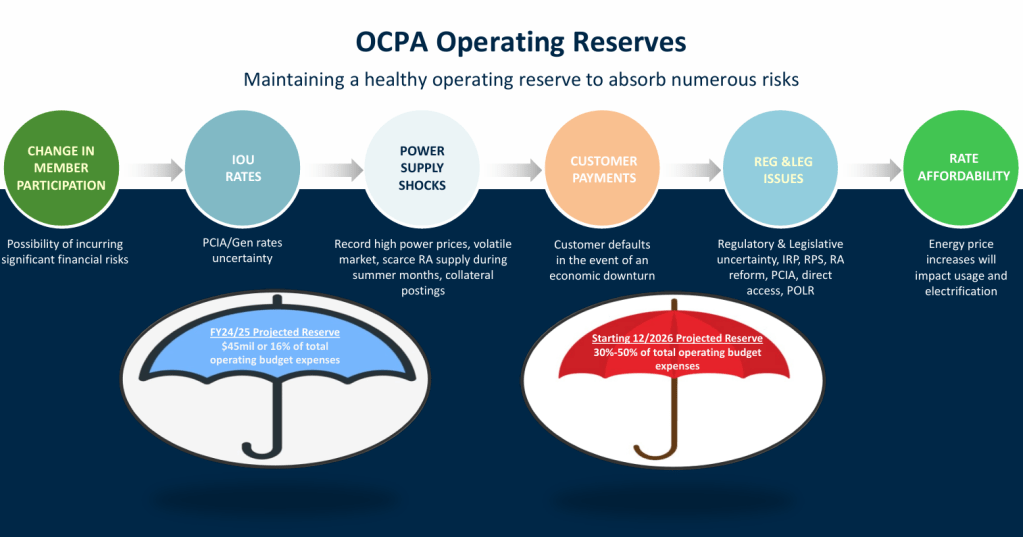
Every single one of those six risk factors outlined in the colored bubbles at the top come down to one thing: politics, both inside and outside of Southern California, over which we as Costa Mesa residents have almost no control.
Take “Change in Member Participation”. A huge risk of the OCPA model is that cities suddenly decide to leave the power alliance, leaving the other members potentially propping up a financially distressed OCPA. This just happened, not once but twice: Orange County pulled out of OCPA before it fully integrated into the system, and Huntington Beach just made a fairly spectacular exit.
Even Irvine, one of the founding OCPA cities, was teetering on the brink of leaving. I say “was” because, thanks to the election of a pretty liberal Democrat to Mayor Larry Agran’s old district council seat in April of this year, Irvine may rescind its intent to withdraw.
But who knows. And besides, if only one Council election stands between a city as significant as Irvine staying or leaving, I can’t say I love taking on that risk at the moment.
The other massive political elephant in the room is, of course, the Trump Administration. The Trump Administration has signaled hostility to green power initiatives across the board and has recently made moves to slash hundreds of millions of grants to green power generation efforts, a decision that’s since been tangled up in the courts. It is very early days yet in the Trump Administration and, so far, the Supreme Court of the United States has been fairly open to allowing Trump to exercise executive power when it comes to grant making authority. So, to the extent OCPA’s business is subtly dependent on the green energy revolution continuing, it certainly may face some headwinds in the next couple of years.
Now, are any of these political problems OCPA’s fault? Obviously what Washington, D.C. decides to do is completely out of its hands.
Its local problems, on the other hand, have been at least partly self-inflicted. Recall, for example, green-energy-friendly Irvine council member Kathleen Treseder’s exasperated comments last December about OCPA’s less-than-transparent board meetings. So, at the very least, I don’t see any harm in letting OCPA get another year or two under its belt and repair its relationships with absolutely critical members like Irvine.
In sum: I give OCPA an A+ for effort in reaching out to me. But something I learned in the corporate world is that there are friendly meetings and then there are term sheets. I’ve been across the table from plenty of very good folks where, at the end of the day, we couldn’t reach a deal. I’m not sure I see one here.


 Goat Hill Rodeo
Leave a comment