
Well, folks, the Costa Mesa City Council is back at it tonight with an agenda that’s mercifully shorter than some of the behemoths we’ve seen this fall. But don’t let the brevity fool you: there’s still plenty of meat on this bone, particularly if you’re interested in watching the city potentially shoot itself in the foot on labor policy or if you’re tracking our glacially-paced housing element implementation. Let’s skip the routine presentations and consent calendar items this time and dive right in.
Public hearings: clean up in the building code; clean up in the General Plan
First up we have a fairly routine adoption of the 2025 California Building Standards Code. This is the kind of thing that happens every few years when the state updates its building codes and cities have to formally adopt them with whatever local amendments they feel are necessary. This item is pretty perfunctory.
The second public hearing is more interesting from a policy perspective: amendments to the Land Use Element of the General Plan to make it consistent with our Sixth Cycle Housing Element.
If you’ll recall, Costa Mesa had to adopt a new Housing Element to comply with state mandates, and that Housing Element identified specific sites where the city could theoretically allow more housing. Now the city needs to update its Land Use Element to reflect those Housing Element commitments — otherwise the documents contradict each other, which is a no-no under state law.
As I recounted here, the long and tortured Housing Element process has left plenty to criticize, and I wonder if any of the council members will take this item as an opportunity to air any concerns they might have. This is yet another example of City Staff failing to cross “Ts” and dot “Is” when it comes to Housing Element compliance, even if this particular misstep amounts to a foot-fault.
Or they might wait to later in the night when we get an update on the citywide rezoning, which is also part of the Housing Element debacle. More on that in a minute.
Ooooooold business: OCTA finally pays us back for the I-405 express lane project, two years later
Finally, we have an item where money is coming in rather than going out. In the first Old Business item, the city will approve Amendment No. 7 to its agreement with OCTA for the I-405 Improvements Project, which will allow OCTA to (finally) reimburse the city an additional $1,989,000 in mitigation work to address the detours and other roadway impacts caused by the I-405 freeway project.
If you’re scratching your head wondering, “what I-405 freeway project?”, I forgive you: that’s because this long overdue cash dates back to the project that wrapped up in December 2023, almost two years ago. That’s the one that added the new express lanes in each direction, which, at the time were very controversial.
However, with both the passage of time and a bit of experience, the lanes are turning out to be quite the success. They’ve reduced travel times on the affected stretch by a whopping 15-32% during peak hours, and, more remarkably, this time savings has been maintained in spite of increased traffic by increasing tolls during those hours.
In fact, the demand for fast travel on the 405 is so high that, not only are commuters willing to pay premium toll prices, the I-405 express lanes are turning a profit. It would be great to get an update from Mayor John Stephens, who also serves as on Orange County Transportation Authority (OCTA) board member, about what OCTA plans to do with all the extra cash. I could certainly see an equitable argument that the cities through which the I-405 runs should see some of that money, and not just as reimbursement for all the impacts construction caused.
One last word: you might recall that the I-405 wasn’t the only freeway in Costa Mesa getting extra lanes. State Route 55 also saw a lane expansion, but it didn’t turn any of that extra capacity into tolled lanes. And that’s despite the 55 being, in the city’s words, “one of the most heavily congested freeways in Southern California.”
So: wouldn’t the 55 Freeway be a great candidate for the next generation of tolled lanes?
*ducks rotten tomatoes thrown from all directions*
Now, hear me out: The 405 toll lanes show that congestion can be managed without endlessly expanding freeway capacity. And every time the 55 freeway is expanded, Costa Mesa has to deal with even more traffic being funneled onto its streets. This spills over into hidden costs for the city, including increased traffic, increased pavement maintenance, loss of public transit efficiency, and (saddest of all) more roadway collisions, injuries and deaths. Wouldn’t it be worth it to allow some locals to pay a fee-for-convenience, if, in exchange, we can lower commute times for everyone without overloading our local street grid?
Just a thought.
Self-checkout lane regulations get their day in Council, unfortunately
As I predicted back in April when I wrote about Long Beach’s self-checkout study, this zombie idea has now shambled its way to Costa Mesa. Tonight’s agenda includes “Consideration of an Ordinance to Require Staffing at Self-Service Checkout Stations.” The Agenda Report describes what was adopted in Long Beach, which was essentially a requirement that all grocery and drug stores over 15,000 square feet provided, at minimum, one dedicated employee for every three self-checkout kiosks.
If that 1:3 ratio were applied to local stores, the Staff found out that all local drug stores would be compliant (in other words, they already staff at or above this ratio), but that all local grocery stores that maintain self-checkout kiosks would be noncompliant. And moreso, some of them would be wildly out of compliance: Northgate Market, for example, would need to hire two more full-time attendees dedicated to monitoring its nine self-checkout kiosks if it wanted to keep all of them open and available to customers.
If you read my prior piece I gave a bunch of reasons why, in the abstract, adopting this ordinance is a bad idea. But now the Agenda Report has helpfully given me some specific reasons, too! Bear with my brief soapbox diatribe because I think it actually sheds some light on petty crime generally in the city.
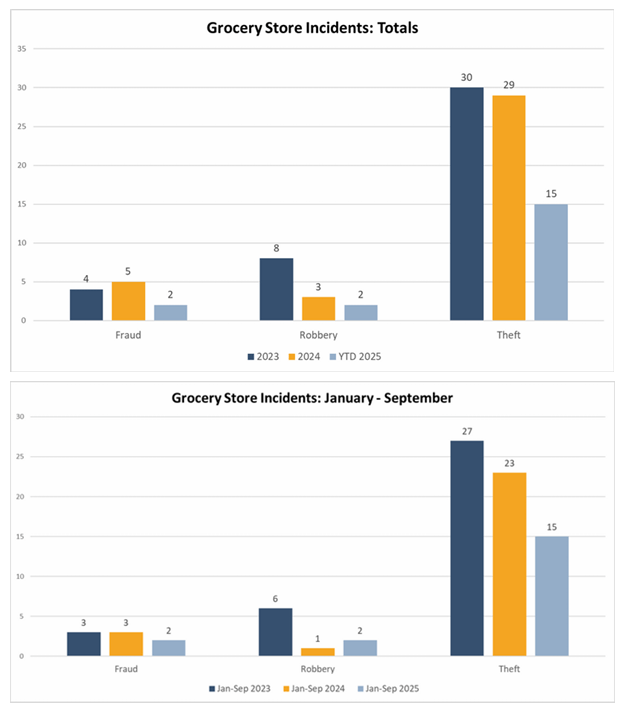
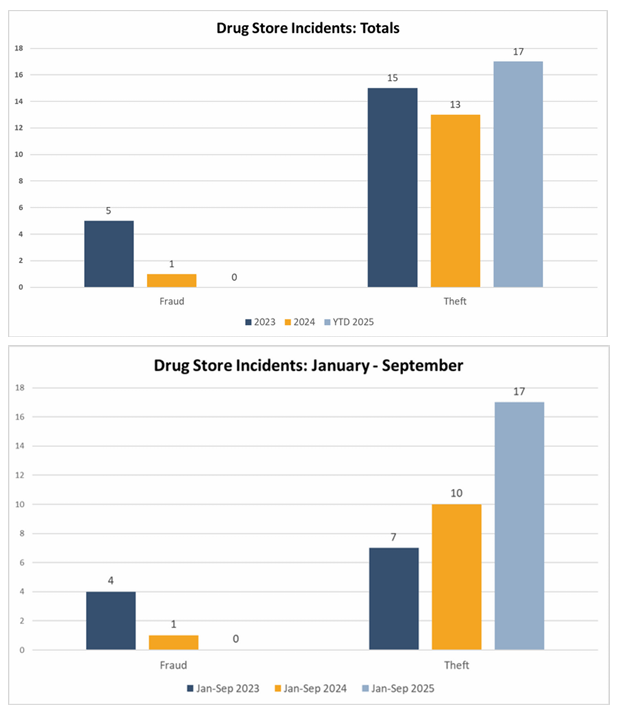
On the way to trying to give the City Council a picture of the issues faced by self-checkout workers in Costa Mesa, the staff helpfully compiled the following graphs showing incidents of fraud (i.e., using a stolen credit card), theft (stealing without force, i.e., shoplifting) and robbery (stealing stuff by force) in local grocery stores and drug stores:
Here’s what I see.
First, while drug store thefts are definitely up, grocery store thefts are way down from 2023. Given that our local qualifying drug stores are already complying with the 1:3 self-checkout staffing ratio but our grocery stores are not, this data seems to throw a big bucket of cold water on the notion that self-checkout staffing is the key to theft deterrence.
Unfortunately the graphs provided by the Staff above lack sufficient specificity to really lean on that conclusion. The graphs don’t indicate, for example, which stores were coded as “drug stores” or “grocery stores” for the purpose of the analysis. Are all grocery stores in the city included? Or only the ones bigger than 15,000 square feet? Or only the ones bigger than 15,000 square feet and operating self-checkout lanes?
And here’s another problem: what about unreported crimes? How many times are items simply leaving the store without a police report being filed?
Without that granular information, it’s impossible to tell whether the drug stores (with higher staffing) or the grocery stores (with lower staffing) are doing better on a per store or per retail square foot basis. Which, of course, you would need in order to determine whether there is any correlation at all between staffing levels and crime incidence.
And you know what: I don’t really care. As you can see, doing this kind of regulation can draw one so deep into a rabbit hole of conjecture and assumption that crafting a fine-grain policy becomes impossible or, at the very least, undesirable.
Here’s what really matters: the Costa Mesa Police Department (CMPD) is currently recording less than two incidents per month across all drug stores or all grocery stores, respectively. That simply isn’t a sufficiently egregious impact on the cost to effectively police the city — and that is what we are solving for, right? Not some abstract desire to see guaranteed labor jobs maintained come hell or high-tech water? — to justify levying tens of thousands of dollars of costs on some of our biggest grocers, not to mention cause the CMPD and our city attorney to run around in circles chasing compliance complaints.
Last and, sadly to say, least: the rezoning update
Finally, we have an update on the “Neighborhoods Where We All Belong” public engagement process for Housing Element rezoning. This is the actual implementation work — going parcel by parcel and rezoning the sites we identified in our Housing Element to actually allow the housing we said we’d allow.
As I’ve noted before, we passed Measure K back in 2022 but we still haven’t rezoned a single parcel. That’s right: it’s now late 2025 and we haven’t actually implemented the voter-approved measure that was supposed to unlock housing development in our commercial corridors. This is the kind of execution failure that drives me absolutely bonkers.
Tonight is just a public engagement update. And you know, as much as I love engaging the public, you know who I’d love to engage even more? How about the property owners and developers that are supposed to, I don’t know, actually execute this “vision” in the real world?
What’s the level of property owner engagement and interest? Are there any early signals about whether developers are actually interested in building on these sites once they’re rezoned?
That last question is particularly important. We can do all the rezoning in the world, but if the economics don’t work or if our permitting process is too onerous, we’re not going to see any actual housing built. If we don’t produce the housing we promised, the state can (and will) take away local control.
Tick tock.
So yes, I’ll be watching this item closely.
PS: Go out and vote!
It’s Election Day in Costa Mesa! While none of our representatives are directly on the ballot, Proposition 50 promises to redraw the congressional boundaries and throw Costa Mesa into a brand new district. So if you’re into sharing a congressional district with the very odd bedfellows of Santa Ana, Long Beach, Huntington Beach and Newport Beach (albeit temporarily), by all means, vote yes.
Personally that sounds like a special kind of hell, so it’s a no vote for me. But to each their own. Go vote!


 Goat Hill Rodeo
Leave a comment