
Happy belated New Year, y’all!
I hope you all had as a relaxing, joyful and refreshing holiday season as we did. But time marches on, and it’s time to get back to work.
The first city council agenda of the year is certainly packed with items. But thankfully they aren’t all items worth dwelling on, so let’s jump in and see what we can make of the biggest ones. And since I’m in a good mood, let’s start with the positive news before we jump into the controversial stuff.
Great news on the parks front
This agenda includes the announcement that the city has selected a contractor to execute the rebuild of Shalimar Park, which has been in the works for more than four years. This park-poor area is desperately in need of investment, and more than half of the funds used for this project will be coming from state funds secured by then-State Senator Dave Min.
This great development sits amidst a succession of contract awards for Costa Mesa parks, many of which are in various stages of completion. The City broke ground on the Brentwood Park renovation earlier this month, while the complete rebuild of Kechum-Libolt Park is in the middle of construction. Work is ongoing at Fairview Park to rehabilitate certain bluff habitats. The new cafe at Lions Park is slated to award its operator contract soon, which is (as far as I’m aware) the last item on the punch list before it can set its official opening date. And the contract for the multimillion-dollar expansion of the skate park went out to bid in December, meaning we should be getting a contract awarded soon.
While this is all excellent news, there is still reason to worry about the Costa Mesa park capital improvement program. Last year, the money put towards such projects was a painfully low $1,350,000 in the 2025/2026 budget, with the balance of funds for these ongoing projects mostly coming from outside grants. The city’s ability to self-fund future park projects is still a serious concern. So let’s keep an eye on that as budget season heats up later in the spring.
Controversial item #1: the self-checkout ordinance is here
Following the introductory discussion last year, City Manager Cecilia Gallardo-Daly has dutifully brought forward a proposed ordinance to regulate self-checkout machines in grocery and drug stores larger than 15,000 square feet. At a high level, the proposed ordinance would limit self-checkout to 15 items or less and require employees directly monitor the machines. It would further cap the number of machines each employee could monitor to three. Failure to comply with these regulations could result in a $100 fine per missing employee per day, increasing each day to a max of $1,000 per day per missing employee.
A close reading of the agenda report, however, suggests that the staff isn’t entirely convinced its proposed ordinance is a good idea. While it dutifully describes the information it gathered from the United Food and Commercial Works (UFCW), the union pushing the ordinance, the evidence presented isn’t particularly compelling. Yes, it admits, reports of retail thefts are down by about 50% since 2019. But, UFCW argues, that’s because the rate of reporting retail thefts to the police has plummeted, too!
And that might be correct, but UFCW doesn’t argue — and the Agenda Report declines to speculate — why a greater employee presence would improve the theft reporting rate. In fact, UFCW admits that local stores have policies discouraging employees from reporting minor thefts, and this proposed ordinance does nothing to change that. So I’m not sure why it would be better to have two employees helplessly watch merchandise walk out the door rather than only one (or none).
Additionally, Staff spends a lot of time ticking through the potential risks adopting such an ordinance would pose to the city’s economic development, including, but not limited to, a loss of sales tax revenue to other cities and encouraging grocers and drug stores to locate outside of the city. Yuck.
But the real tell is that the Staff also proposes to add methods of “alternative compliance” which, if read broadly, would gut the requirement altogether. In fact, the exceptions below look remarkably tailored to Costa Mesa’s existing retailers. If a subject retailer includes the following design elements, it will be off the hook:
- Designing self-service checkout stations to be in a clearly defined area separated by railing or
other barriers (this is exactly how Mercado Gonzalez Northgate Market and Target stores are already arranged) - Placing self-service checkout stations in relation to staffed stations so that customers must
pass by staffed stations when exiting (almost all grocery and drug store self-checkouts are placed at the front of the store, where this could be interpreted to be true) - Dedicating at least one staff person to the separate and secured area of self-service checkout stations (as noted elsewhere in the agenda report, this is already a requirement of the UFCW’s labor agreement with local grocery and drug stores)
These exceptions are so broad that it may be that this rule has no practical effect on staffing levels in any Costa Mesa store. So why bother passing an ordinance that does nothing but add administrative drag to our local economy?
Well… convincing local jurisdictions to pass *something* in this ballpark would help UFCW bolster its case when lobbying for a statewide rule, which it is presently attempting to do. And, I hate to point this out, several city council members on the dais have taken direct donations (usually in an amount of $1,000-2,000) from the local UFCW union. These include Mayor John Stephens (who is termed out), Council Member Loren Gameros (District 2 – who is also running for mayor in 2026), Council Member Andrea Marr (District 3 – termed out) and Council Member Manuel Chavez (District 4 – termed out).
That said, Mayor Stephens has also received similar amounts of campaign donations from Mercado Gonzalez Northgate Market.
Make of that what you will.
Controversial item #2: Irvine partners with the Bridge Shelter
If you recall last year when we discussed Newport Beach’s decision to end its relationship with Costa Mesa’s Bridge Shelter, I speculated that Newport Beach might be replaced by Santa Ana — and I’m relieved to have been wrong. Costa Mesa’s new city partner will be Irvine, who is committing to rent beds at the Bridge Shelter at a rate of $163 per bed per day.
There is just one, tiny problem.
The Irvine contract is nothing like the one the city currently has with Newport Beach, either in terms of money or time. First, the Newport Beach arrangement gives that city exclusive access to up to 20 beds, meaning that Newport Beach has to pay Costa Mesa whether it uses its alotted beds or not. The new contract with Irvine, in contrast, only obligates Irvine to rent beds on an as-needed basis. In other words, Costa Mesa will shoulder the full financial burden of empty shelter beds across the entire facility. And, as the agenda report points out, that burden is substantial: while the city can “flex down” what it pays its food vendor to serve meals at the shelter if the population drops, it cannot do the same with the funds it pays to the shelter operator. So even if the shelter is empty, the city is on the hook for paying the operator’s full rate.
And, even if Irvine does utilize 20 beds all the time, the anticipated revenue from the contract is only $489,000, that pales in comparison to the $1,359,225 Newport Beach was paying the city annually. Why? Because the initial term of the Irvine contract is for only five months. The initial term expires on June 3, 2026. Then what?
The City Council will absolutely approve this deal but that doesn’t mean the Bridge Shelter is out of the woods. On the contrary I think this deal is so weak that it is suggests the market for its services has functionally collapsed.
That said, I look forward to receiving some additional information on a positive, if arresting, recent development: in the past two months, the Bridge Shelter has had 28 vacant beds on average. That’s a huge change from the shelter being consistently full in prior years. What accounts for the substantial drop in homeless individuals using the shelter? Has Costa Mesa also seen a significant reduction in its homeless population, similar to what Newport Beach reported at the end of last year? And if so, why?
Big(ish) items if you’re a housing nerd: the small lot ordinance gets an update, and City Council will get a screening review of a condo development smack in the middle of an industrial zone
Only the true zoning dorks, developers and multifamily building owners will get excited about the item to update the small lot ordinance, which will transform lot subdivisions on multifamily-zoned parcels from a discretionary zoning decision to a ministerial one.
This ordinance has been wending its way through the Planning Commission last fall and I expect it will be approved at the City Council. Although some of the more conservative planning commissioners complained that changing these splits to a ministerial process would also eliminate the notice to neighbors that typically accompany discretionary approvals, I don’t expect that complaint to move too many council members.
On the other hand, the somewhat curious proposal for a condo development on Placentia Avenue between W. 16th and W. 17th Streets may attract a few more questions. The developer, Warmington Residential, proposes to place 34-unit live-work for-sale housing development, right smack dab in the middle of one of the densest industrial zones in the city:
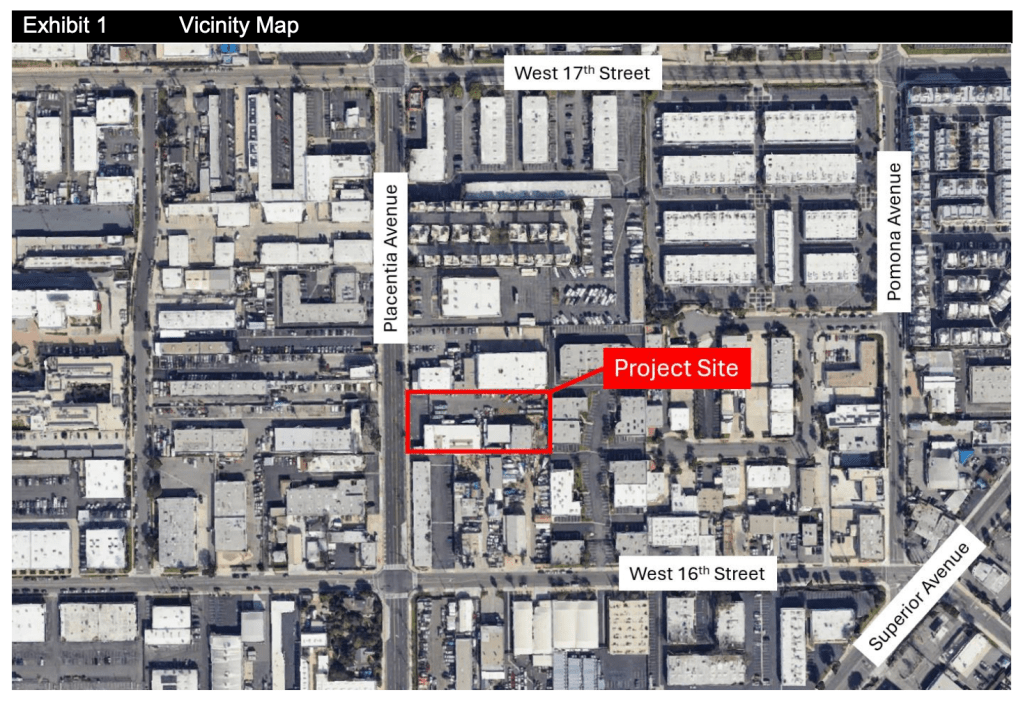
Even though I’m about as yes-in-my-backyard as they come, even I double-take a bit at placing a housing development right in the middle of a number of auto-oriented industrial uses. First, as you can see from the arial view, this development wouldn’t be close to anything intending to serve residential neighborhoods, such as parks, schools, houses of worship, or even grocery stores. And second, even though there is now a fairly nice bike lane on Placentia Avenue, it’s tough imagining future residents wanting to spend a lot of time on that road outside a car.
The developer seems to agree as it has included more parking spaces than Costa Mesa’s already conservative zoning code requires. So not only will this development be entirely hemmed in by non-residential uses, it will also be entirely car dependent.
Could I imagine the our otherwise pretty housing-friendly City Council hesitating on this one? Absolutely. But they’ll likely have to swallow their discomfort. As discussed last year, the city is still in the crosshairs of the California Department of Housing and Community Development (HCD) for its epic tardiness in implementing its Housing Element. Even mouthing a willingness to shoot down a housing development, especially one that otherwise generally conforms with the city’s existing zoning (which, amazingly, this one does — thanks antiquated plans of yesteryear that otherwise went nowhere!), is likely to draw the evil eye of state regulators.
So I expect the City Council to lob as much constructive criticism at the project as possible.
Finally: keep an eye on Costa Mesa employee salaries
The last item of the night will focus on signing up a bunch of agreement updates with the various unions representing Costa Mesa’s city employees, most of which appear to focus on raising certain salaries to align with competitor cities and ensuring that certain supervisor roles are paid enough to separate them from the salaries paid by subordinates.
The fiscal impact of these salary increases across various city departments totals about $440,000 in additional salary spending, which presumably will have even more significant annual impacts. One jumps out in particular: an eye-popping 21% salary increase for the Neighborhood Improvement Manager. It just so happens that one of the responsibilities of the Neighborhood Improvement Manager is to oversee the Bridge Shelter, which, as you read above, isn’t presently doing so great, so this is very curious timing.
But not to worry: the agenda report assures us is either covered by the present FY 2025-2026 budget or “sufficient revenue increases” to cover the remaining salary adjustments.
Perhaps this is an opportunity for someone on the dais to ask, “what revenue increases?” As readers might recall, last year Costa Mesa found itself in a budget pinch because revenues underperformed expectations. I think that alone merits a bit more detail about what alleged good news might be lurking under the rug.
Or… maybe City Hall is just really excited about the prospect of raising taxes.
 Goat Hill Rodeo
Leave a comment