
Back in August, the City of Costa Mesa received a letter from the California Department of Housing and Community Development (HCD) that sent its Housing Element rezoning efforts into warp speed.
In the letter, HCD notified the city that it was no longer merely lagging behind in its efforts to complete its state-mandated rezoning; it was officially late and in violation of state law. If the city didn’t act soon, the letter warned ominously, HCD would assess severe penalties, including withholding critical state funds and imposing potentially hundreds of thousands of dollars in fines.
Then, in November, I highlighted Mayor John Stephens’s statement that the communication from HCD was so serious that the city was now expecting to complete the required rezoning by March 2026, which frankly seemed almost impossible. But now we know how the city plans to do it.
Instead of following the original promise of Neighborhoods Where We All Belong (NWWAB, a horrific acronym by the way), which was to comprehensively rezone all of the commercial corridors included in the “Measure K” 2022 ballot initiative, City Hall told the Planning Commission last night that it now plans to rezone the sites listed in the Housing Element first, with the other Measure K sites to follow. In other words: the rezoning process is so nice, we’re gonna do it twice.
For context, the Housing Element sites are a widely-distributed subset of parcels within the Measure K boundaries. I know that’s hard to visualize — maybe a picture would help?
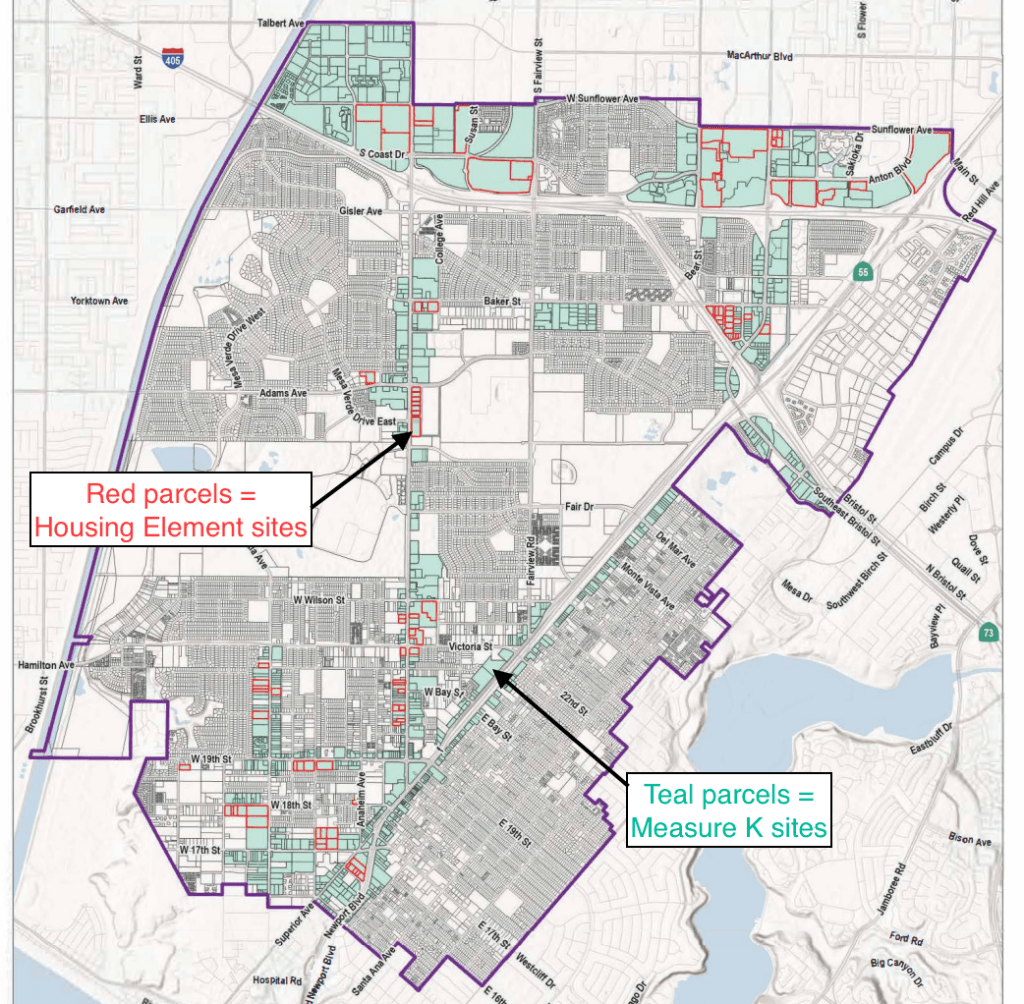
Based on a close listen to the Planning Commission discussion last night, it sounds like Staff has negotiated a path with HCD to get the city’s Housing Element “certified”, a state of regulatory bliss where the likelihood of the State suing us or yoinking the zoning code out of our hands drops substantially. If the City just rezones the parcels outlined in red above, the Staff reported, the state will certify the city’s Housing Element.
So, easy peasy, right? Well, no: there is nothing certain in life other than death, taxes, and zoning being a pain in the ass.
Bifurcating the rezoning process is probably legally necessary…
First, not only do I think this two-step approach is correct, it may be the city’s only path to certification before HCD sues the pants off of us. I said as much back in November.
If the city were to follow the original NWWAB plan and lumped Housing Element sites and Measure K sites together, it would be committed to an ordinary-course, public rezoning process and all it entails: many public meetings, even more meetings of elected and appointed bodies such as the Planning Commission and the City Council, and a full-blown California Environmental Quality Act (CEQA) review.
This could take months, maybe more than a year. Meanwhile, the likelihood that the city would be sued by HCD during that time is almost 100%. And, given that penalties are calculated on a monthly basis going back to the date of the notice of violation — which, in our case, would be August 2025 — calling those potential penalties “material” wouldn’t do them justice.
By pulling out the Housing Element sites separately, the city gets to speed-run the specific work that gets it over the certification finish line as fast as humanly possible. A new law, SB 131, exempts Housing Element site rezonings from CEQA entirely. And as for public outreach, it looks like the city will take the position that such outreach already occurred during the Housing Element process, meaning it doesn’t have to be redone now. With those two big poles in the tent out of the way, getting these targeted rezonings done by March 2026 doesn’t seem impossible at all.
But solving inter-governmental bureaucracy problems isn’t the purpose of the Costa Mesa zoning code. It is to logically and deliberately plan the look and feel of the City of Costa Mesa. And on that measure, this process is quite bad.
… but rezoning is hard enough without trying to do it twice
Let’s assume the Housing Element zoning standards expressed in the Agenda Report — which, by Staff’s own admission, are the bare-bones standards needed to match the unit numbers and densities listed in the Housing Element — were adopted tomorrow. City Staff gave no indication that it was abandoning the effort to rezone the rest of the Measure K sites following the rezoning of the Housing Element sites. So presumably, with the Housing Element sites out of the way, that process would start right away. This second rezoning effort, Staff assured the Planning Commission, would have all the bells and whistles that the Housing Element rezoning skipped.
But of course, there is one big problem with this, which is obvious if you study the map above: the “neighborhoods” being planned would be shot through with Housing Element sites!
For example, how would you comprehensively plan this neighborhood up near the freeway triangle, when half its parcels will have their zoning locked in by the Housing Element?
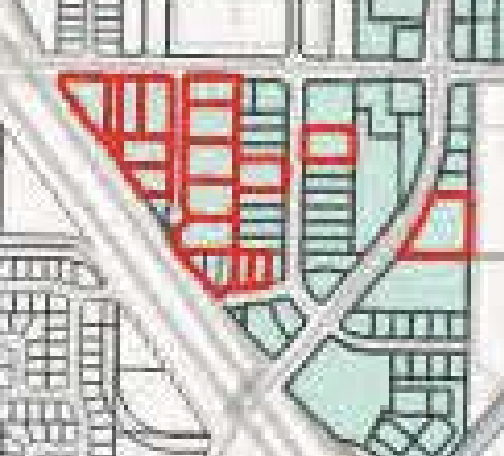
The answer is: you can’t. Either the City will need to retroactively apply the detailed zoning updates generated by the Measure K process to the Housing Element sites (which HCD would have to bless) or this area will simply have a hodge-podge of development standards.
Setting these difficulties aside, what are the Costa Mesa residents to think? Imagine going into a NWWAB rezoning meeting only to find out that half the parcels within a particular area are effectively off-limits because they’ve already been rezoned without a public process. Some might find that confusing; others will be quite annoyed. Propertyowners, too, may be chagrined to find out that their next-door neighbors get better or worse zoning rights depending on whether they were paying attention to the Housing Element process that wrapped up years ago.
Additionally, once the first step of Housing Element site rezonings is accomplished, I imagine a lot of people would be hard pressed to understand why the city is asking them, again, to effectively answer the same questions about the same areas. Process fatigue is a real thing.
And finally… what about the SEVENTH Cycle Housing Element process?
It’s already 2026, and the Sixth Cycle Housing Element process only runs through 2029. Not only is the Seventh Cycle Housing Element process on the horizon, it has already begun in some of California’s more rural counties. So, even as we see the light at the end of the tunnel, remember: sometimes it’s the exit, and sometimes it’s the oncoming train.
 Goat Hill Rodeo
Leave a comment