
As previewed last week, the Planning Commission will get started tonight on the first-baking-of-the-potato that is Costa Mesa’s commercial corridor rezoning effort. As I was preparing my notes for this discussion, I stumbled upon this plaintive plea in a local Facebook forum by one of our Planning Commissioners (!) to “make your voice heard”:
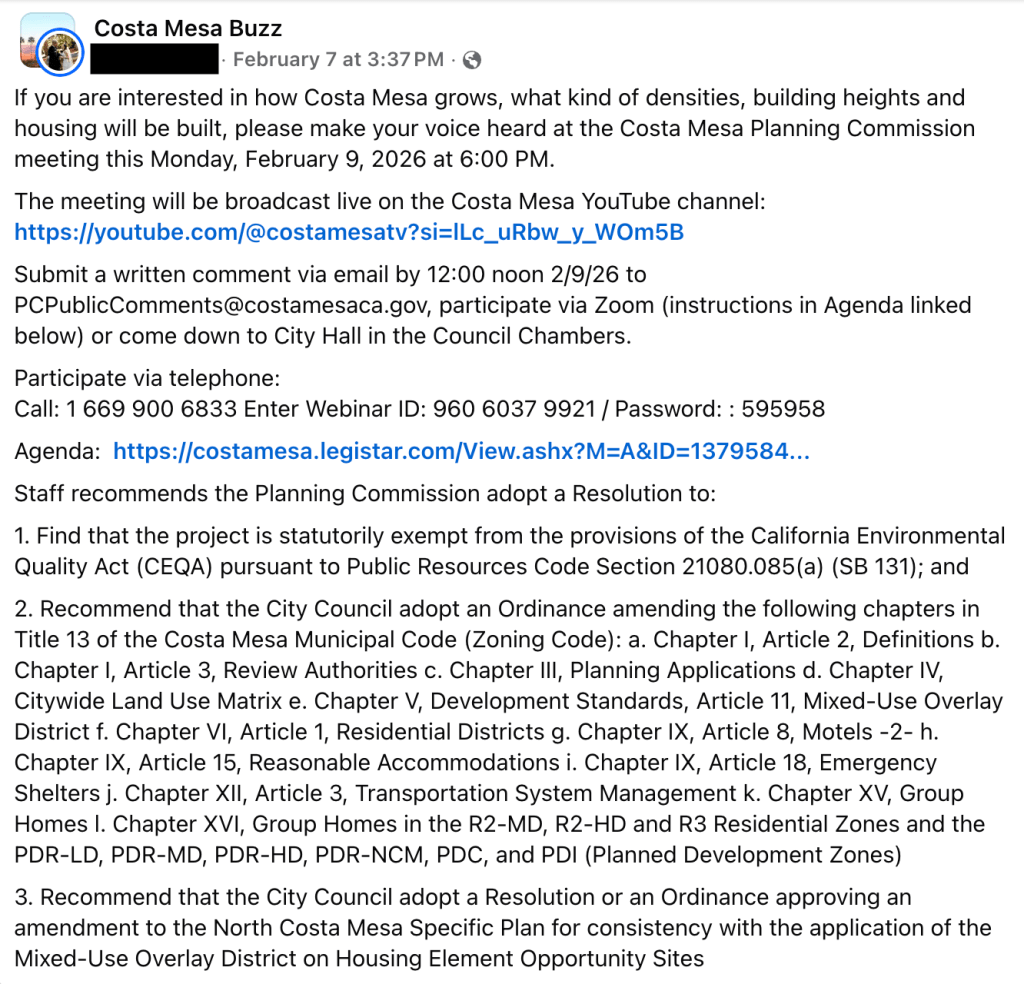
What, you don’t have an immediate, informed reaction to the proposed amendments to Title 13, Chapter III, Planning Applications? Nothing to say about Title 13, Chapter VI, Article 1, Residential Districts? I’ve heard that Article 13, Reasonable Accommodations, is a banger — certainly you can come up with something pithy to say about that?
Snark aside, the nature of this item makes informed public engagement without any meaningful guidance all but impossible. Go ahead, flip through the over 110 pages of strikethroughs and underlined text yourself. If you’re still confused, head over to Agenda Report and see if that clears things up. Feel ready to make targeted comments about “what kind of densities, building heights and housing will be built” based on what you read?
Of course you don’t. And that doesn’t make you a bad resident. It makes you a victim of absolutely terrible public engagement. I’m of the opinion that bad public disclosure is actually worse than no disclosure at all. At least when the government hides stuff from us, it looks shady and people are curious enough by nature to what to figure out what it’s up to. But if the government discloses massive amounts of complex information at once, or does so in a way with minimal summation in plain English that give the public some sense of what is really going on, well, then, we can’t complain its hiding anything.
But never fear; I’m here to give you a few concrete things to think about as you look at this massive pile of zoning changes.
1. The stuff M[s/r]. Planning Commissioner wants you to “make your voice heard” about is already pretty much set in stone, so I wouldn’t bother
Remember, we’re in this zoning mess because of the Housing Element, and we’re in hot water with the State about the Housing Element because we need to implement State law. Those regulatory needs have driven both the number of housing units the new zoning map will accommodate as well as the dimensions of just about every parcel on the map.
In other words: height, density, and housing typologies have already been decided for the parcels in this first round of zoning, and changing any of them now would upset the apple cart in terms of getting State approval of our Housing Element “on time” (i.e., pathetically late rather than criminally late). So when M[s/r]. Planning Commissioner tells you to “make your voice heard,” [s/h]e really just means “tell us how mad this makes you.” Because there is pretty much nothing anyone on the Planning Commission dais will actually do about any of those things at this point.
2. The bigger question is what is not being done by this round of zoning changes, rather than what is
Again, the zoning changes themselves are driven either by State law (meaning that the city has little wiggle-room to do something differently) or basic geometry (meaning even planners have to bow to the impossibility of fitting six, 400-square foot units on a 1,000-square foot lot without building a second story).
But what is up for debate is the approach the city is taking to doing that rezoning. As I mentioned earlier, the city has decided to bifurcate the upzonings it plans to do as a result of Measure K, so that the Housing Element sites are rezoned first.
And that means that a lot of decisions are going to go half-made, or not made at all, with respect to this first round of rezonings. For example, take this quizzical paragraph buried within the proposed regulations of the new “multi-use overlay district” (MUOD), which governs all the sites we are upzoning right now:
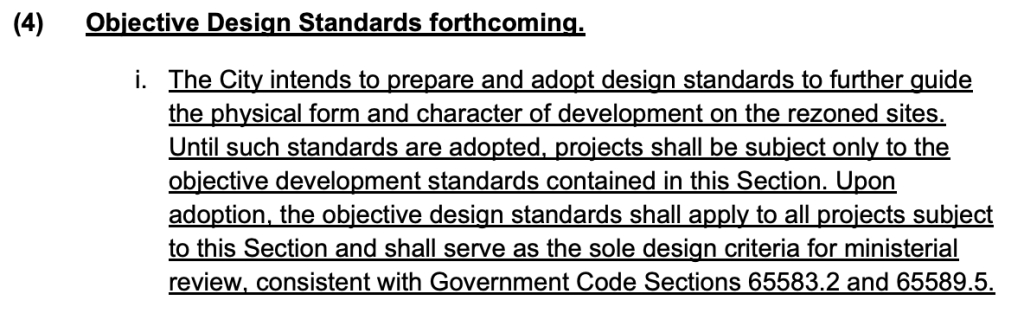
So, in a nutshell, this appears to be saying that the these Housing Element sites will get upzoned with only the barest objective design standards listed in the new provisions (density, parking, setbacks, lot coverage, open space, and height), with the rest… TBD.
Now, who knows how long it will take the city to actually come up with those additional “objective design standards.” At the last Planning Commission meeting, Staff told the commissioners that the public outreach on these standards would begin in March. But Staff also said that the City Council would likely be reviewing these upzonings in March, meaning that it is highly likely that there will be several months (or maybe even years) when these sites will have the upzoning but not the complete set of rules to govern development there.
The Planning Commissioners, particularly Chair Jeff Harlan and Commissioner David Martinez, expressed concerns about this gap period, though, being the good urbanists they are, they were more concerned that such a process could result in inconsistent standards for adjacent properties. While I share their concerns, I’m a touch more practical: what will happen to a development that tries to get its entitlement, say, a day after the City Council passes this upzoning? Will there be a benefit to racing to altar, so to speak, given that only the barest of standards will apply? Maybe!
Or maybe, as Chair Harlan — a development professional himself — implied, property owners will be sufficiently confused by this approach that they may prefer to sit tight and wait for the full set of rules. So while this two-step process might make Sacramento happy, it may (ironically, but in true California fashion) do little to jump-start development.
#3: Expect some grumbling about “streamlined development review”
The other flashpoint buried in these rezonings is the creation a “streamlined development review” process, which essentially bypasses public notices and Planning Commission hearings if an eligible project otherwise fits within the zoning code. While this was already true of smaller developments, this rezoning will codify for all city projects the significant expansion of “streamlined review” imposed on Costa Mesa by a series of state laws in recent years.
In particular, I expect someone to perk their ears up about the new category of “use by right” developments that will receive this bare-bones review. I had to ask my pet AI to give me a list of developments that might fall into this category by State law since they’ve kinda been all over the place:
- Accessory Dwelling Units (ADUs): Almost all residential zones allow ADUs by right.
- Affordable Housing (AB 2011/SB 6): Multifamily projects with at least 20% lower-income units on sites identified in housing elements. AB 2011 allows 100% affordable projects in commercial zones.
- Supportive Housing (AB 2162): Projects that provide housing with linked services for targeted populations, subject to specific criteria.
- Religious/Institutional Housing (SB 4): Housing developments on lands owned by faith-based organizations or independent higher education institutions.
- Housing Element Sites: Specific sites identified by local governments in their housing elements that must be developed with a minimum percentage of affordable housing.
In addition to these, the city also is also adding residential developments with at least 20% of the units deed restricted as affordable units and, intriguingly, small commercial add-on developments to the “streamlined development review” bucket.
I expect some of the more conservative commissioners to take issue with the removal of public notice and meetings about these projects which, if I’m reading the new rules correctly, could be quite large. Many of them were not happy with the city’s recent small lot ordinance, which similarly limited public review.
So there’s plenty to talk about. It’s just wedged between a lot of stuff that either isn’t changing or can’t really be changed.
Which, unfortunately, is par for the course these days when it comes to useful city transparency.
 Goat Hill Rodeo
Leave a comment