
The latest update on our Housing Element saga evades a good food metaphor, so let’s try a mechanical one. Building an airplane is extremely delicate and precise work. It takes years of planning, testing and fabricating to get the parts ready to assemble. Then, each piece must fit together just so, as the slightest vibration or misalignment can cause the whole thing to come apart in midair.
At this point, what Costa Mesa appears to be doing with its Housing Element is assembling a jumbo jet on the tarmac, as the fuselage is rolling down the runway toward takeoff. It’s picking up speed. The engineers are frantically assembling the wings and the engine chassises.
And… something big just fell off.
The Planning Commission’s first cut at the Housing Element rezoning earlier this week was about as rote as expected, with the Staff’s recommended plan essentially sailing through on a 6-1 vote (Commissioner Jon Zich, who rhetorically spit on the whole process, voted no).
Essentially. There was one, big change included in Chair Jeff Harlan’s successful motion. The Segerstroms wanted out of the Housing Element process altogether:
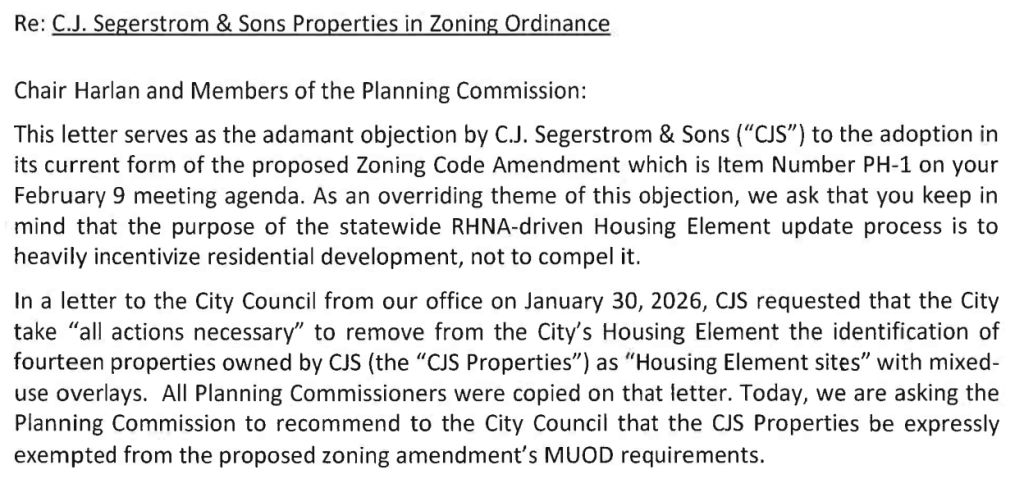
And, being the obliging body the Planning Commission tends to be, it replied: Godspeed, and it promptly exempted all of the Segerstrom properties from the Housing Element rezoning.
Why would a big player in the development world — arguably Costa Mesa’s largest and most important landowner — suddenly want to be excluded from the city’s Housing Element rezoning project?
Well, it looks like that New Commune DTLA LLC v. City of Redondo Beach case that I wrote about at the end of last year finally caught up with us. Once the Segerstroms realized that the Costa Mesa rezoning wouldn’t be adding residential development rights to their commercial properties, but rather substituting their existing commercial zoning rights with new ones that would require any redevelopment to dedicate at least 50% of its total floor area to housing, they wanted to drop cooperation with the city’s Housing Element process like a hot rock. “[The Segerstroms] cooperation relied on the City’s assurance that these overlays would not jeopardize existing zoning designations, but instead would give [the Segerstroms] the option to pursue residential uses if and when consistent with [the Segerstroms’] business planning,” an earlier letter from the Segerstroms complains. Obviously, when that “option” becomes mandatory, that’s a lot less attractive.
Is this a big deal?
I think so? On the one hand, the Segerstroms control a whole lot of land in Costa Mesa, and, if I’m reading the Housing Element correctly, their properties accounted for a big chunk of the city’s Housing Element sites by unit count:
| Housing Element Site No. | Description | Net Unit Count |
| 134 | National University | 520 |
| 136 | National University | 152 |
| 137 | Home Ranch | 443 |
| 138 | Home Ranch | 1,772 |
| 198 | Home Ranch | 0 |
| 139 | 3400 Bristol/Offices | 47 |
| 140 | 685 Sunflower Ave | 78 |
| 141 | 3410 Bristol/Offices | 121 |
| 205 | 3420 Bristol/Offices | 70 |
| 145 | South Coast Plaza Parking Lot | 575 |
| 146 | South Coast Plaza Parking Lot | 483 |
| 147 | South Coast Plaza Parking Lot | 900 |
| 203 | 1590 Adams/Post Office | 9 |
| 204 | 1590 Adams/Post Office | 120 |
| TOTAL | 5,290 |
Pheeeeeeew. Losing 5,290 planned-for housing units puts a big dent in the total planned-for units included in the city’s Housing Element. Hopefully my math’s wrong — hey, I’m a just a stay-at-home mom now. It’s possible.
But on the other hand, the Housing Element actually planned for far more additional zoned capacity than the city strictly needed to satisfy its Regional Housing Needs Allocation (RHNA) of 11,760. In fact, taking together all identified Housing Element sites, which encompasses far more than just the Segerstrom properties, the city was actually planning for 17,042 new housing units — representing a “buffer” of… 5,282 units.
So, if my math’s right, losing 5,290 potential housing units eats the whole buffer, and it puts the Housing Element underwater by 8 units. Oh dear. And I think it’s a bit worse than that; the Housing Element has to account for not just a total number of units but also units within certain income categories. For example, because our buffer for additional very low income housing units was razor thin to start with — we only provided for 103% of the required RHNA units in the existing Housing Element sites — the city is almost certainly going to fall behind in that category, and it may now be behind in others as well.
Now, cities do not have to build in a buffer in order to stay in compliance with state Housing Element law (though it is strongly recommended). In fact, buffers can be too big; just ask Newport Beach, which is facing a nasty popular ballot initiative fight over that very question. So Costa Mesa can, theoretically, achieve Housing Element compliance without these properties being included, assuming it finds a few more units of new capacity here and there to just get over the required RHNA allocation numbers.
But what it can’t manage, at least without finding a lot more Housing Element sites, is any other property owners yanking their properties out of the Housing Element process. Unfortunately, I think the risk that may happen is high. The Segerstroms cannot be the only landowner included in the Housing Element that is getting cold feet about the prospects of their ongoing commercial developments suddenly becoming “legal nonconforming”, such that they can only be redeveloped into housing.
So now what? Well, since the Planning Commission has pushed its plate of vegetables over to the City Council’s place at the table, it will be up to them to figure it out.
There is some good news. First, the city may be able to pick up a few more planned-for units from the Fairview Developmental Center master plan, which is now projecting to include more than 3,500 units of housing compared to the Housing Element’s comparatively conservative 2,300-unit estimate. Plus, who knows — maybe some new property owners will come forward and ask to be included if they see the zoning rights swap being in their interests.
And second, the city is still in reasonably good shape with respect to overall housing capacity, thanks to the additional planned rezonings under Measure K. Presumably landowners that balk at being included in the Housing Element will still welcome the additional rights granted them by the city’s Multi-Use Overlay District, which, when applied to non-Housing Element sites, can be purely additive.
But it’s a blow. There is no doubt about that. Can the plane still fly with a big chunk of the tail section missing? We’ll find out!
 Goat Hill Rodeo
Leave a comment