

Welp, the Great Costa Mesa Housing Meeting is over. I’ve had a few days to digest it. So, contra my irresponsible goofing on the front end, I’ll try and make up for it with a nice, sober review of what actually happened.
But First: What *Didn’t* Happen
Let’s start by dispatching with the negative space. The Women’s History Month presentation went ahead as scheduled, but the Active Transportation Committee’s annual was wisely booted to a later meeting. The discussion of storm drain fees was dutifully opened and continued.
And not only did the Council fail to award the half-a-million dollar contract for planning the Fairview Park bluffs restoration, it wasn’t even discussed as it was booted from the agenda at the beginning of the meeting. Sadly, that didn’t stop the Daily Pilot from getting ahead of itself:
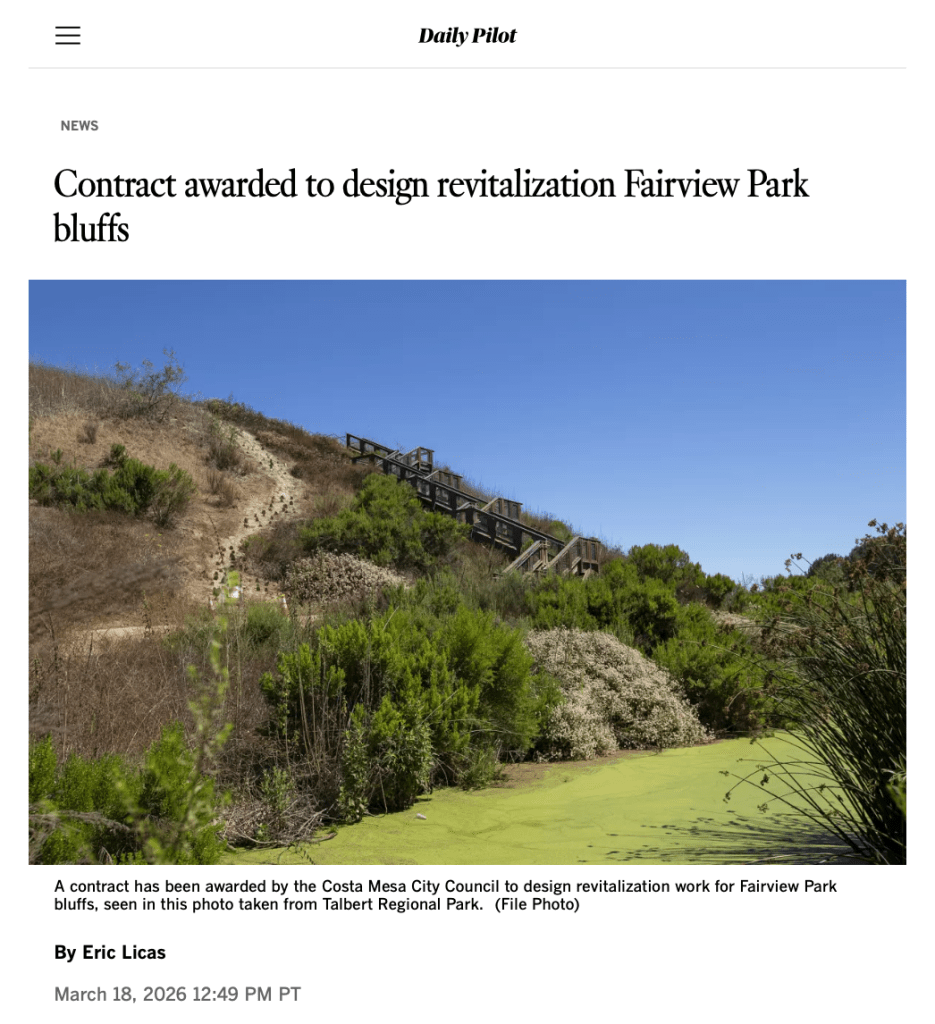
Oopsie. The story was deleted once it was pointed out nothing reported in the piece actually occurred. But hey: maybe they can just put it in a drawer for when this outrageously-bloated-but-probably-inevitable contract gets approved in a couple weeks.
What Did Happen, Part I: Council turns back more tenant protections
That said, the Daily Pilot recovered well and produced a great story describing another item that did get discussed at length, which is the City Council’s turn-back of efforts to track at-fault evictions and create a city-managed rental registry.
For those who aren’t Daily Pilot subscribers, the short version is that both proposals failed on 5-2 votes, with different pairs of partisans left in the minority each time.
However, that doesn’t really do the discussion justice, which took up about half the (very long) meeting and featured over an hour-and-a-half of public comments. Both tenants’ rights advocates and local landlords showed up in force. And while the discussion remained mostly civil, these were clearly emotional issues for both sides.
With respect to tracking at-fault evictions, visibly frustrated Council Members Andrea Marr and Arlis Reynolds ended up sidelined by the majority’s concerns over inserting City Hall into the rental market.
In the second discussion regarding the rental registry, it was the opposite side of the aisle that found themselves stuck on the outside looking in. Although the top-line matter of proceeding to create a registry failed, the more liberal members still wanted to pursue a “Network for Renters’ Solutions” that would consolidate the city’s tenant assistance programs and potentially provide additional resources for landlords and renters. This must have looked a little too much like “registry lite” for the more conservative Council Members Jeff Pettis and Mike Buley, each of which voted no.
In general, I think these were the right calls. The Costa Mesa rental market is vast, complex, and full of human messiness. As Council Member Manuel Chavez pointed out, the city’s taken a stance of benign neglect when it comes to all kinds of housing regulation for a very, very long time. In the absence of direct oversight, hundreds, perhaps thousands, of bespoke solutions to high housing costs have grown up, from illegal sublets to code-defying subdivisions to severely overcrowded units. Yes, sunlight can disinfect, but anyone who’s been out in the sun too long knows that disinfection requires destruction. I don’t think we are ready to find out the extent to which many Costa Mesans live in housing arrangements that cannot fit neatly into our codes. So yes, sometimes it’s better to not ask, even if the data would be useful down the road.
What Did Happen, Part II: Costa Mesa undergoes its most significant rezoning in decades
Amazingly, lost in all the angst over tenant protections was that this was the meeting where Costa Mesa finally (or maybe just for now) rezoned its dozens of (remaining) Housing Element sites to accommodate (most of) its Regional Housing Needs Allocation and satisfy part of the California Department of Housing and Community Development’s (HCD) demands on the way to Housing Element certification.
And while this is an incredible achievement for both this City Council and the city’s Development Services team, the caveats littered in the statement above hint at why this moment felt so anti-climatic. As previously discussed, the City Council finished the process of removing Segerstrom and several other landowners from the list of Housing Element sites over the New Commune DTLA case. And along the way, yet another big landowner — this time Drawbridge Realty and its mega tenant, Anduril Industries — asked to remove Anduril’s office space from the Housing Element too, which the Council had no choice but oblige. As the visibly anxious Anduril attorney made her case, I couldn’t help but wonder: if major landowners are panicking and looking for the exits, is it possible we will see a smaller landowner come begging to be removed after her parcel has already been rezoned? If if the city refuses to undo the rezoning, will the city be sued?
And yes, if you are wondering: Anduril’s office is in the Hive, the property that once had an approved plan to be converted into over 1,000 units of new housing. So pour one out for all the housing advocates out there.
There was one bright spot. Planning Commissioner David Martinez showed up and, speaking on his own behalf, suggested that the City Council exempt all of the Housing Element sites from the city’s parking minimum requirements, seeing as AB 2097 already exempts most of the sites from these requirements by State law. And, remarkably, the City Council did just that when it included that change in the motion, which passed unanimously.
Let me say that again: the City Council just voted unanimously to approve the first-ever repeal of minimum parking requirements in the history of Costa Mesa. So yeah, while it only impacts Housing Element sites, most of which were exempt anyway, that’s pretty cool.
With these changes, the City has completed baking #1 of its twice-baked-potato strategy. However, thanks to Housing Element site defections from Segerstrom and the like, it might be turning into a thrice-baked potato, with the added step being finding a sufficient number of new Housing Element sites to replace the old ones, doing public outreach on rezoning those, and then adding them back into the Housing Element/rezoning updates.
In describing this debacle, Council Member Buley quipped, “I’m thinking of this analogy: how do you end up with a camel? You ask a bureaucracy to design a horse.” With the benefit of hindsight, I’d say this: we actually started out with a pretty good horse (the Measure K comprehensive rezoning effort) and, using some bureaucratic black magic, turned it into a pretty messed-up camel (the tortured inclusionary housing ordinance, the inexcusable delays, the missed deadlines, the threats of being sued by HCD, the now-thrice-baked-potato rezoning strategy, and whatever the hell remains of Neighborhoods Where We All Belong).
Bleh. What a mess.
What Did Happen, Part III: The Council saves the Jamboree Senior Center housing project, “Dave” style
Finally, the last couple of items dealt with two affordable housing developers coming to the City Council with a big problem: their projects wouldn’t happen if they didn’t come up with some big wads of cash, and quick.
The first one was American Family Housing (AFH), which is the non-profit housing developer in charge of the former TravelLodge’s conversion to affordable supportive units under the State’s Project Homekey program. AFH apparently ran into some headwinds relating to water infrastructure and roof issues, leaving the project about $2.7 million in the red.
The second was Jamboree Housing, the lead developer of the much-talked-about affordable senior housing project that is planned to sit atop of the Costa Mesa Senior Center’s parking lot. Jamboree’s issues were less structural and, well, more squarely our fault. It was on track to receive a $1.8 million grant from the County of Orange “for which the project was no longer eligible”, and the loss of that grant had the knock-on effect of losing about $1.7 million in matching State funds, putting the project suddenly $3.5 million the hole.
Why? Er, because the Orange County grant could only go to projects in cities with certified Housing Elements, which, obviously, we lack.
While the Council seemed a bit skeptical of backfilling AFH’s construction cost overruns — it ultimately threw only a $350,000 loan from the City’s HOME funds its way — it equally seemed determined to save the Jamboree project. So, in a process that was reminiscent of one of my favorite scenes from the absolutely delightful 1990s move Dave, the City Council went searching through the budget to find enough funds to save the project.
In the end, the City Council awarded Jamboree an additional $3.25 million in low interest loans, funded in part through a low-interest loan from the remaining HOME Funds of $1.15 million and an additional $2.1 million coming entirely from the City’s Housing Trust Fund. This neatly avoided the Staff’s suggestion of also tapping the One Metro West development funds, which, if you recall, were subject to a deferred payment scheme that would have made doing so pretty complicated.
Now, while it is hard to get too fussed about this solution on the surface — after all, both the HOME Funds and the Housing Trust Fund were both, directly or indirectly, created through the use of Federal or State grant funds, and both were set aside for the explicit purpose of providing funding for affordable housing — it really hurts to see these funds used to plug holes created by the city’s fecklessness in the Housing Element process. Future projects will not receive gap funding, which in turn will result in a net loss of affordable housing units built in Costa Mesa in the foreseeable future.
That’s quite the outcome for a State housing policy intended to build more housing. Now you can see why I was resorting to rhymes last time. Better that than to regret the torrent of expletives that I almost put to paper.
 Goat Hill Rodeo
Leave a comment