
Tonight, the City Council will get its first look at the proposed 2026-2027 Capital Improvement Program, which is the first step of its months’ long evaluation of next year’s budget. And there’s lots of fun stuff in here: parks! Alleys! Roofs! Chillers! More green paint!
Sadly there are weightier matters to ponder, too. For several months now I’ve heard rumblings that the 2026-2027 budget cycle will be “difficult”. At first blush, that doesn’t seem to be the case based on the proposed CIP. Backing out the proposed $12,000,000 bond for the future reconstruction of Fire Station #2, which was a line item both last year and this year, the overall CIP budget has grown approximately $2.94 million, representing an almost 10% increase from last year.
And refreshingly, this growth is driven mostly by better General Fund support rather than outside grant funding. General Fund transfers to the Capital Improvement Fund (Fund 401) increased by about $1.64 million, which accounts for little over half of the overall CIP investment growth.
But tucked deep in the staff report, there are some flies in the CIP ointment.
Yep, we are back to the good old capital asset needs (CAN) ordinance. I hate to ask you to do homework but before we proceed, I would strongly recommend reading this article from the Daily Pilot about last year’s budget crisis, which resulted in waiving the CAN ordinance and deferring repayment of the waived amounts for ten years. And if you don’t subscribe to the Daily Pilot, you can get the free, Temu-version by reviewing the budget section in my 2025-midyear update.
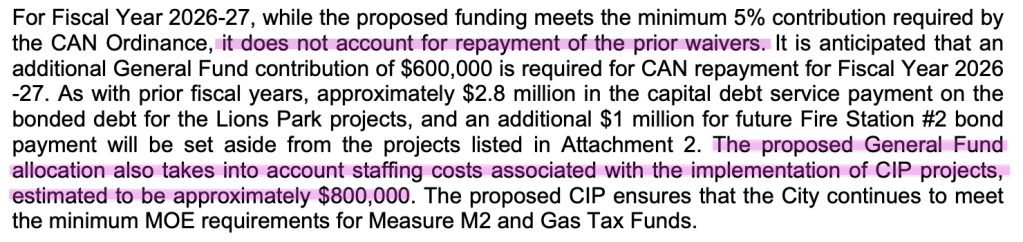
There are at least three problems with the paragraph above, particularly the highlighted bits. Let’s go through each.
CAN you “rollover” prior waivers?
The first odd statement in the Agenda Report excerpt above is that this budget will not account for “prior waivers” of the CAN ordinance. As a recap, the City Council deferred $2.9 million in required CAN spending in FY 2024-2025 and directed staff that it be repaid over a 5-year period, and then deferred another $1.2 million of such spending in FY 2025-2026, directing this tranche be repaid over a 10-year period. Thanks to some last-minute budget wrangling, the $1.2 million deferred last year actually came out of the fund established by the “Information Technology Needs” (ITN) ordinance, which is almost identical to the CAN ordinance except it obligates the city to dedicate only 1.5% of general fund revenues to IT spending (versus 5% for the CAN ordinance).
Both the CAN and ITN ordinances contain “emergency exceptions,” which the City Council used to put these deferrals into place. These “emergency exception” provisions require that, in the event the ordinances are not followed due to an economic downturn or other emergency, the city must “develop a plan to replenish” the missing funds.
But, critically, it doesn’t say that the city actually has to replenish them. For example, even though it takes a supermajority of the City Council to approve a deferral of these funds, the ordinance is silent regarding continually deferring those funds into future years. In theory, a bare majority of the City Council could simply amend the “plan” to perpetually kick the can down the road (pun very much intended).
And here we are, doing just that. So to answer the question above, yes — it seems like you can perpetually rollover prior CAN (and ITN) spending, without any consequences. Seems pretty broken to me!
Um, since when are “staffing costs” synonymous with “capital asset needs”?
The second highlighted section in the Agenda Report excerpt above seems even more problematic. Here is the text of the CAN ordinance:
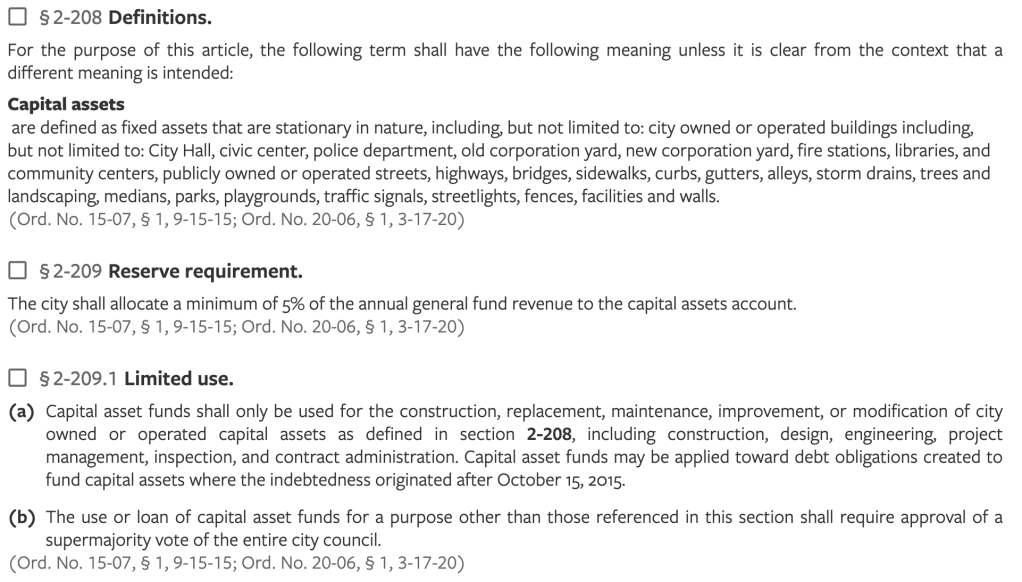
Notice the words “labor” and “staff” are missing from the ordinance, and I have to believe that was on purpose. The CAN ordinance was, in Steve Mensinger’s and Jim Righeimer’s own words, “created to protect our roads, police and fire stations, public buildings—everything residents rely on every day. It was passed because we knew future councils would face pressure to divert those funds when times got tough.” Divert to what, you may ask? I have to assume Mensinger and Righeimer, both loud-and-proud crusaders against the growth of City Hall, had salaries in mind.
Yet that looks like exactly what the gloss on the CAN ordinance above proposes to do. “Staffing costs associated with the implementation of CIP projects” looks a lot like salary spending recharacterized as capital improvement spending.
If the City Council goes down this road, then the CAN ordinance will have lost all meaning. You could recast half the Public Works department personnel as “capital assets” and never have to put money towards actual concrete-in-the-ground ever again.
In order to avoid this, I hope the City Council insists on applying Section 2-209.1(b) above, which requires approval of use of CAN funds for “a purpose other than those referenced in this section” to be done by a supermajority vote. If a supermajority of the City Council wants to make a mockery of the CAN/ITN ordinances, so be it. But they’ve got to own that.
Finally: Where is the mid-year budget report, and what ever happened to re-evaluating the CAN ordinance?
So, since I had to go crawling through last year’s minutes for this piece, I’m going to insist you share some of my pain. Here’s an interesting excerpt from the minutes of the meeting that Frankenstein-ed the budget together last year:
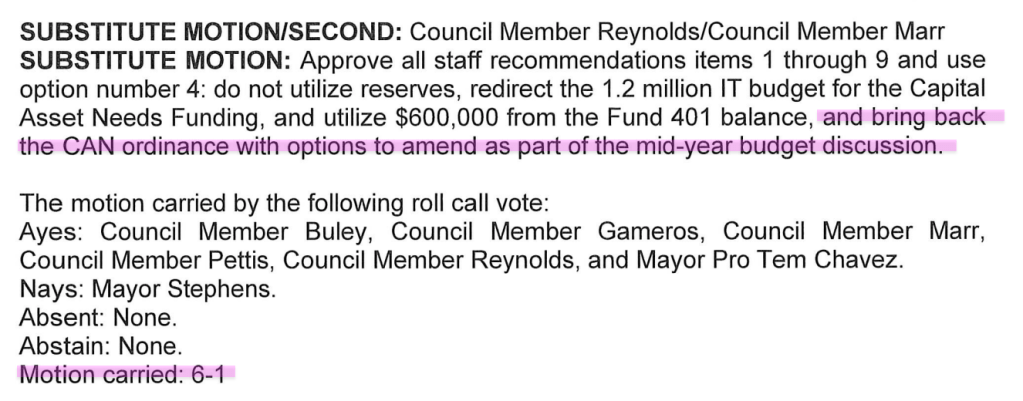
So… does any of this even matter? As far as I know, City Hall hasn’t proposed a date for a mid-year budget update yet, and I don’t think the Finance and Pension Advisory Committee has gotten one, either. But, whenever that happens — and turnover at City Hall might explain some of the delay — these minutes suggest that the Finance Department is obligated to bring forth “options to amend” the CAN ordinance.
What that might look like is anybody’s guess. I think there is a majority to scrap the CAN ordinance altogether, which would relieve the city from the paper debt created by continuously rolling over the CAN deferrals. But scrapping the CAN would also be an admission of guilt that, at the end of the day, the “pressure to divert funds when times got tough” was simply too great.
Alternatively, the more level-headed council members hopefully see this for what it is: an all-hands-on-deck emergency, where structural spending is rapidly consuming infrastructure maintenance. Placing the city on a better long-term footing will require very hard (read: staffing) choices. Do they have the stomach for that?
 Goat Hill Rodeo
Leave a comment