
How about that for a hook!
But seriously, based on our agenda this week, I expect a somewhat long and tendentious meeting, most of which will cover familiar ground.
First, let’s get the most boring bits out of the way. The City Council’s meeting will be nearly bookended by matters that, while they aren’t riveting, are important to keeping the city running well: storm drain infrastructure and waste hauling. The latter is driven mostly by updates in the cost of hauling waste to landfills managed by Orange County, so I don’t expect much discussion about that one.
The former, however, does have a couple eye-popping tables worth paying attention to. How painful could storm drain fees be? Well, following the nexus study, the city is proposing to revise the maximum allowable fee for dealing with the infrastructure upgrades needed to accommodate new development. How high can those fees go? Uh, are those percentage increases from existing fees in the high hundreds?
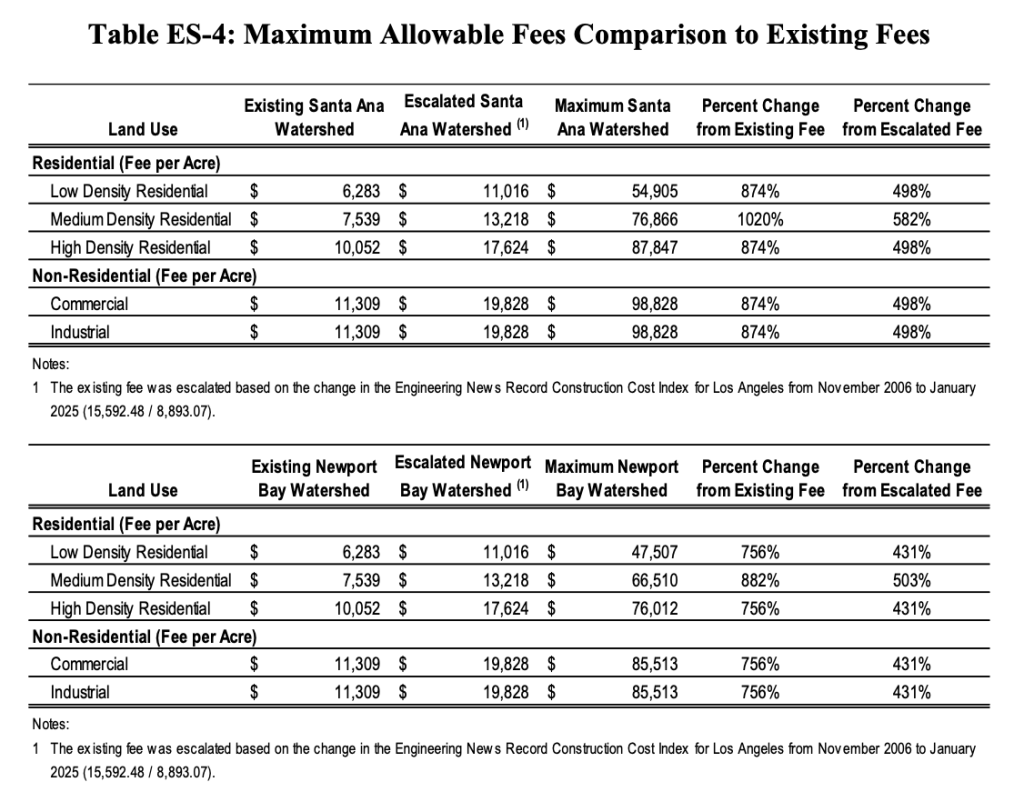
Yeesh. Why are these so high? Well, the fees are determined by working backward from the cost of the infrastructure projects that are needed in the next couple of decades. State law requires that the city develop a capital improvement project list for storm drain infrastructure that needs to be completed by 2040 to address the storm drainage needs of current and future development. Squint at the last row:
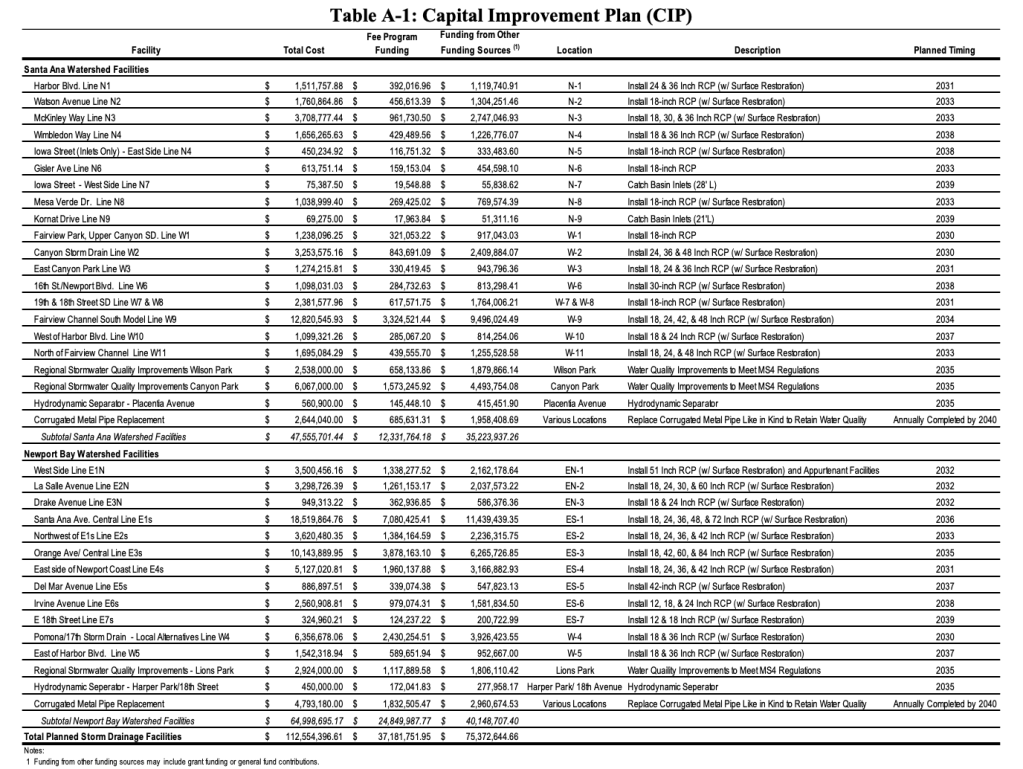
For those who can’t read that tiny writing: based on this list, Costa Mesa has over $112.5 MILLION of storm drain projects it should complete by 2040, which would require just over $8 million worth of completed projects per year. Disturbingly, this table also indicates that two-thirds of this spending won’t even be covered by development storm drain fees; it will be covered “other sources”, which, if you read the itty-bitty footnote at the bottom of that table, “may include grant funding or general fund contributions.”
Yeah, that’s not going to happen. Instead of adopting these maximum fees and this ambitious set of capital improvement projects, staff recommends that the city council instead adopt some percentage of the maximum fee as the actual fee charged, and then pare down the projects to some more achievable subset. Staff further recommends waiving the fees for development that results in a conversion from a high-impact land use (like an industrial plant) to a lower-impact land use (like a medium density apartment building). So the net effect on development may be somewhat low, despite the gag-inducing numbers.
Still, it is humbling and frightening to contemplate just how expensive invisible infrastructure like storm drains can be. Hopefully that reality isn’t lost on the city council.
Turning to the rest of the agenda, it’s a lot of stuff you’ve heard about before.
- The massive Housing Element rezoning gets its second reading tonight, which will clear the way for the City to continue down its winding path towards Housing Element certification. I previously wrote about the city’s most recent struggles to accomplish that. While I generally don’t expect much new to come out of this discussion, keep an eye on the idea of “parking minimums”. Last time, the City Council (perhaps without full awareness) by motion stripped out all minimum off-street parking requirements from the Housing Element sites. Staff, perhaps not fully understanding the motion, kept a few minimum requirements around guest parking and other corner cases in the draft. Advocates against parking minimums will likely try to pull those out, while council members who might have been caught sleeping last time may fight to expand them.
- The grant-funded Fairview Park bluff restoration project, which is proposing to burn a quarter of the project’s already bloated $2 million budget just on design, will get discussed tonight.
- The proposed Code of Ethics, which featured prominently in the discussions following the ouster of former city manager Lori Ann Farrell Harrison, will get its first reading tonight. The Agenda Report’s long and painfully detailed recitation of all of the different federal, state and local law already circumscribing the behavior of elected officials, appointed officials and city staff may be a hint that City Hall isn’t as excited about adopting a separate code of ethics as perhaps some of the council members are. Will we see old wounds reopen on the dais over what constitutes “civil” behavior?
- The Costa Mesa Skate Park Expansion, which is a very exciting project to add additional skate areas as well as a pump track to the already regionally famous skate park, may finally get awarded. This project went out to bid way back in December 2025 so it’s been curious to see it take so long. A quick glance at the agenda report suggests why: the bids were higher than the city hoped.
- Strangely, the Active Transportation Committee’s presentation of its annual report is being presented as a new business item, rather than a presentation. Perhaps Public Works is looking to use the occasion to do a victory lap over its many high-profile active transportation projects completed in the last year or so?
- Finally, the City Council will make appointments to various city committees. This might seem like bland work, but here’s a thread to start following: The Animal Services Committee (ASC) will see a majority of its members appointed or reappointed. Why does that matter? Well, word on the street is that there are significant controversies brewing over the fate of the city’s animal shelter, some of which have started to percolate up into the mainstream news. The ASC would be the first body consulted in any change to the city’s shelter policy.
Additionally, there is an interesting 2026 election hook, too: not only does Steve Smith, a declared candidate for City Council District 5, currently serve on the ASC, Cara Stewart, a declared candidate for City Council District 3, is seeking reappointment to the ASC as well. Who might reappoint her? Well, if outgoing Mayor John Stephens doesn’t do the honors, perhaps 2026 mayoral candidate and current Council Member Loren Gameros would. And Gameros’s likely opponent for mayor, City Council Mike Buley, also has an appointment to ASC this time around. So for once, this small and often overlooked committee may become an epicenter of Costa Mesa politics. Who would have thought!
 Goat Hill Rodeo
Leave a comment