
I already tend to write a lot and I promise: this one isn’t going to be easy to unravel. So grab a drink and settle in.
As you might already know, Costa Mesa is considering adopting an “inclusionary” housing ordinance. The scare quotes are intentional and, over the course of this series, I’ll unpack why I think that’s warranted. But first, let’s talk about what the City is considering and how we got here.
In the simplest terms, inclusionary housing ordinances condition the approval of new residential developments on the inclusion of “affordable” units, meaning units that must offered for rents that households with low or moderate incomes can afford. The logic goes something like this: in an environment where it is profitable to develop new housing but construction costs are high, developers have little incentive to build anything except “luxury” housing for high income earners. Therefore, the government can and should step in to either mandate or incentivize developers to produce units with rents limited by law, so that there are a sufficient number of affordable units available to meet demand. This usually looks like a “set aside” requirement, where new developments must include some percentage of units (usually 10-20%) that are offered at low or moderate prices.
Taken at face value Costa Mesa is long overdue to adopt an inclusionary housing ordinance. Almost 47% of our population qualifies as “low income”, and a substantial majority (60%+) of households rent rather than own their homes. And thanks to massive rent inflation in the last 3 years, it’s UGLY out there:

Note that the figure above shows average rents. While I would be more cautious using average rents if there were lots of new development dragging up the high end of the average, that simply doesn’t exist in Costa Mesa right now. So average rents give a reasonable estimate of the amount of pain in our housing system. And as you can see, there is plenty of it.
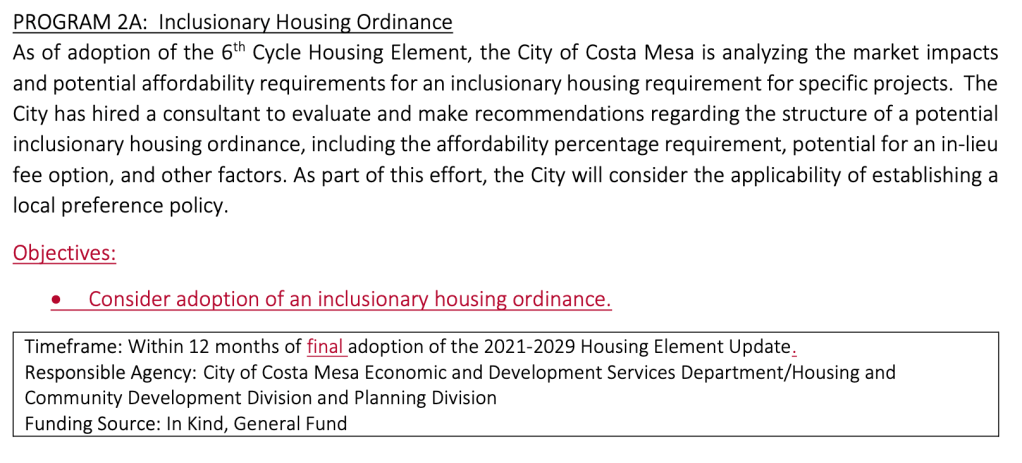
In addition to substantial rent inflation, the City is also required to adopt an inclusionary housing ordinance as part of the Housing Element process. Why it is required to do this is a bit of a mystery. The final Housing Element approved by the City Council in November 2022 stated only that the City would “consider the adoption” of an inclusionary housing ordinance. Then, in March 2023, the Staff quietly made “minor, non-substantive, and necessary” updates to the approved Housing Element, which the Staff claimed didn’t need to go through the City Council for further review before submission. You be the judge: is this “minor and non-substantive”?
November 15, 2022 Approved Housing Element:
March 1, 2023 Staff Amendments to the Approved Housing Element:
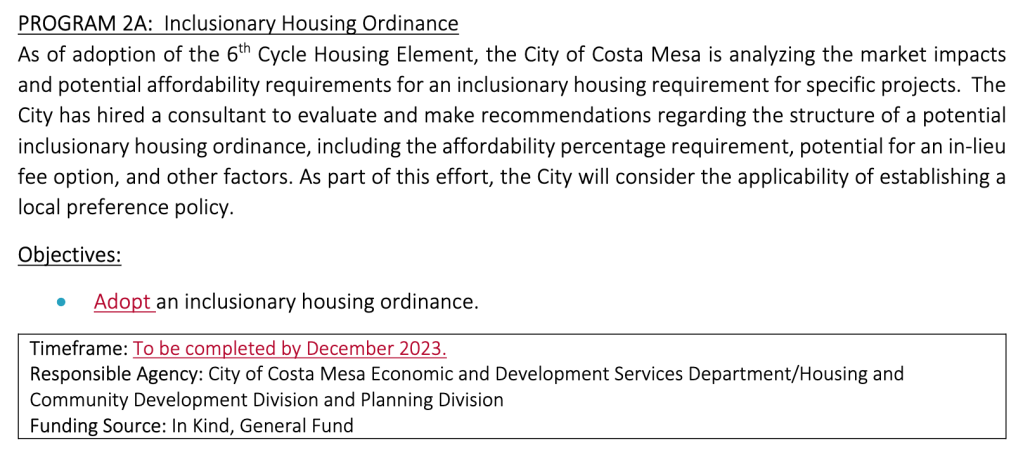
So in other words, the inclusionary housing ordinance went from being something the City was only obligated to “consider” adopting to one it must adopt by December 2023. Why the California Department of Housing and Community Development (HCD) would require the City to make this change is beyond me, given that some of HCD’s guidance considers inclusionary housing ordinances to be constraints on the production of housing. However, Cynthia McDonald, a resident who helped found Costa Mesa First and never misses an opportunity to opine on housing and zoning affairs, claimed in a public comment that the change was made by the request of the State.
Oh well.
Regardless of how this obligation got in there, we now have a duty to adopt an inclusionary housing ordinance in order to get through the Housing Element process. In Part 2, I’ll dive into the ways we might think about whether an inclusionary housing ordinances has been successful.

 Goat Hill Rodeo
Leave a comment