
Back during the height of the COVID pandemic, the City Council considered an item that seemingly came out of nowhere. Some of the members, including the Mayor, had received significant campaign donations from the groups that would directly benefit from it. The item was introduced as the last item of a contentious meeting, and then continued “to the next meeting” — a continuance that lasted for almost 18 months. When it finally came back, the Democrats had an iron grip on the Council and and an even stronger booster of the item had been elected. Taking issue with what seemed to him to be naked partisanship, the former Chair of the Costa Mesa Planning Commission, Rob Dickson, wrote that that the item was “intensely offensive” and that “it stinks to high heaven.”
No, I’m not talking about retail cannabis. I’m talking about the Community Workforce Agreement (CWA).
What is the CWA, you may ask? Effectively, it’s an agreement by the city with the local construction and trade unions to use only union labor for significant city projects. In return for this very generous exclusivity, the unions promise to deliver the city certain benefits, the most important being that they will target 35% of the labor on any particular project to be either “local” (i.e., workers hailing from Costa Mesa or its schools) or military veterans, and target 10% of the labor to be from disadvantaged communities (think single parents, people experiencing homelessness, people on public assistance, even ex-cons).
On the surface, the CWA looks like all upside. One of the public speakers in favor of the item at the time it was finally adopted in February 2022 put it this way: “I lived non-union for 12 years. I lived check by check. I could only afford one car… then I was able to work on a PLA project. Let me tell you what this did for me. It opened my eyes… Is this what I’m worth? Man, I’m worth this much? Why isn’t my boss giving me the opportunity to earn a livable wage?… When that project ended I became a union member. I now own a house, have two cars and put two kids through college. What is wrong with this?”
It’s hard to argue with that. But not impossible. Let’s go a bit below the surface.
So… where does the money come from?
First, while it is nice to give construction workers “a living wage” — though a wage that gives you the ability to own a home, own two cars and put two kids through college in a city where 65% of residents are renters and where college tuition rates have substantially outpaced the rate of inflation might come in a touch above what most would consider “livable” — where does this money come from?
Remember that part above where the CWA provides unions with exclusivity over city projects? Well, with exclusivity comes bargaining power, and with bargaining power comes the ability to demand higher prices. These higher prices manifest themselves as higher bids for city projects, which then come out of the pockets of city taxpayers. So the CWA is, effectively, a welfare transfer of taxpayer funds from our Capital Improvement Program (CIP) budget into the pockets of unionized workers. With a bit skimmed off the top, of course, for the consultant we had to hire to administer the program as well as the union representatives themselves.
This isn’t exactly hypothetical. One study by the National University System Institute for Policy Research looked at over five hundred projects executed under community workforce agreements — also called “project labor agreements”, or “PLAs” — in the school district context and found that the presence of a PLA was consistently associated with 13-15% higher project costs. So the city effectively agreed to pay a 13-15% tax on the construction of every project under the CWA. That’s a far cry from the 2.5% estimated “administrative costs” discussed in the CWA’s agenda report produced back in February 2022, and very, very far away from the 0.8% overhead cost that Public Works Director Raja Sethuraman gave during the staff presentation at the time.
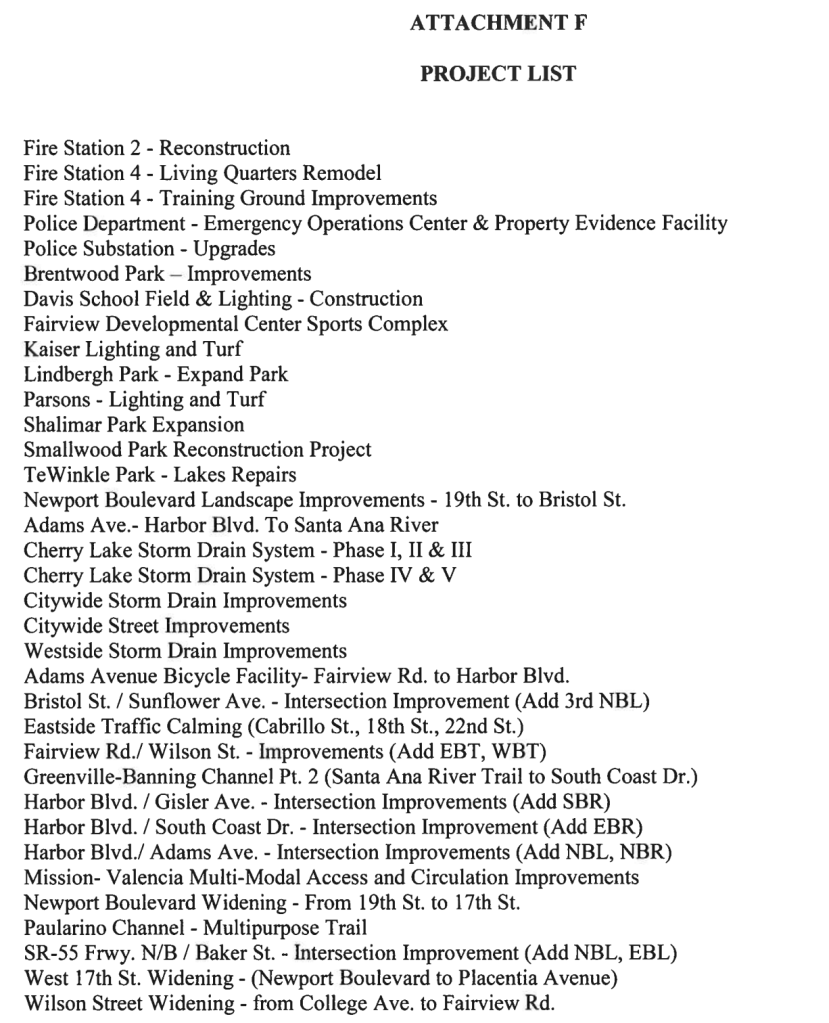
So what did we agree to pay this tax on? If you take a look at Attachment F of the finalized agreement, you’ll see that list is pretty long — in fact, it covers about $200 million of CIP projects, of which Public Works estimated that about $80 million of which would be executed over the five year period of the contract:
Well, shoot.
So how is this working out for us in practice?
Although the CWA wasn’t fully approved until February 2022, the signed agreement’s effective date was post-dated back to January 1, 2021. Since January 2021, there has been only one project awarded under the CWA — the Adams Avenue repaving project that is ongoing as I type this. The original estimated cost of the Adams Avenue project was $2,278,862, which amount included budgeting for a 10% contingency (jump to PDF page 337 at the link). Fast forward to today and the Adams Avenue project’s lowest bidder came in at $2,327,723.20, which, as far as I can tell, did not include the an additional 10% contingency of $232,772, bringing the total cost to $2,560,495.20. That’s about 12.4% over the estimated budget back in 2021 — right in line with what the National University study predicted. The City quietly covered the additional cost through our gas tax money and passed it without comment through the Consent Calendar.
Now, of course there has been significant inflation since 2021, so maybe that’s what’s really driving the higher number. And despite concerns that CWA projects might have fewer bidders, the Adams Avenue project had five. So perhaps we can take comfort that the bidding for a major road project was fairly competitive despite the CWA governing the project. But what I haven’t seen, and perhaps it is too soon to know, is whether the winning bidder — All American Asphalt — actually met the 35% local hire and 10% disadvantaged community hire targets. Did they? Who knows. Perhaps one of the City Council members who were oh so very eager to adopt the CWA back in February 2022 will remember to ask.
But, hold the phone: are we changing the CWA?
That brings us to the most recent City Council agenda, which spelled much more troubling news for our CWA projects. Once again, gently nestled into the Consent Calendar amongst many other routine items such that it would avoid notice, was the news that the City’s attempt to bid out the lakes repair project at the city’s largest active use park — Tewinkle Park — had effectively failed, receiving only one bid. That bid, at $3,981,657, was almost double the City’s budget for the project of $2,000,000. So, what happened? From the Agenda Report:
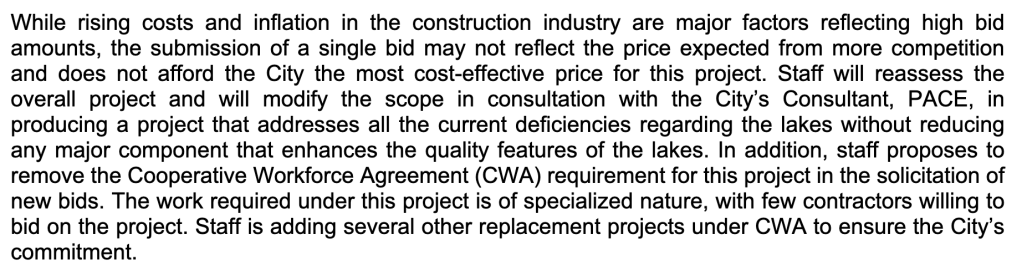
“The work required under this project is of a specialized nature, with few contractors willing to bid on the project.” Well, gee, that certainly sounds like limiting your pool of potential bidders via the CWA allowed the lone bidder to command a spectacular price. No amount of “reassessing the overall project and modifying the scope” is going to fix that fundamental problem, so the City here is quietly admitting that the only way to get competitive bids is to remove the project from the CWA all together. Now, reading the CWA, I am skeptical that the City is actually allowed to do that: after all, if it could simply add or remove projects at will, the CWA would be effectively worthless. So the only way the unions would agree to that would be if the city offered even better (read: more expensive) projects in return.
SO WHAT THE HECK: why is the staff getting to decide what these replacement projects are?? Shouldn’t the City Council be made aware of, and vote on, new multimillion dollar CIP projects that will be subject to the onerous terms of the CWA in place of the Tewinkle Lakes project?
I think they should. And if they don’t, get ready for even more playing fast and loose with the CWA as construction material and labor inflation come back to bite the city in the you-know-where with respect to these projects.
Bottom Line: The CWA is bad policy and we should let it go away when it expires in 2026, and beware more labor concessions.
The CWA is imposing a substantial hidden tax on every subject CIP project. That tax is far, far greater than the 0.8%-2.5% “administrative” cost that staff estimated at the time of adoption, and the City Council made a huge mistake not recognizing this. This hidden tax doesn’t just blow up the costs of our CIP projects, it does so in a way that adds delay (by having to rebid projects that don’t get competitive bids) or may make the projects as approved effectively infeasible. And so far we haven’t even gotten any reporting on whether the unions have delivered on the promises they made that made the agreement so “attractive” in the first place.
And frankly, it is more than debatable about whether those benefits actually are attractive. Yes, it sounds nice to preference local workers and give them better wages and benefits. But I’d remind everyone reading that nonunion workers are locals, too, and they’ve been bared from competing for these local projects — not exactly supportive of their wage and benefit outlook. Who is looking out for the Costa Mesa high school graduates that decide they don’t want to join a union, or don’t want to be subject to their onerous dues structures or political lobbying? Well, nobody in City Hall, that’s for sure.
And what about all those arguments about a “living wage”? Back at the time of the CWA’s adoption, supportive Council Members connected higher guaranteed wages under the CWA to the outrageous housing costs imposed by living in Costa Mesa. Well, frankly, that idea smacks of “everything bagel liberalism“. Not only will our CIP projects deliver critical, high quality city infrastructure, they’ll also solve our housing affordability problems by making sure workers have enough money to live here! And if you are to believe the hype of the program, we’re solving homelessness with a homeless hiring quota, veteran welfare with a veteran hiring quota, and even the reintergration issues of ex-cons with an ex-con quota.
If that’s even remotely the case, City Hall better bring receipts, because I don’t see any evidence of that. All I see, at the moment, is a straight transfer of taxpayer money into the hands of a privileged class of workers, not only at the expense of taxpayers who get less value for their dollars but also at the expense of non-union locals who get shut out. There’s a reason why project labor agreements have been banned on taxpayer funded projects in at least 23 states. But until this thing expires, we’ll just have to eat the cost.
One last thing: If all this talk about the hidden costs concerns you, keep an eye out for more ways labor may try to impose these costs in other areas. Will we see a proposal for a prevailing wage requirement in the Measure K rezone sites? We’ve already imposed an inclusionary housing requirement, another “everything bagel” policy, so I wouldn’t be at all surprised. And Council Member — and union member — Loren Gameros already proposed last meeting re-targeting the first-time homebuyer program for public safety personnel in the name of “retention”, which neatly avoids mentioning the fact that our police and fire folks are all unionized, so keep an eye out for that, too.
Remember the problem with all of these policies: If the projects get so expensive that none of them actually get executed, everybody loses. The taxpayers don’t get their projects, the workers don’t get paid, and the companies we need to grow our “ecosystem” eventually will leave. We’re already down this hole. We need to stop digging.


Leave a comment