
Or it might be. Hear me out.
First, some context.
Costa Mesa’s largest contiguous residential area is known locally as the “Eastside”, and it occupies a long rectangle bounded by Newport Boulevard to the West, the Newport Heights neighborhood of Newport Beach to the South, Irvine Avenue to the East and CA State Route 73 to the North. While Eastside has a reputation as being a bit “Newporty” given its seemingly high concentration of expensive single-family homes, that impression is deceiving. In fact, a good chunk of the parcels in the Eastside are zoned either medium or high density residential, and there are a lot of apartment complexes scattered throughout the neighborhood. There is also some light commercial located on Newport Boulevard and one of Costa Mesa’s best commercial streets, E. 17th Street, cuts through the neighborhood’s Southern end.
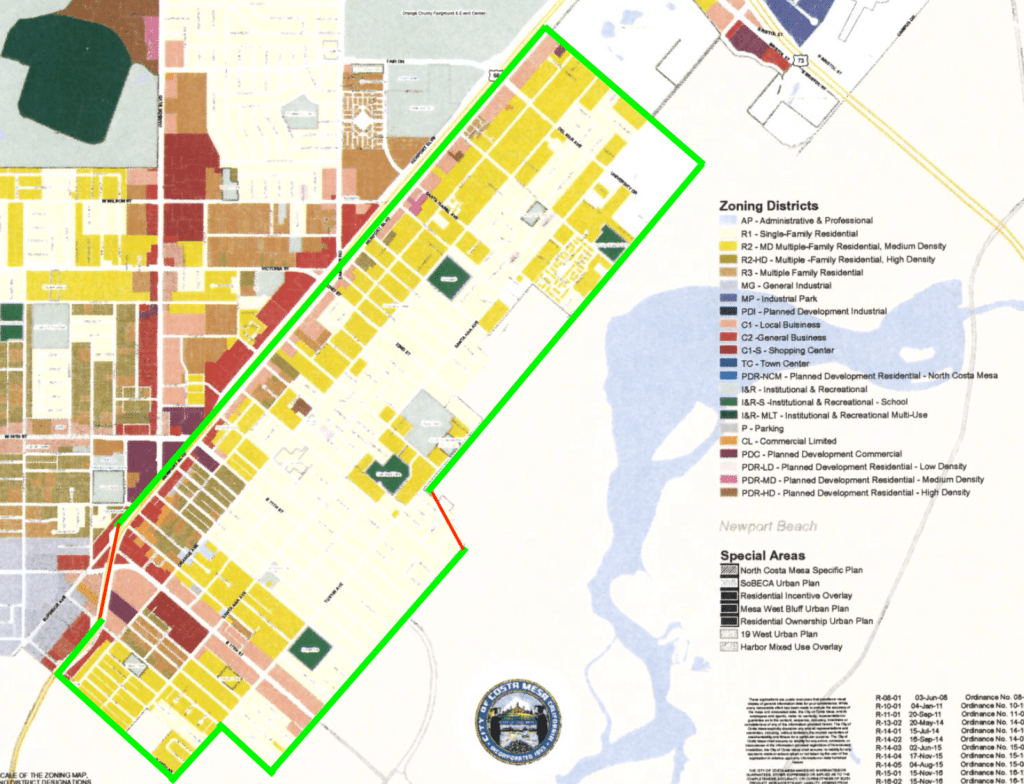
Santa Ana Avenue runs right down the center of the Eastside, North to South. It is a two lane, bi-directional road with a striped center line and bicycle lanes on either side running almost the full length of the neighborhood (more on those in a minute). In many ways it is a painfully typical Californian residential arterial street. So why is it so special?
It’s because, through both planning and evolution, it is likely Costa Mesa’s busiest street in terms of bicycling. It attracts athletic cyclists on their way to the Back Bay or the Pacific Coast Highway for a long ride. It is a favorite route of surfers and daytrippers looking to skip Newport Beach’s sky-high parking fees when they get to the beach. It is also a popular commuter street for elementary, middle and high school students heading to Woodland, Kaiser, Ensign or Newport Harbor, many of which are too young (or too resource-strapped) to own a car. And more recently, I’ve spotted many adults traveling southbound by bicycle, presumably on their way to the many shops and restaurants on E. 17th Street.
This high level of bicycle traffic is important because it means that, more than any other Costa Mesa street, Santa Ana Avenue has the potential to be a model for where the City needs to go in terms of transportation.
For decades, the City (perhaps without realizing it) has been grappling with a fundamental geometry problem. The City’s street grid it set in the sense we aren’t going to be able to expand most of our streets’ capacity to move automobiles any time soon. And as I’m constantly reminded, Costa Mesa is “built out” and there is zero appetite for the City to exercise its eminent domain powers to widen the roads.
So we’re stuck with the automobile capacity we have, and our crowded streets attest that this capacity is nearing its limit. And that’s a big problem. First, the number of vehicles owned by each household is continuing to increase. Where a family of four or five might have shared one car in the 1970s, that family now has enough income to support owning two, three or even four cars. And second, the number of people occupying any particular unit of housing is also going up. As a result of the run-up in housing prices, we are increasingly seeing multiple households crowding into units meant for one household. Crowded housing units also result in more cars per unit. And of course we have plenty of visitors and cut-through commuters on our streets.
So while our automobile capacity is fixed, our car population will steadily increase unless we do something about it. While limiting the population is one option, it isn’t a very palatable one: that means pushing out families with kids, limiting opportunities for young people, and keeping housing prices really high.
Or… we use the streets we have more efficiently. And that is why I’ve become something of an active transportation and transit evangelist: not because I particularly like walking, bicycling or taking the bus (although they have their charms), but because I don’t see we have a lot of other choices. If we don’t use more efficient use of our streets — and these alternative modes are way more efficient, in terms of both road space and land eaten up by parking — our transportation system is likely to get choked by private automobile congestion. And the only way to move to a more efficient transportation system is to make alternatives to driving more attractive. While massive snap investment in buses would do the trick, I have to admit the political will isn’t there at the moment.
So what can we do today to start inching towards less car dependency? I’ve thought about this long and hard, and I think fostering the nascent popularity of bicycles, particularly e-bikes, is our best answer. Most trips by car feature a vehicle with a single occupant traveling less than 3 miles, so switching to a bike wouldn’t be overwhelmingly difficult. Bike infrastructure is relatively cheap compared to transit. We have relatively flat geography — they don’t call us a mesa for nothing — with year-round wonderful weather. And with a built environment featuring neighborhood schools and bike-friendly amenities such as the nearby beaches and nature trails, people are motivated to get out and ride.
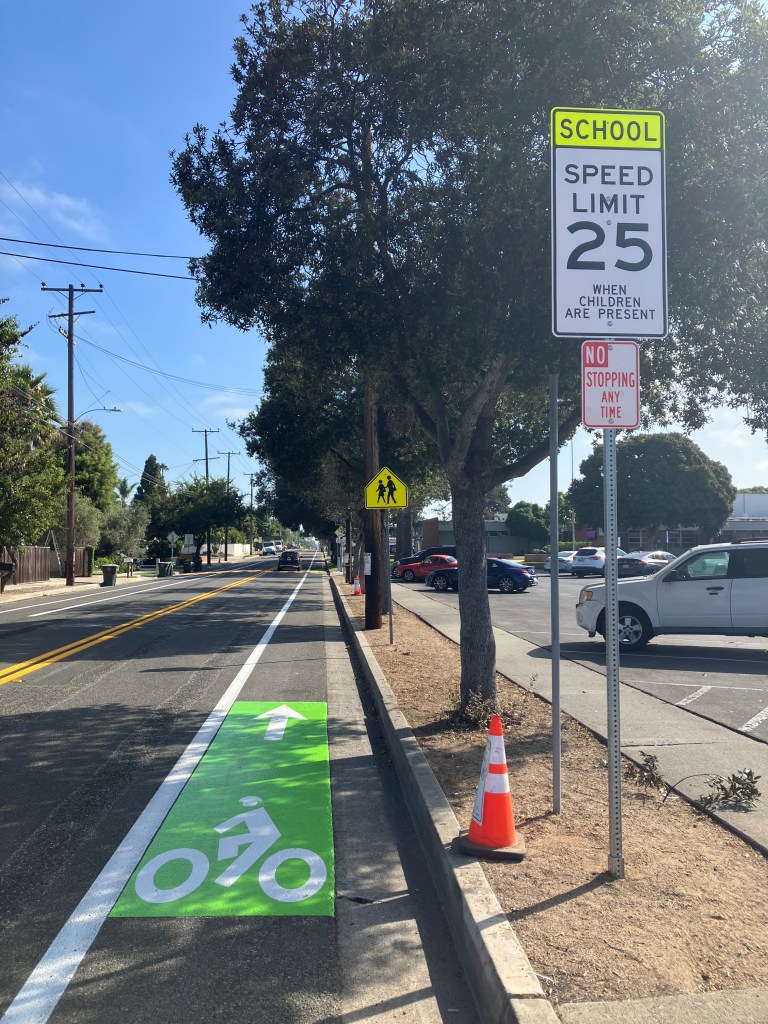
So that brings us back to Santa Ana Avenue. While the City has been doing its part by building some active transportation infrastructure — for example, after a long lobbying campaign by residents, Public Works finally completed the bicycle lane in front of Kaiser Elementary just a few weeks ago — the massive uptake of bicycles, particularly e-bikes, has been mostly organic. The streets that connect to Santa Ana Avenue are generally low traffic and comfortable for even novice bicyclists to use. And, perhaps more importantly, Santa Ana Avenue connects bicyclists to where they want to go. It is the primary route for most of the neighborhood to reach the shops on E. 17th Street, for example, and it is a primary route to the beach.
This means that, while we already see a lot of bicycling on Santa Ana Avenue, we have the potential to see even more. We have already seen a significant uptick in bicycling on this stretch thanks to the popularity of e-bikes. This is where changes to the road geometry are the most effective: when they follow the lead of the residents. The residents of the Eastside are excited about bicycling. Excited enough to drop thousands of dollars on new e-bikes. Excited enough to put their young children on the back of an e-bike for an afternoon trip. Excited enough to let their young children bicycle alongside them for a joy ride. In a day and age of car supremacy, that’s a really big deal.
So what would happen if we saw bicycle traffic on Santa Ana Avenue really pick up? Well first off, that would be a huge boon to the livability of the Eastside. Streets crowded with bicycles are safe streets, as motorists drive more slowly on them or avoid them all together. Fewer speeding cars means fewer traffic accidents, less pollution and a quieter neighborhood. And more people on bicycles means more friendly waves and more eyes on the street. Best of all, bicycling tends to be a self-fulfilling prophecy. Where there is latent demand, seeing bicyclists on the street will encourage other curious folks to try it, too. Soon you have people of all ages and abilities giving it a try. At that point the “safety in numbers” effect kicks in, which will allow even fearful people to ride. And so on.
But even more importantly, a Santa Ana Avenue bustling with bicycles would serve as a useful blueprint for other neighborhoods to copy. We could study it and learn so much about what makes bicycling popular in Costa Mesa, rather than having to rely on distant examples with distinct contexts.
So how does Santa Ana Avenue take the next step? Completing the Santa Ana Avenue bicycle lane through E. 17th Street seems like a no-brainer. I understand the Public Works Department is already looking at the segment south of E. 17th Street to get buffered bicycle lanes, which would be a huge improvement. But the stretch between E. 17th Street and Broadway is very difficult, as that section abuts several apartment complexes that push a lot of their residents’ cars into on-street parking, which would likely be affected by new lanes.
But maybe the right next step isn’t more space, it’s more time. Could the City close Santa Ana Avenue to motor vehicle traffic for a few hours for one day a week in the Summer? I don’t think it’s that crazy of an idea. Houses with driveways that are accessed from Santa Ana Avenue could be permitted to use the road as needed. And all other drivers should have access to Orange Avenue or Tustin Avenue, which are also bi-directional streets that serve the entire length of the Eastside between them. And a Santa Ana Avenue that was almost car free, even for a short time, would be glorious. Kids could bicycle in the travel lanes without fear. And adults could join in, too — or walk, run, skateboard, whatever. It would be a way to give the neighborhood precious recreation space without having to invest millions in creating new parks.
But for now that’s just a dream. But if the bicycling trend on Santa Ana Avenue continues, it might yet be a reality.


 Goat Hill Rodeo
Leave a reply to Mr Eastside Cancel reply