
The campaign is on and the candidates are starting to hone in on their opening statements. In particular, the City Council challengers — who just might be advised by the same folks, since their pitches are remarkably similar — are highlighting three issues: crime, cannabis, and homelessness. I think it’s worth looking at each critique in turn.
Yes, this means I have to talk about cannabis at some point. Fiiiiiiiiiiiine.
But let’s start with crime.
Peters, Buley and Pettis: Crime is up!
According to the challengers, crime is bad and it has been getting markedly worse in recent years. “In 21 years, petty crime and homelessness went from virtually nonexistent to prevalent in our community,” City Council District 1 Candidate Mike Buley said in a statement to Costa Mesa Confidential. City Council District 6 Candidate Jeff Pettis similarly identifies a trend of “rising rates of property crime” and proposes increasing law enforcement funding and creating neighborhood watch programs.
Mayoral Candidate Jim Peters put it even more plainly at a recent candidate forum at the Noble Cause Foundation: “Crime is up. Murder, rape, arson are the big three… it also seems like there is a lot of home invasions. I can name at least three districts where [constituents reported] either their home being invaded or their neighbor’s. I don’t know if it is local gangs or the Chilean gangs… it’s not as safe a city as we used to have” (emphasis mine).
Sounds bad.
But *is* crime up?
Let’s start with the statistics.
If you recall back from the beginning of the year, I put together a few little charts showing crime trends in the city based on its Uniform Crime Reporting (UCR) reports, now known as the National Incident-Based Reporting System (NIBRS). At the time I only had access to the data through 2022; however, the data for 2023 has now been published.
Let’s start with the major crimes (including what Peters called “the big three”: murder, rape and arson):
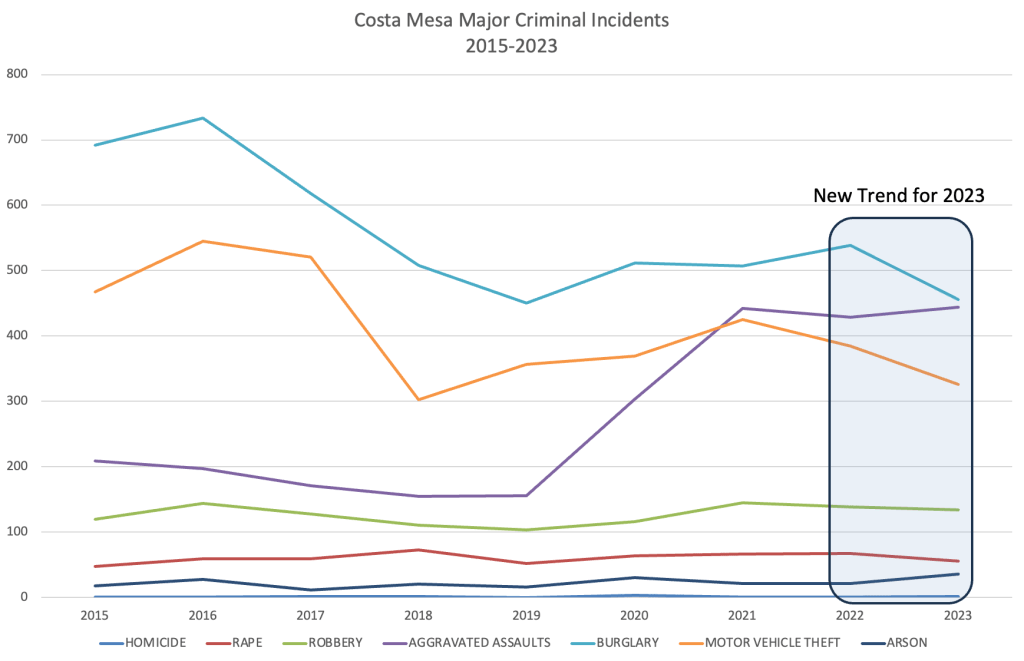
Can we say from this chart that major crimes are up, particularly since the Democrats took control of the City Council in 2018? With the exception of aggravated assaults (more on that below), these crimes look mostly flat once you account for a COVID-19 pandemic bounce that hit pretty much every jurisdiction. If anything, two categories that rose during the pandemic, burglary and motor vehicle theft, both appear to be down from 2022 to 2023.
The burglary trend in particular seems to run contra to Peters’s perception. Yes, there was a concerning almost 20% increase in burglaries reported from 2019 to 2022, but 2023 saw over a 15% drop in burglaries in just one year. Our burglary rate per capita is also way down from a recent high in 2016. And the robbery trend — or lack thereof — contradicts the narrative that Proposition 47 (passed in 2014), which reduced the penalty for theft of up to $950 worth of merchandise from a felony to a misdemeanor, has been causing a year-over-year rise in smash-and-grabs. Robberies have stayed pretty consistently in the 105-140 per year range since 2015, with minimal year-to-year variation.
So we seem to be getting a handle on burglaries and motor vehicle thefts (down over 23% from a recent peak in 2021). But, like many cities in California, Costa Mesa seems to still be struggling with aggravated assaults, represented by the purple line in the chart above. What’s troubling about this is that aggravated assault can be a catch-all for many types of social dysfunction, as the category captures all assaults with the purpose of inflicting severe bodily injury. So these aggravated assault statistics could be describing anything from domestic violence to escalating bar fights to gang-related attempted murders to… using a stolen forklift to intentionally ram bystanders (c’mon, man). That level of precipitating-event diversity makes identifying root causes, or even proximate causes, very difficult.
But no matter what it’s capturing, personal violence does seem to be up.
But what about property and petty crimes? Let’s break out the “quality of life” chart, also updated for 2023:
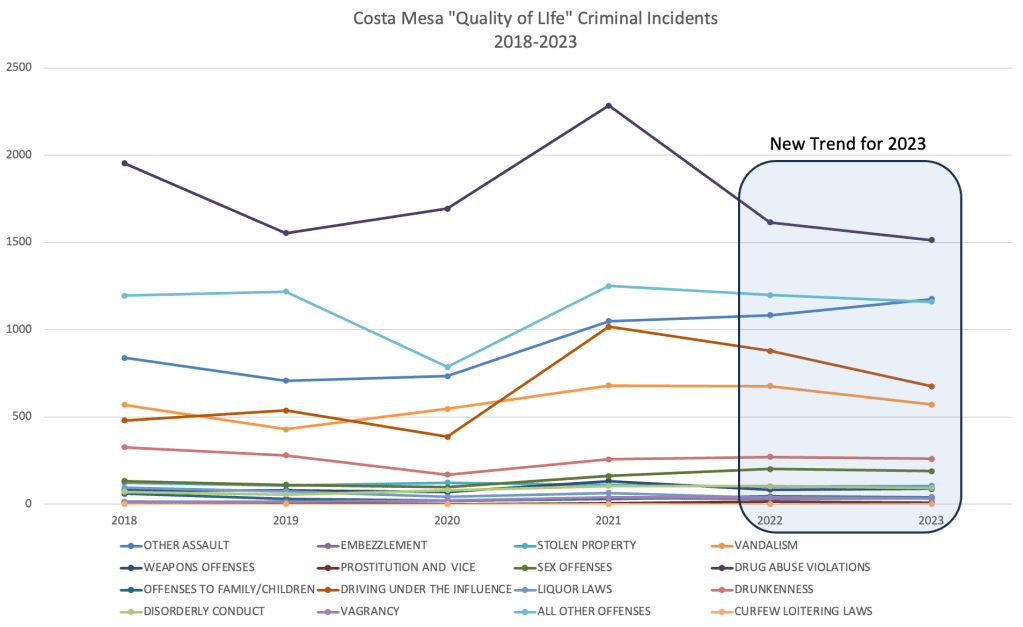
I’m not seeing a lot of drama in here. If anything most of these crimes seem to be bending downward from local highs in 2021, again where all crimes seemed to tick up during the upheaval of the pandemic and the subsequent lock-downs and school closures. Even DUIs, which spiked alarmingly from 2020 to 2021, have been trending downward, though they remain elevated compared to 2018.
What about property crime? The quintessential property crime is “stolen property”, which covers everything from mailbox theft to lifting an e-bike out of someone’s garage, is bumping along the bottom of this chart, staying within the narrow band of 102-123 such incidents per year over the period (there were 106 in 2023). That’s not exactly a statistical crime wave.
However, once again the notable exception to this rosy news for the city is that “other assaults” (the dark blue line in the chart above) is steadily rising. This tracks along with the concerning aggravated assault trend above.
Now, figuring out why assaults and aggravated assaults seem to be bucking the overall flat or downward trend for other crimes is probably asking for far too much curiosity in an election year. When I discussed this before, I mused that better data (such as granular mapping of our assault cases to figure out where, when and why these incidents were occurring) might shed light on our problem. Too bad City Staff seem somewhat allergic to data and the challengers don’t seem particularly interested in assaults.
But what if crime is up and the statistics aren’t capturing it because fewer people report crime?
That’s entirely possible, as capturing something as inchoate as “crimes that might have occurred but didn’t rise to the level of a police report” is, as you might guess, very difficult. Tools like the National Crime Victimization Survey (NCVS) try to work this problem from the other end by doing very large-N surveys (hundreds of thousands of households) to determine how often people across the nation experience crime. However, the problem with this approach is that gathering up this comprehensive data is extremely time consuming. As of this writing the most recent NCVS data available is from 2022.
It is helpful to note that NCVS data has consistently shown that property crimes are much more likely to go unreported than violent crimes against the person, such as robbery, aggravated assault and homicide. It is also why some researchers try to use proxy crimes like motor vehicle thefts, which are property crimes that are reported to the police at a very high rate, to get a sense of the actual property crime rate in the community. Recall I did the same with copper wire thefts as a potential proxy for petty crime, and the anecdotal data didn’t look so good. So might Peters, Pettis and Buley have a point? Maybe. But if they do, it’s more likely the data is hiding a real trend in property crimes than violent crimes.
So is crime an effective campaign issue in 2024?
Almost certainly, even if the available data paint a muddy picture at best. The truth is that, pretty much no matter what actual crime statistics show, there will always be about 30-40% of the population that perceives crime in their area getting worse. That group will be especially vocal during times of economic or political instability, and it’s hard to get more unstable than the 2024 elections.
But the problem is that, setting politics aside, it is very difficult to pin 5-8 year trends on any particular City Council as a practical matter. Sadly, and perhaps shockingly, the City Council doesn’t really control the City’s public safety policy. The City Council or the Mayor can only approve (or disapprove) funding, and frankly I do not recall an instance where Police Chief Ron Lawrence has come to City Council with budget asks and been refused. In fact just a month or so ago, the entire City Council backed the Chief’s request for additional police personnel, even when budget hawks, such as super-resident Ralph Taboada (and decidedly less-super yours truly), asked them to tap the brakes in the name of fiscal responsibility. It turns out no one, not even Don Harper, is a fiscal conservative when the Police Chief comes calling.
If instead the challengers want to critique how public safety has been managed rather than how well it is being funded, I wonder: Do they realize this is actually a critique of CMPD Chief Ron Lawrence or City Manager Lori Ann Farrell Harrison, rather than the incumbent electeds? How would they would manage these two department heads differently? So far they haven’t said. Hopefully potential constituents will ask.
So sure, beat the fear drum. But remember, making crime the centerpiece of your campaign for Council is a double-edged sword: yes, it may help to tie your incumbent opponent to rising crime rates, but if you win, your new constituents may hold you accountable for crime trends you can’t directly address. And then you’ll be stuck where the incumbents are today: whatever the trends are, your opponent will always say crime is up. And even if it is, short of sacking your Police Chief, there is little you’ll be able to do about it in a short run to save your seat.
But what about in the long run? Thankfully I don’t have to run for anything, so I’ll have some thoughts on that soon.


 Goat Hill Rodeo
Leave a comment