
We’ve had a couple of updates since the initial results from election night, and so far the margins for all candidates appears to be remarkably stable. So while the race in District 6 is too close to officially call, the races in Districts 1, 2 and the Mayor most likely are not. What can we take away from the results so far?
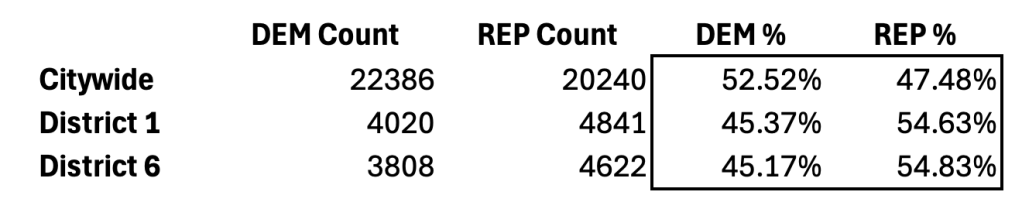
First, recall this table I posted back in August, showing the registration breakdown by party identification for all of the districts:

For the moment, although I know this is a gross oversimplification, let’s just focus on the “Dem” and “Rep” columns and assume that all the other voters would sort proportionally into each column if they had to choose (meaning we can disregard them for now). What would we expect the percentages to look like?
And here are the results as of this morning:
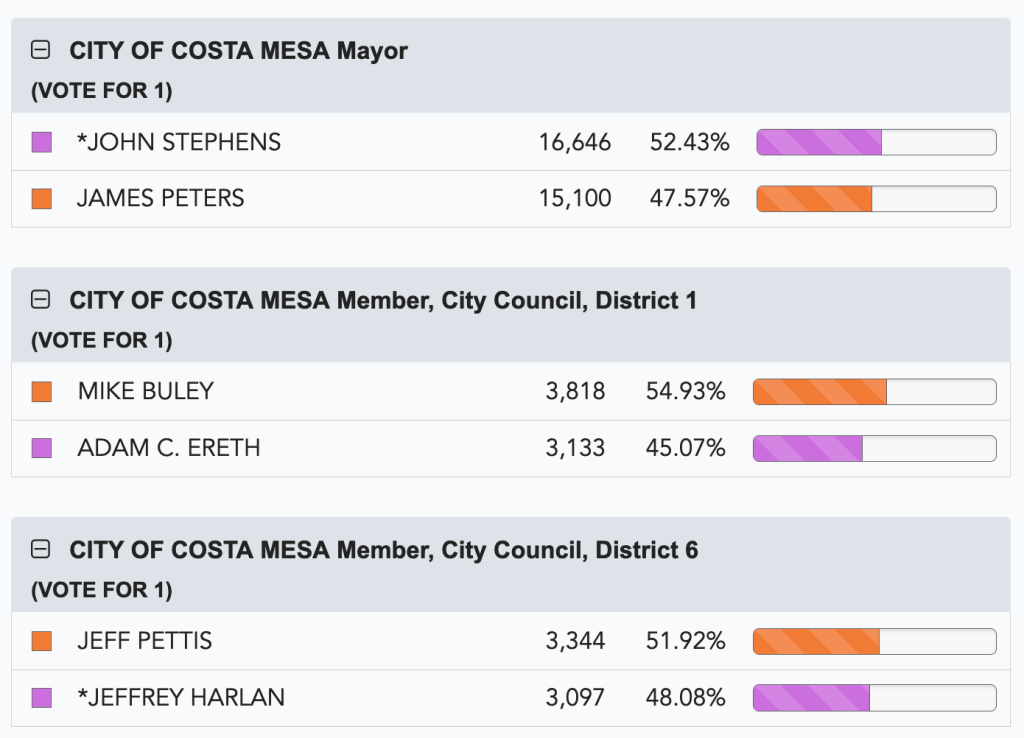
In other words: in the Mayor’s race and in District 1, the results are mirroring party identification almost perfectly. However, in District 6, Jeff Harlan clearly received some crossover votes and outperformed the other Democratic candidates, but it may not have been enough to overcome the Republican registration advantage.
Now, of course, it’s a mistake to assume away the voters that aren’t registered with either major party, as “No Party Preference (NPP)” folks make up about 22% of the electorate. But without really granular data it’s difficult to tease out how this group voted, whereas Democrats and Republicans tend to show down-ballot loyalty to the tune of 90%+. So maybe the NPPs in the Eastside are remarkably bluer than they are in District 1 or citywide (though personally I doubt this as an Eastside resident).
Mayor’s race: Stephens likely survives despite a red wave punishing all Democratic incumbents
Given that Stephens trounced Republican John Moorlach in the 2022 elections by almost 10 points and that Moorlach (a former State Senator) had far more name recognition and stature than 2024 challenger James Peters, I could understand if Stephens feels disappointed it was much closer this time around. However, I’m not sure I agree he should. Take a look at this data, helpfully provided to the public by the California Republican Party:
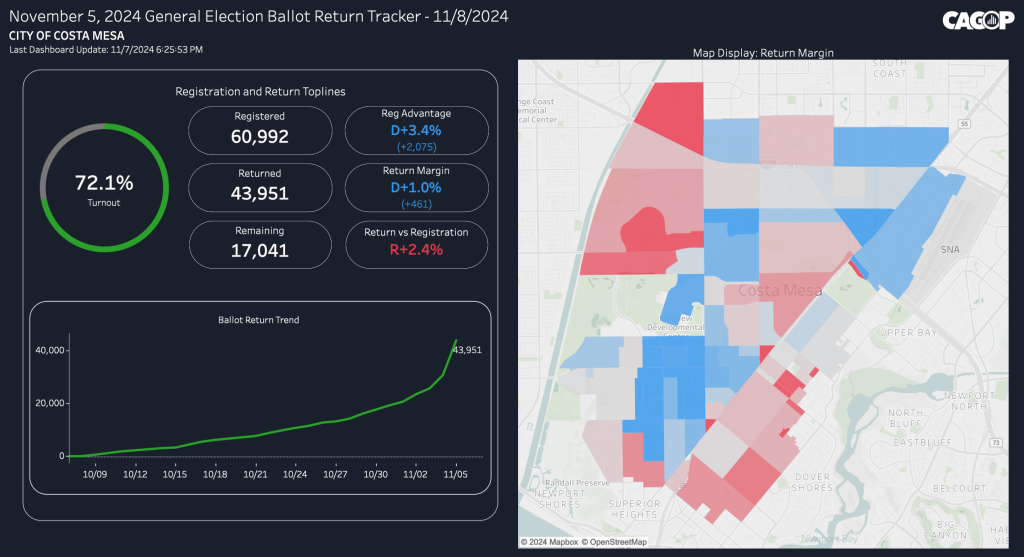
Look at that “return vs registration” number, which represents the proportion of ballots returned by partisan voters compared to the proportion of registrations. Clearly this was a redder electorate than what voter registration would imply. So Stephens should be happy that he was able to effectively break even when facing voters that were 2.4% more Republican than expected.
Therefore, I don’t think anyone should read into these results a mass repudiation of Stephens’s approach or policies. The fact that Stephens was able to effectively hold serve in an environment that has been remarkably difficult for Democrats generally suggests that Costa Mesans are standing behind their Mayor. So if I were Stephens, I would be relieved the hard work he’s put in to stay connected to the residents has paid off.
District 1: “Mandate” level numbers are likely deceiving
Obviously anyone with eyes can see that GOP-favored Mike Buley has trounced Democrat Adam Ereth, despite Ereth’s current chairmanship of the Planning Commission and support of fellow incumbent Democrats. So Buley’s got a mandate to stand up to the Democrat-dominated Council, right?
Eh, I wouldn’t read it that way. Looking closely at the CAGOP tool linked above, it appears that Republicans turned out in larger numbers than their registration proportion would predict in all but one District 1 precinct. That fact, paired with the fact that the Buley/Ereth contest almost perfectly mirrored registrations generally in the district, and it seems clear that the national level trends were doing a lot of work here. Ereth wasn’t rejected so much as he simply wasn’t able to distinguish himself enough to resist political gravity.
District 6: Harlan’s moderation is rewarded, but perhaps not enough
Harlan seems to have done better than his Democratic compatriots: not only did he manage to perform at least as well as party registration would predict, he seems to have done significantly better.
That said, as of this writing, he still trails challenger Jeff Pettis by about 250 votes. Althogh late-counted ballots are helping Harlan chip a bit into Pettis’s lead it’s unlikely (but not impossible) to be enough. Late mail-in ballots tend to lean Democratic in normal times. These are not normal times. The mail-in ballots this time around were redder than usual, and the day-of vote was heavily tilted to the GOP. That suggests late deciders (and late-motivated voters) were going for Trump, which isn’t a good sign for down-ballot Democrats.
What about ballot curing? If you recall, ballot curing helped rescue Measure K from a 600+ vote deficit in 2022. Could the same happen in Harlan’s race? It’s possible, but I think it is different this time around. Ballot curing costs money, which usually comes from candidates in larger races chasing their own votes. While Dave Min and Scott Baugh are locked in a razor thin race and therefore have every incentive to engage in ballot curing, I wonder how likely it is that Dave Min’s folks will look for votes in the relatively red Eastside. Baugh, rather than Min, seems more likely to look for votes there, which is likely to find Pettis votes as well.
But perhaps we’re getting ahead of ourselves. More than 2,000 votes in the Eastside remain to be counted, and as I said above it is really hard to guess which way the significant numbers of NPPs might have voted. So maybe Harlan will pull it out.
One more thing: democracy dies in darkness
Political wonks will recall that phrase (hopefully with a snicker) as being the one adopted by the Washington Post shortly after it was taken over by Amazon head Jeff Bezos. As as trite of a statement as it is, unfortunately, there is some truth in it.
There was almost zero local coverage of the Costa Mesa races. There were no debates, no candidate forums, not even a questionnaire for the candidates to fill out from the Daily Pilot. The Orange County Register did a series of pro forma profiles on each candidate, but the space allotted to them was so spare that they didn’t really give voters any meaningful information.
The candidates also seemed allergic to aggressively prosecuting any issues themselves. The Democrats, Harlan’s op-ed in the Voice of OC notwithstanding, generally hung back and let union-backed PACs to send around mailers saying everything was hunky dory in Costa Mesa Town. The Republicans didn’t do much better and relied on outside political money from the GOP and the GOP-adjacent Lincoln Club attack the incumbents on crime and homelessness. They’ve put forward few, if any, answers of their own.
Instead, all the candidates seemed content to wage yard sign wars and focus on their bases. Even social media was limited to one-way communications from the candidates, and few of them ventured into general forums to discuss any issues with the public (Jeff Pettis was the notable exception to this, to his credit).
So it is little surprise that, with no attempts at persuasion and no way for voters to draw meaningful distinctions between the candidates, the vote basically fell along partisan lines. And this is really, really bad for Costa Mesa politics generally. It suggests that the vast majority of people are not paying attention to local issues and therefore are not going to reward — or punish — them for what they do or who they are. And that environment tends to breed three kinds of candidates: the lazy, who rightly gamble that reaching out to voters, reading every item, and generally serving the public is a waste of time, the radical, who know they won’t be disciplined by the media or the ballot box, and worst of all, the corrupt, who see lack of oversight as an invitation to self-enrichment.
So if I’m sad today, I’m the most sad about that. The collapse of local media seems unfixable. We will likely need a complete sea change in how local news is collected and distributed in order to address the information vacuum. Until then, it will be on us, the residents, to keep them honest.


 Goat Hill Rodeo
Leave a reply to Goat Wrangler Cancel reply