
Waiting for City Hall to pull together its final proposal for closing the budget shortfall is such a bummer. It’s sad to look at all the initiatives the city is trying to undertake and wondering: will they survive this next round of cuts? Will they make it into next year’s leaner budget? Or will they be put on hold permanently?
The stark reality of the situation was brought home during the last Parks and Community Services (PACS) Commmission meeting, where City Staff dropped what, to me, is a bombshell: the FY 2025-2026 parks improvement budget is projected to be only $650,000. That means that, effectively, the entire park improvement agenda is going to be put on hold next year, other than finishing up on-going projects.
So while I cry into my teacup (I’ve also regrettably given up coffee for Lent), I thought it might be time to dust off some very goofy, but very fun and thrifty, projects that the city might still be able to pull off during fiscally tough times. Here are the three out-of-the-box solutions to cheer everyone up as we gear up to cut stuff.
Expensive problem: The Tewinkle Lakes repair project is severely over-budget and the goose poop is piling up. Cheap, fun solution: Send in the PAW Patrol!
I have a longer piece on this story that I’m working on, but astute readers of this blog know that the long-awaited project to repair significant leaks in the liners of the lakes inside Tewinkle Park has had a rough go of it. First, the project’s bid failed because it attracted only one bidder, who offered a contract price that was almost double the city’s estimate. Then, it failed again after the City failed to remove the project from the purview of the Community Workforce Agreement, resulting in the same lone bidder simply knocking a few hundred thousand dollars off the still-wildly-over-budget quote. Needless to say, it’s going to be a while before our leaky lakes are addressed.
In addition to fixing the leaks, another goal of the project was to use design elements to contain the waterfowl that frequent the park to certain areas and to reduce the amount of bird poop — particularly goose poop — that litters the grass of Tewinkle Park. As a mother of two small children I can attest that goose poop is a huge and disgusting problem there, one that has actually caused me to hesitate to go to Tewinkle simply because I didn’t want to have to deal with poopy shoes and clothes. Worse, I’ve since discovered that not only do the geese poop all over the park, they poop all over the nearby school fields, too. The fields at Tewinkle Middle School, Costa Mesa High School, and Jack Hammett Sports Complex have goose poop problems, too. And even if the Tewinkle Lakes project was on schedule, it wouldn’t solve the problems on far flung fields.
Obviously nobody wants to engage in “strategic population reduction” of our lovely geese and ducks. So I’ve got a better plan: commission some responsible local dog owners to patrol the parks with their well-trained off-leash dogs.
Ok, before you pelt me with eggs (those are expensive!), hear me out.
First, this is actually a well-tested solution. Geese obviously don’t like dogs. They especially don’t like to be in places where dogs are likely to be. Other cities have leveraged this instinctual behavior by intentionally placing off-leash dogs in areas where goose or other bird droppings are a problem. For example, the City of East Chicago, Indiana uses the professional service Wild Goose Chase to patrol a stretch of lake beach previously overrun by seagulls, resulting in significantly better water quality. And the Capital Goose Patrol, made up of professionally trained border collies, actively patrols the National Mall in Washington, DC to ensure its iconic grass remains poop-free.
But those are professional services, and we’re trying to save money. So here’s the shoestring version: why not let local residents prove that their dogs are especially well-trained off-leash, and give them the privilege of running their dogs off-leash in goose-prone areas? To avoid scaring people, these residents and their pets could be strictly vetted, given vests to wear while on-duty, and the dogs could be size-limited to avoid intimidating park-goers.
A citizens’ dog brigade isn’t unprecedented, either. Sandpoint, Idaho, recently turned to pet dogs and their specially-licensed owners to patrol City Beach, a key city gathering spot that had been overwhelmed by canada geese. Sandpoint had tried everything to that point to bring its goose population under control, going so far as to round a bunch of them up and euthanize them, all to no avail. But residents recalled that, before there was a goose problem, dogs were allowed off-leash on the beach. Could the banning of dogs several years ago have led to the goose population exploding? The city was willing to test it by allowing vetted, vested residents bring their well-trained dogs to the beach at random times to keep the geese on their toes. And it seems to be working: according to the Sandpoint Goose Patrol Facebook page, goose poop sightings are down, and geese are less prevalent on the beach since the program started last August.
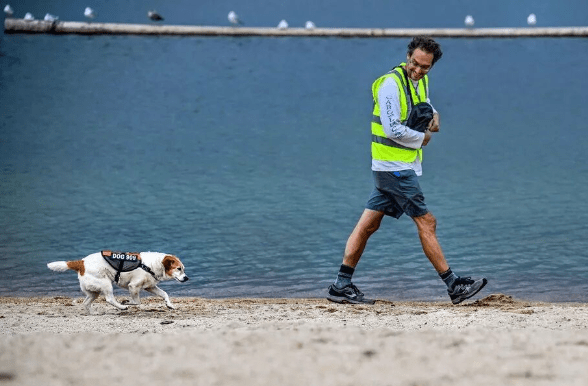
Could a PAW Patrol work in Costa Mesa? If done carefully, yes: I think it could. We have hundreds, probably thousands, of dog owners that would jump at the chance to be allowed to run their dogs off-leash at Tewinkle Park. And of that group, there has to be a handful of dogs that are gentle enough, small enough, and brave enough to chase geese while also exhibiting sufficient human awareness and self-control to stay away from other parkgoers. And the best part: relying on citizen-contractors means the city could ring-fence liability, and it would get these services basically for free.
Expensive problem: Arts initiatives might get cut. Cheap, fun solution: Get private businesses to buy some goats!
As many of you know, Costa Mesa styles itself as the “City of the Arts”. And outwardly it seems committed to this vision: for example, it boasts a stand-alone Arts Commission, whose sole focus is to review and innovate in the realm of public art.
It turns out, however, that art doesn’t just spring out of the ground; you have to pay for it, and in that area, the city’s been pretty lacking. Yes, it has fully funded an “Arts and Culture Master Plan”, mostly on the back of cannabis taxes, but that “full funding” amounts to only about $400,000 for three years.
Unfortunately this tight funding hasn’t left the Arts Commission with much to do. So I have a solution that, if structured properly, wouldn’t cost a lot of city funds and would certainly keep the Arts Commission’s hands full: a fiberglass goat parade.
Have you ever heard of the Cow Parade? Well, if not, now you have. the Cow Parade is a very successful public art campaign that places almost life-size fiberglass cows, decorated by artists, all over a host city for a short period of time. And I’ve just recently learned that Kingsport, a small town in Tennessee with a loose connection to goats, put a spin on the cow parade idea by commissioning painted fiberglass goats to grace its downtown and certain civic events.
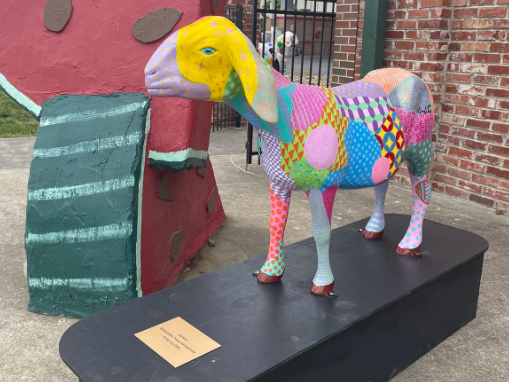
Now, look, I’m sure goats are really important to Kingsport. But Costa Mesa is Goat Hill. Goats are OUR thing! There is still a flock of goats grazing in the middle of the city at the OC Fairgrounds! We can’t let another town get away with this!
Thankfully, we don’t have to, and we can do it on the cheap. All we need to do is call up Kingsport and ask them (A) hey, where did you get the goats? And (B), how did you pay for them? Turns out, the answer to (B) might be “not much”, because Kingsport allows the goats to be privately sponsored. For just $1,500, a private individual or business can purchase the right to place a goat, complete with tasteful private branding if desired.
Think of the endless possibilities. An eclectic LAB Anti-Mall goat painted with wildflowers greets you as you exit the parking lot. A hipster goat stands watch as you sip your latte at NEAT Coffee. An adorable book-clad goat gets head-pats from little kids outside the Donald Dungan Library. A saucy rainbow goat hangs out near the entrance to Strut Bar & Club off W. 19th Street.
For a song, Costa Mesa could install more public art than ever before and make a huge place-making impact at the same time. C’mon, Travel Costa Mesa. This such low-hanging fruit. Let’s get some goats in Costa Mesa!
Expensive problem: Everyone wants traffic calming, but there’s no money. Cheap, fun solution: tactical urbanism!
This one is near and dear to my Costa Mesa Alliance for Better Streets (CMABS) heart.
It seems like there isn’t a City Council meeting that goes by when someone doesn’t come up to the microphones to complain about reckless driving, speeding, and other car-related problems. The most recent meeting, in fact, saw two speakers complain back-to-back about cut-through speeding on Towne Street, which is just off of W. 19th Street. “It’s just unsafe. People are constantly going 40-50 miles per hours down Towne Street. It’s ridiculous. It has turned into a raceway,” one commenter reported.
He then expressed support for addressing cut-through traffic by closing one end of the street and turning it into a cul-de-sac.
And honestly: that’s a fabulous idea that the city could do tomorrow. But what about the budget woes? You might ask. Where is the city going to get the money to rip up asphalt and concrete, run public meetings, get permits and install a full-blown turn-around in a built-out area?
Simple: just skip all that. Poll the neighbors about which end to close, and then just close it. Use cones, use planters, use temporary bollards like the ones placed along some of Costa Mesa’s bicycle lanes. That would be super cheap and easy. And while we use these inexpensive materials, we can start iterating on a better long-term solution. First, does the closure work? Is it workable for Towne Street residents? Are there pain points that weren’t anticipated, like fire truck access, an elderly neighbor that has trouble navigating a three-point turn at the end of the block, or a delivery route that has to egress through this stretch? If so, no problem. Move the cones until these problems are resolved.
This iterative approach is called “tactical urbanism”, and it refers to using readily available, cheap materials to temporarily re-design city streets so that cities can experiment with new approaches. CMABS has long championed tactical urbanism as a cost-effective way to address cut-through traffic, speeding and reckless driving. Tactical urbanism doesn’t have to be pretty; it just has to work, and it has to give the city time to refine the design and gather the resources for a more permanent solution. And in this environment, where residents are going to continue to expect results even when resources are tight, this seems like a logical approach.
In the case of Towne Street, it would be easy enough to drop some concrete planters at one end of the street and start collecting data. Does it reduce speeds? Does it reduce the number of vehicles on the road? Are other streets impacted by diverted traffic? This can all be done on the cheap with simple electronic traffic counters.
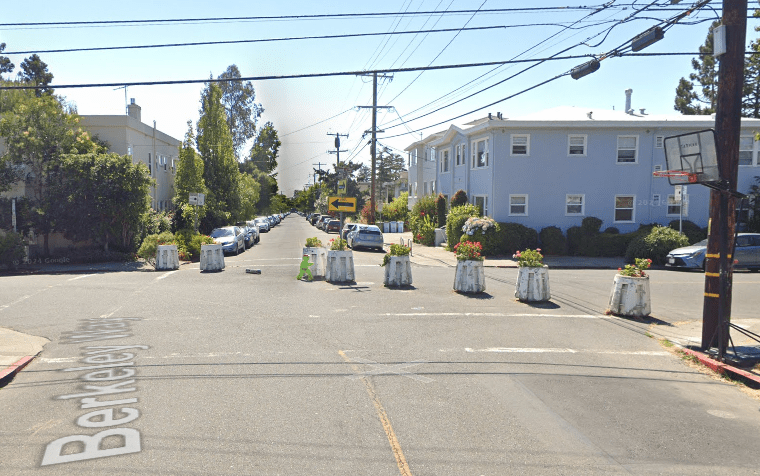
Maybe, at the end of the day, it doesn’t work as well as people want, and it gets removed. And that’s ok. What the people really want is responsive government. Costa Mesa can deliver that in a cost-effective way if it gets creative. Now, whether it can muster the will to be creative is another question.
 Goat Hill Rodeo
Leave a comment