
Hi there. I know I owe you some follow-up after dropping the “are we broke?” bomb in the last post. But instead of getting you and me over our skis, I thought I’d wait for the next City Council agenda to dig into what we learned at the last study session and how that will translate into budget talks over the next few weeks.
So while I was waiting, I figured I’d catch up on the Arts Commission meeting from last evening. I was intrigued because, although the Arts Commission usually sits out the budget process, there were not one, not two, but three budget-related items on the agenda last night. This unusual move mirrors similarly remarkable agenda items appearing on the Parks and Community Services (PACS) Commission agenda a few weeks ago. Hmmmmm.
Seems like the Arts Commission and the PACS Commission might be asserting themselves? If so, there seems to be a bit of a stumbling block in their way. So, with all due respect to the great discussions last night regarding public art, budget priorities and the lamentable situation with the Costa Mesa Playhouse being evicted by the Newport-Mesa Unified School District, here’s what I thought was the most interesting exchange from last night.
In fact, it was so interesting I’m going to take the unusual liberty of producing the transcripts verbatim. To set the stage, remember last Arts Commission meeting there was a bit a kerfuffle win the Arts Commission’s city website, where the description of its powers was changed to reference the municipal code after Vice Chair Fisher Derderian had interpreted the website to give the Arts Commission budgetary review authority? Well, as I hoped he would, the Vice Chair did go read the municipal code and, lo and behold, he found out it housed a whole host of powers for the Arts Commission:
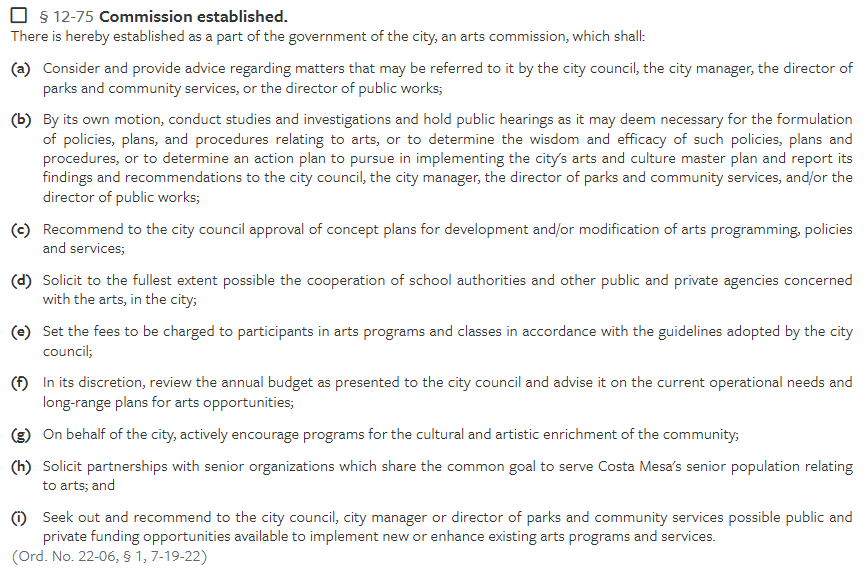
First, Vice Chair Derderian highlighted these powers in his commissioner comments. Then, during the discussion of funding for public art in the city — one that circled around, but did not directly address, the Daily Pilot article that called out the use of cannabis tax revenue to fund city arts operations, rather than actual art installations — the Vice Chair sought to use them. He proposed forming a subcommittee to perform a deeper dive into the current ways the city funds public art as well as the staff’s proposed recommendations for new funding streams. And that’s where things started going sideways:
Ashley Thomas, Senior Recreation Supervisor: Vice Chair, if I can interject real quickly. So any subcommittees do require city manager approval. So we could bring that suggestion forth and then get some feedback back from our city manager. But thank you for the suggestion. We’ll get back to the group.
Brian Gruner, Director of Parks and Community Services: I think uh something else to consider you know with that recommendation would be to um you know look at incorporating that into the next master plan. Um and that would be a little bit more of a formal process and that will definitely be you know um sent up to the city council level for you know review and approval. Um, so I think that would be something a little bit more appropriate for you know bringing that into that picture.
Hmm. First of all, to Ms. Thomas’s point: Where in the code does it say that the city manager could veto the formation of a subcommittee voted on by a validly constituted City Council commission? I know this sounds like boring lawyer stuff but it’s important. Subcommittees are really the only way your commissions can “do work” outside the walls of City Hall, because the Brown Act will prevent them from collaborating outside a public meeting otherwise. So to say that City Hall is a check on subcommittee formation is essentially to say that City Hall also edits what the commissions work on generally. That doesn’t sound exactly right to me.
Furthermore, Director Gruner pushing Vice Chair Derderian’s suggestion off to the master plan discussion doesn’t seem “a little more appropriate” at all. It seems inappropriate for staff to tell a commissioner the “appropriate” time for a deeper investigation of an agendized item for discussion would be be, especially when that suggested time is more than a year off. It might be more efficient, and perhaps more logical, but appropriate? I don’t think so. The staff’s clear resistance here is notable.
Stay with me through the minutia. After this exchange and a few more comments from other commissioners, Vice Chair Derderian got straight to the point (watch it yourself via the link, or read the transcript below):
Vice Chair Derderian: Would it be possible for us to make a motion to form a subcommittee that then is submitted to the city manager for them to review and to get back to us formally as to what that would look like and how we would proceed or a study session?
Monique Villasenor, Recreation Manager: That would be putting like the cart before the horse type of feel, I think.
Gruner: So, right. Yeah. We would have to, you know, connect with the city manager first and have that, you know, discussion and dialogue and see what the directive would be from her.
Derderian: Yeah. So, help me understand then. So, with the municipal code, it says by its own motion, conduct studies and investigations and hold public hearings. What exactly does that mean, “by its own motion” in allowing us to be able to host these things outside of these specific meetings?
Gruner: Yeah, that’s a good question. And one of the things that we’ve been working with the city clerk on is is, you know, developing a a a more detailed training protocol um for the commission to kind of clarify what that exactly means. It’s kind of up to interpretation. Um but I think having that clarification from the clerk is going to provide a lot more uh clarity and a better direction on on on how the commissions operate and and what they can and can’t do.
Derderian: So there’s no movement that we can make now, no motion or anything of the sort that would allow us to at least submit that to the city staff?
Gruner: Not at this time. No, not at this time.
Derderian: Okay. Thank you.
Commissioner Charlene Ashendorf: But you, can we direct staff to move forward, move forward into it?
Gruner: Yes. And that’s what we will do.
Ashendorf: Just so that’s in the record. Since we’re not making a motion.
Yeesh. Where to start.
First, what is staff doing stepping in front of a City Council commission and telling them they “can’t” make a motion to propose forming a subcommittee to the city manager? The Brown Act requires that motions relate to the subject matter of the agendized item — and there ain’t no way you’re convincing this lawyer that forming a subcommittee to study that very item, is outside such item’s scope. And as I noted above, I really don’t see the argument that the city manager has authority over the commissions to form subcommittees. If I squint, maybe, MAYBE the city attorney could step in and make a legal objection to some procedural defect — say, for example, the subcommittee too many members or its mandate was too vague — but the city manager?
Just as the city manager has some touchiness about the City Council butting into her domain, particularly when it comes to staffing, I hope the City Council gets a bit irked when the staff starts encroaching on its territory. Public bodies investigating subject matter pertinent to their charters is the essence of democracy. I hate getting all dramatic but, sometimes, you gotta drag these discussions back to basics. By clipping the wings of the commissions, City Hall is clipping the wings of the City Council itself.
Second, I am even more offended by the suggestion that the Arts Commission — and by implication, the PACS Commission, who have brought up similar points — need education by the clerk because they can’t read the plain language of the statute. Education, by the way, Director Gruner implied would be behind closed doors during commissioner “training”.
If the municipal code that empowers two of the city’s most important public bodies is “up for interpretation”, there is no training by the city clerk that will cure that ambiguity. It must be cured the old fashioned way: by reading the code in a public hearing, taking comments and questions from the residents and their representatives, and by having our elected officials vote on any clarifications.
Or the City Council can just clear this up now, and direct the staff to bring forth the “clarifications” it proposes to the plain language of the municipal code. I for one would like to see the staff justify apparent its position that the duly appointed commissions of the City Council are not independent public bodies that represent the public will, but mere sounding boards for whatever the staff thinks the city should be doing.

 Goat Hill Rodeo
Leave a comment