
When it rains, it pours.
First we had a budget that looked a lot weaker than prior years. Next, we got the news that beloved Police Chief Ron Lawrence was retiring next month. And then, of course, in the midst of this uncertainty, the City Council decided to fire former city manager Lori Ann Farrell Harrison.
Everyone is a bit preoccupied. So naturally, this is the perfect time to get huge updates regarding the redevelopment of Fairview Developmental Center (FDC).
Before we dive into that, it’s worth noting that Staff is also asking the Planning Commission to consider General Plan amendments to accommodate the planned Hive Live development at the former Chargers practice facility. In normal times, I’d spend a lot of time discussing this very large, transformative development.
But we are not in normal times. We are redeveloping 100 acres in the geographic heart of the city.
So how is that going? Well, the short answer is: this deal just keeps getting worse all the time.
Want the longer answer? Read on.
The return of the FDC: what we knew, what we didn’t
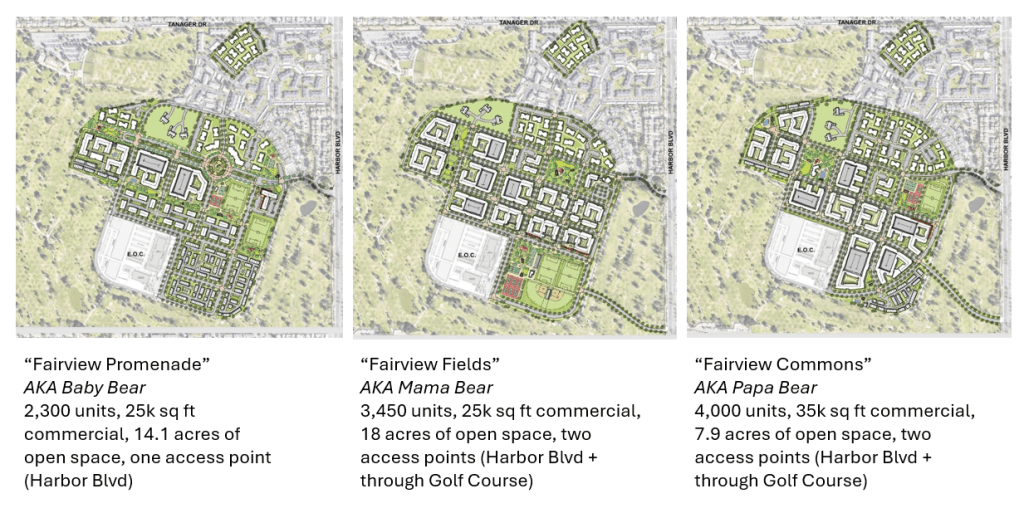
Those of you who have been following the FDC “outreach” process, such as it was, are probably aware that there were a series of public outreach meetings held late last summer. The last of these meetings presented some high-level land use ideas that basically fell into “baby bear,” “mama bear” and “papa bear” categories in terms of density and intensity of land use:
… And that was basically the last we heard of the FDC project. Other than occasional rumblings about real estate negotiations popping up from time to time in the City Council’s closed session agenda, including last week’s marathon closed session, there have been no public updates regarding this project for at least six months.
Until late last week.
New info: the State has already weighed in
The first thing that jumped out at me in the materials for the study session this evening was the disclosure of a letter dated June 28, 2024 from the California Department of Developmental Services (DDS), the state agency that presently controls the FDC site. This letter contains two important revelations.
First, long before it disclosed any potential land use plans to the public, the City of Costa Mesa had already developed three preliminary layouts and submitted them to DDS for evaluation. Remarkably, one of these plans looks very different from what was shown to the public later in the summer:

Alternatives 1 and 2 line up pretty well with the “Baby Bear” and “Mama Bear” plans shown above. But what on Earth is Alternative 3?! It sure looks like the City thought it had a realistic path to do a land swap with the Costa Mesa Golf Course, whereby it would shave off the Northwest corner of the FDC site and carve out the land along Harbor Boulevard for more housing and amenities in exchange. This idea was approvingly discussed waaaay back in March of last year at the Planning Commission level, so it looks like the Staff tried to make it work.
Alas: the second revelation of the June 2024 DDS letter was that, despite its creativity, the State doesn’t like it. In fact, it didn’t like any option that incorporated large amounts of open space that was set aside for the purpose of sport fields. “As DDS staff advised in previous discussions,” the Letter notes tartly, “the inclusion of such a sports and recreation complex is incompatible with the State’s interests as specified in Government Code 14670.13,” which provides that the FDC site will provide for affordable housing for the “greatest extent feasible.”
Unfortunately, DDS’s narrow interpretation of its mandate meant that Alternative 2 was also effectively eliminated by the State in June 2024. Which leads to the third, more unfortunate revelation from its letter.
The city knew that the “Fairview Fields” (or “Mama Bear”) option had already been rejected by the State. But, for whatever reason, it put it out to the public as a viable option anyway when it convened the “public engagement” workshops in late July and early August 2024.
Sigh. When the State is calling the shots and residents are asked to weigh in on options that are already off the table, it really, really makes the “resident input” part of this process feel like a complete sham.
New Info: none of the proposed options are financially feasible except (surprise!) the largest one
In another nod to State requirements, the city also released the results of the financial feasibility study it conducted to determine whether, after all the planning is said and done, the resulting development could actually be built for sufficient profit that a developer would want to take it on. The results are sobering:
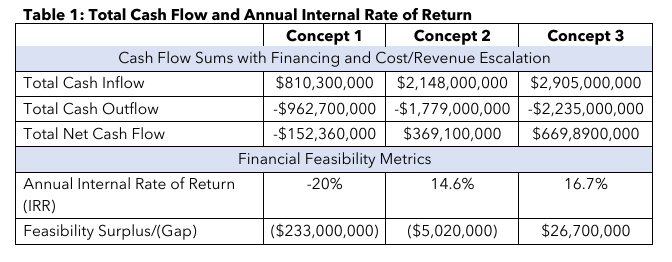
Note that we’re back to comparing the “Baby Bear” (Concept 1), “Mama Bear” (Concept 2) and “Papa Bear” (Concept 3) plans first shown above. What this table says, in plain English, is that all of these projects are going to cost an ungodly amount of money. It also says that, since most developers will not take on this kind of project without at least a 15% IRR, only one option — Concept 3 — stands a good chance of actually being built.
So the State and the math agree: to address all the existing problems on the FDC site, and to address the mechanical State mandate for “as much affordable housing as possible”, we have to pick “Fairview Commons” aka “Papa Bear” aka “Concept 3”.
What 4,000 housing units in FDC would mean for the City of Costa Mesa
It’s… well, it’s probably not great.
I hope by now I’ve burnished my YIMBY credentials enough such that the following points won’t be construed as being “anti-housing”. On the contrary, I am very much pro-housing. In fact, I’d be supportive of adding more than 4,000 housing units to the City’s stock in the next decade or so.
But would I jam all 4,000 of them in an isolated cul-du-sac surrounded by either impassable golf course or impenetrable state assets like the Emergency Operations Center, with no clear plan for public transportation, only 35,000 ft of commercial space (that’s like, one grocery store), and just a smattering of small parks as the only new public amenity space?
No. I would not. Here are three big reasons.
Bad outcome #1: Too many cars will destroy Harbor Boulevard, and maybe the city too
The first problem with the Alternative 3/Concept 3/”Fairview Commons”/Papa Bear plan is a usual suspect: way too many cars. This plan is anticipated to bring in up to 10,000 new residents into this very tight space, and with very few on-site amenities like commercial, social, religious or educational space, everyone is going to have to leave every day to get the things they need. Worse, there is no mention of adding public transportation to the plan, so they’ll have to walk, bike or drive in and out.
While the agenda report makes the claim that the incorporation of an interconnected network of pedestrian and bicycle paths will “promot[e] active transportation and reduc[e] reliance on cars,” even this active transportation advocate knows that’s codswallop. The plan provides for zero civic space other than meager park space, meaning that churches, schools, government buildings, post offices, and police/fire stations won’t be accessible by bike or by foot. And even if those amenities exist in the neighborhoods just outside of the FDC, those happen to some of the most active-transportation-challenged areas of the city.
Worse, there isn’t even a head-nod to doing anything constructive about this problem. Will there be garages full of fleets of car shares? Crickets. What about a dedicated bus line through the development? (What’s a bus? whispers the Agenda Report). How about dedicated paths directly to area schools outside the development site? Nope.
Without seriously rethinking the approach in this manner, everyone in FDC is going to drive. And that eventuality is estimated to generate a staggering 18,501 car trips per day.
18,000 new cars on Harbor Boulevard is going to push that corridor beyond its limit. The Agenda Report notes that, once Alternative 3 is fully built out, the “level of service” (i.e., how much traffic a particular corridor experiences) would fall from what presumably is an “A” today (the grade for free-flowing traffic) to a “C” or an “E” depending on the time of day — meaning you’ll be sitting through a light or two as you crawl towards the 405 Freeway.
But not to worry! “Due to its higher housing capacity,” the Agenda Report blandly notes, “Concept 3 is expected to generate the most traffic and may require additional offsite improvements such as added lanes and signal timing adjustments.”
Let’s let that sink in for a second. Selecting Alternative 3 means we are going to widen Harbor Boulevard to accommodate the car traffic. Not to do something sensible like add a bus priority lane. We are going to have to use eminent domain to widen Harbor Boulevard to make way for even more cars.
The giant car-scar that is Newport Boulevard will now have a dark companion in Harbor Boulevard, which will further slice the city apart into a disjointed mess. This would have massive, massive implications for the City of Costa Mesa as a whole that are hard to overstate. Pretty much all the hard work Costa Mesa has done to pursue reforms that really could loosen the chains of car dependency would be swiftly undone by widening the road that funnels out-of-city traffic directly off the 405 freeway.
Bad outcome #2: “Affordable housing to the greatest extent feasible” is no way to design a neighborhood
Much is going to be made of the fact that Alternative 3 only contains 4.9 acres of green open space (mostly in the form of two smallish parks) while preparing for over 10,000 people, resulting in less than an acre of new green space per 1,000 residents within the FDC site. And that’s a very legitimate concern: without sufficient green space onsite, the FDC residents are inevitably going to fan out across the city to seek that space elsewhere, which in turn will put a lot of pressure on our already crowded park system.
But I’m more concerned about the plan’s complete lack of third places that aren’t parks. This is another area where the Agenda Report’s claim of “walkability” falls completely flat. Walkable or bikable… to where? Yes, the plan includes 35,000 ft of commercial space, but what about churches? What about schools? What about theaters or libraries?
Nothing in this plan creates the kinds of things. And you absolutely need these things to have a successful neighborhood. To understand the scale of the miss here, compare the FDC site with another Costa Mesa neighborhood of similar size. Stitch the three census tracts that make up the area of the Mesa Verde neighborhood below and you get about 10,000 people, which is close to the number of residents Alternative 3 may move into the FDC:
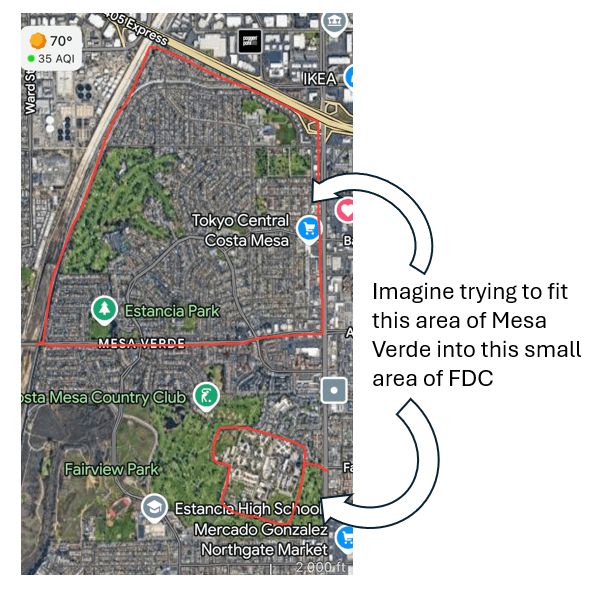
That area of Mesa Verde includes:
- Three schools (Adams Elementary, Tewinkle Middle School and Early College High School)
- A fire station (at Royal Palm)
- Three parks (Estancia Park, Mesa Verde Park, Smallwood Park)
- A golf course (Mesa Verde Golf Course)
- A cemetery (Harbor Lawn-Mt. Olive)
- A library (Mesa Verde branch of the OC Library System)
- At least three churches
- A post office
Now, I wouldn’t say that the FDC site needs all of these things to be a successful neighborhood. But it would have to have at least some of them, right?
In particular, the lack of planning for an elementary school seems like the most egregious miss. If parents aren’t walking their kids to school they’re very unlikely to want to walk anywhere else.
This is the point where we are all supposed to call our State Assembly Persons and State Senators and tell them that the State is making a terrible, terrible mistake interpreting its mandate to build “affordable housing to the greatest extent possible” to mean the FDC must be wall-to-wall housing with little else. That is a recipe for miserable living. Does the state actually like the people who they hope will live here?
Bad outcome #3: Alternative 3 is the most expensive option, and I have no idea how the City will build it or pay for it
The Agenda Report pegs the all-in development price of Alternative 3 at a frightening $1.2 billion, with just over $158 million of that amount earmarked for sitewide development (presumably laying down the necessary infrastructure and performing site preparation) and $18 million for offsite improvements.
But let’s assume that the master developer will end up eating most of these costs. That still leaves two problems:
First, I hope we recognize that this project will completely and utterly consume our public works department for years while the site is being built out and those “offsite improvements” are installed. There is no manager in the world who can take on accommodating an all-at-once, $1 billion+ project into a built-out city while also maintaining a full plate of routine capital projects that are necessary to keep a city humming.
This means that we’ll effectively have to beef up city staff somewhere — either in terms of full-time staff or expensive consultants — long before the city receives a dime of compensation from either the master developer or the State. How we might do this is left unsaid in the Agenda Report.
And even if we manage to get through the very painful construction phase, it would be great if the city had some thoughts about how we’re going to pay to maintain this new neighborhood in the long run. It’s lovely that we were able to get our consultants to spit out a financial feasibility analysis for the developers. But where is the financial feasibility analysis for the city? We aren’t going to be trading away property taxes in this development deal, are we?
I’m glad I’m not a Planning Commissioner in times like these. Based on these new disclosures, I don’t see any good way forward at the moment.
I wish we could just start over.

 Goat Hill Rodeo
Leave a reply to City Council Preview 10/21./2025: Negative Space – Goat Hill Rodeo Cancel reply