
Today, Mayor John Stephens took the stage at the Costa Mesa Hilton to give the annual “State of the City” address hosted by the Costa Mesa Chamber of Commerce. As a majority of the council members were in attendance, the address was technically a “special meeting.”
Which means that, with all due respect to Mayor Stephens’s address, it’s a great opportunity to assess what the state of the city actually is. So I thought I’d go back to the five issues I predicted would challenge the city this year and see how its going.
Personal note: My mood is basically the same as Council Member Arlis Reynolds’s, who posted this to her personal Instagram account this morning. It’s been a very distracting time.
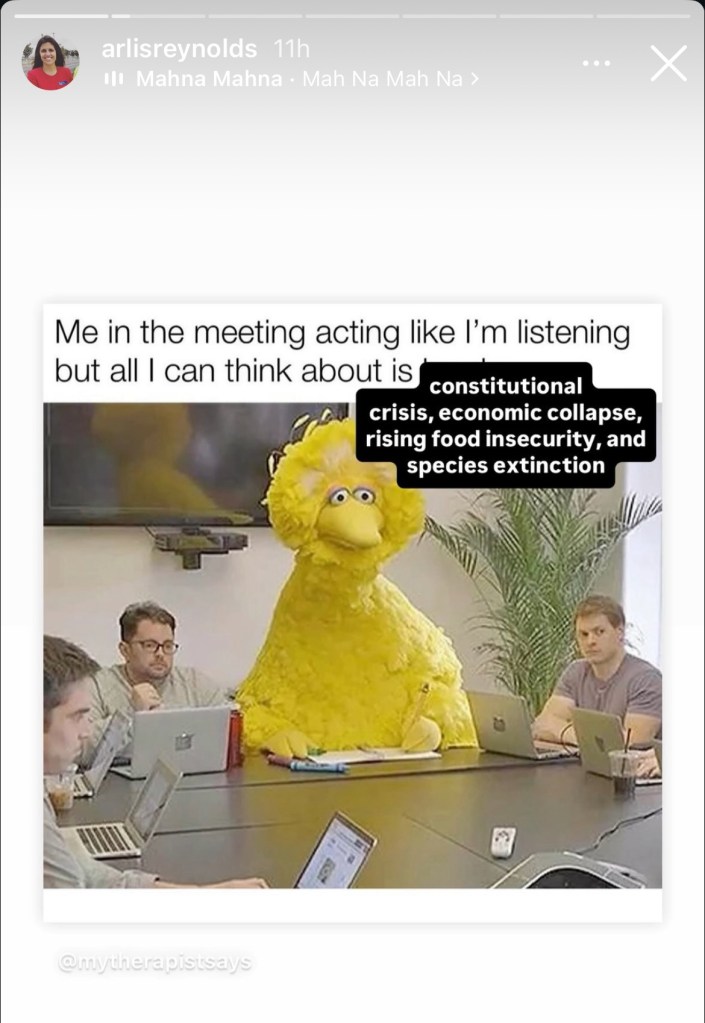
But let’s see what we can make of where we are locally.
Rental assistance: Rents are still rising, but money is scarce, and now we’re probably gutting Section 8
The first issue I worried about was what would become of the City’s tenant-based rental assistance (TBRA) program, which, heretofore, has been primarily funded by COVID-era American Rescue Plan Act (ARPA) funds. Those funds are completely spent. Which is a bummer, because as many predicted, the Los Angeles wildfires this year have spiked rents locally as people and businesses move out of the fire zone.
In the last six months, the City has decided to limp along the program by directing HOME Investment Partnerships Program funding, an annual federal grant to support affordable housing, to shore up TBRA funds.
Which works… for now. But given that the rents continue to rise faster than wage inflation, and meaningful new local housing construction is likely two or three years away at least, a significant portion of Costa Mesa’s renting population remains strained to the breaking point.
Unfortunately, as will be a theme in this post, Federal policy is poised to make things much worse. President Donald Trump’s proposed “One Big Beautiful Bill” (yes, that is the official bill title), AKA the “OBBB”, proposes to radically restructure the federal housing voucher program, colloquially known as Section 8. It proposes cutting Section 8’s funding by about half and also redirecting the remaining funding to state-administered assistance programs. The OBBB would also impose a two-year time limit on aid to non-senior, non-disabled households.
If OBBB passes, we should expect the Section 8 rolls to get slimmed down drastically. That means a lot of families that currently receive Federal vouchers are about to lose them. At the moment, Orange County manages about 11,000 current Section 8 vouchers. If even a few hundred of those vouchers are directed to Costa Mesa households, the impact locally could be significant. And certainly it will outpace the TRBA funds the city can provide.
Homelessness policy post-Grant’s Pass: more enforcement, but more housing, too
While my deepest fear — that funding for the Costa Mesa Bridge Shelter would start to fall apart under budget pressure and the political implications of the Grant’s Pass decision — hasn’t (yet) come to pass, the cracks in the current approach to homelessness and policing have started to show.
But the current system seems to be holding in Costa Mesa for now. The bulk of the Bridge Shelter’s funding made it through the City’s contentious budget process, though it’s worth noting that the city did trim one full-time community outreach worker position in order to help balance the tighter budget.
And on the bright side, we do seem to be seeing two quiet improvements in homelessness policy. Perhaps emboldened by the positive public reception to the Grant’s Pass decision, the Costa Mesa Police Department (CMPD) has been routinely advertising on its social media platforms instances where it addressed public camping and homeless encampments in the city, many of which emphasize the number of citations issued. These encounters are sadly necessary to maintain high quality spaces for all Costa Mesa residents and visitors, including our housing-insecure population. Perhaps the most recent example was the CMPD’s recent sweep of the W. 19th Street corridor at the request of local residents, which drew praise and appreciation from Council Member Manuel Chavez in his public comments a week or so ago.
The City has also approved two housing developments aimed at residents at risk of homelessness. The first is a conversion of the former Mesa Motel site into an affordable housing development restricted to very-low income residents (that conversion passed the Planning Commission 5-1). The second, of course, is the very-long-time-in-coming senior housing development on the Costa Mesa Senior Center parking lot, which received the approval of its ground lease in March. This development’s 70 units will be restricted to low- and very-low income seniors, a population that is particularly vulnerable to falling into homelessness.
CMPD attrition: reversed, hopefully, as a new Chief will take over
Thanks in part to additional incentive funding passed by the City Council last year, the CMPD appears to be on the way to righting the ship with respect to CMPD headcount. I’ve been told that we should expect that the CMPD’s open sworn positions should be mostly filled by the end of this year. If that holds up, it would set up whoever will be taking over the reins from our outgoing Chief of Police Ron Lawrence.
Will that person be Deputy Chief Joyce LaPointe? In a bit of breaking news, she was formally announced as the City’s Interim Police Chief today. If she stays in the position permanently hopefully the CMPD’s staffing woes will no longer be a top concern. Unfortunately, there’s plenty left to worry about.
Federal immigration policy: ICE is back with a brand-new obsession
Perhaps THE story of the last month (other than the budget wrangling discussed below) has been the local impact of U.S. Immigration and Customs Enforcement (ICE) raids across Southern California. This issue has been well documented in the local press, particularly in the Voice of OC, so I won’t recount the blow-by-blow developments here.
What I will note is that, in the one City Council meeting we’ve had since the most aggressive ICE enforcement in many decades began, I was somewhat taken aback by the conversation around this issue. While both Council Member Reynolds and Mayor Stephens obliquely addressed the anxiety, unrest, and sporadic protests triggered by the anonymous ICE raids targeted at working immigrants, the remaining Council Members (Council Members Andrea Marr and Jeff Pettis were absent) ignored the issue almost entirely.
And even Reynolds and Stephens seemed to be biting their tongues. Despite commenting at length about the humanitarian impact the raids were causing, neither of them mentioned by name President Donald Trump, his Deputy Chief of Staff and architect of the current immigration policy Stephen Miller, Border “Czar” Tom Homan or even the Department of Homeland Security (DHS) or ICE. Stephens went so far as to say he wasn’t “at liberty” to name nonprofit organizations who supported immigrants and their families, though he implied he approved of those groups doing so.
Frankly, the scene chillingly reminded me of the cartoonish “He Who Shall Not Be Named” trope in Harry Potter. I have to believe the Council had been advised by the City Attorney or other City staff to avoid a direct political confrontation with an administration that has shown it is not above petty retributions. Which is, of course, absolutely ridiculous and a gross affront to (what I thought was) the American sense of ordered liberty. But here we are.
But there’s more. The silence on the dais extended into public comment. In the last few years, a hallmark of a typical Costa Mesa City Council meeting has been the cadre of mostly Spanish-speaking moms who collaborate to use public comment to highlight issues of public concern in the Westside neighborhoods where they live. They have advocated for everything from rental assistance to park improvements to concerns about graffiti and street safety.
Not one of them showed up at the June 17th meeting. I sincerely hope that was because they were all busy celebrating graduation or were otherwise engaged. But I fear that the prospect of lurking ICE agents, who seemingly are willing to pick up anyone — including American citizens — who are engaged in anti-enforcement protests is chilling the speech we hear at City Hall. And that should be a top concern for everyone on the dais.
And what about the budget?
After previewing the budget showdown a few weeks ago I neglected to update you that, in a moment that would have made King Solomon proud, the City Council did indeed manage to pass a budget that minimized the impact of the projected revenue shortfall on infrastructure spending required by the Capital Asset Needs (CAN) ordinance.
However, they did so — following a bit of clever budget maneuvering by Finance Director Carol Molina — by raiding the IT Infrastructure fund instead, and by applying some of the CAN fund’s balance to this year’s spending. And even with those shifts, the city still ended up with an approximate $1.8 million CAN shortfall, which the City Council determined to pay back over the next ten years. And the money yoinked from the IT infrastructure fund also needs to be replaced, presumably on the same timeline (the motion, which hasn’t been memorialized in the final budget, wasn’t particularly clear on this point).
So the City Council managed to pass a balanced budget by, essentially, borrowing heavily from the future. Or at least from a future where these required spending categories remain in place; as in prior meetings, there were multiple calls from the dais to consider revising or repealing the CAN to mitigate its effect on future budget cycles.
Now we wait to see what our revenue numbers actually look like in the coming months. At least one Orange County city has received fourth quarter 2024 sales tax numbers so hopefully the city will post HdL’s report on our own receipts for that period soon.
Finally, two new issues to add to Costa Mesa’s age of uncertainty: Fairview Developmental Center and the search for a new City Manager
These five issues are bad enough. But, misery loves company, so let’s add two more sticky wickets to the list.
The first, which is decidedly not of the City Council’s making alone, is the slow-motion car-crash that is the Fairview Developmental Center “visioning” process. I will save an update on that process for a future post but, suffice to say, it is very bad news when the Vice Chair of the Planning Commission says that the plan recommended by Staff is unequivocally “not what the community is supportive of” (and he’s right, by the way). And that’s after almost a year of “outreach” and likely millions of dollars have been burnt trying to build exactly that community support.
The second, on the other hand, is a crisis of this Council’s (or, at least four of its members’) choosing, which is that Costa Mesa finds itself without a city manager at the moment. I may have been directionally supportive of such a change but that doesn’t make me a cheerleader of the rudderlessness that will likely ensue. The Summer is a very, very difficult time to make City Hall move on anything quickly. But despite this, it seems obvious that the city needs to start moving forward with its selection process very soon.
So what is the state of the city? I think it finds itself at a moment of remarkable uncertainty. Its people are on edge, its leadership is in flux, and its policy choices of late have been compromised and unsatisfying. It is being buffeted on all sides by State housing mandates, Federal immigration policy, and tight finances at every level of government. So hold on tight.


 Goat Hill Rodeo
Leave a reply to kartoz10 Cancel reply