
As the dog days of Summer start to fade, it’s time to turn the page, literally and spiritually, to the Fall.
2025 is going by criminally fast, isn’t it?
Maybe that’s just the vibe among parents with little kiddos. And procrastinating bloggers.
ANYWAY — I’ve got a lot on my mind for this Fall when it comes to city politics. I know we’re all busy, so I’m just going to pick two big topics (plus a bonus one) that I think we should all keep top of mind in the next couple of months. And I’ll make it even easier: if you hear the word “Fairview”, I’d perk up my ears.
Fairview Developmental Center: Hurtling towards… what, exactly?
This one is coming up quick: the Planning Commission will review the Staff’s plan for the next step in the Fairview Developmental Center planning process tonight, which is to bless a tentative plan so that the City can begin the environmental impact report (EIR) process under the California Environmental Quality Act (CEQA). For the uninitiated, the EIR is an expensive and time-consuming exercise to document, in excruciating detail, how a proposed project may disrupt the surrounding ecosystems — anthropomorphic and otherwise — and whether the project’s proposed mitigation strategies are legally sufficient.
It can take months, sometimes years, to complete the EIR process. To address this, cities and developers sometimes try to push through the required CEQA analysis before a plan has been fully baked, so that the CEQA review can run parallel to the project’s other planning steps. To address the risk that the ultimate project might be different from the one used for CEQA purposes, parties often propose a bigger/more “impactful” project than they ultimately think will be built. This allows an approved EIR to validate as many options as possible.
That appears to be what the staff is recommending to the Planning Commission tonight. They are urging the commissioners to approve the so-called “Preferred Plan,” which is thumbnailed below:

And here are the details:
- 2,300 housing units minimum; 3,800 housing units maximum
- Up to 35,000 square feet of commercial space
- 12 acres minimum publicly-accessible open space
- a street network that includes nods to active transportation
- secondary access route from Harbor Boulevard
But those numbers seem a bit dodgy to me. First of all, I thought we all agreed that 2,300 housing units wasn’t financially feasible, especially at the 40%+ affordability requirement we’re demanding:
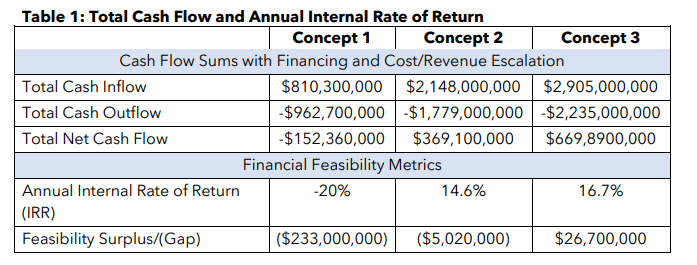
Recall that the differences between these three prior scenarios was primarily unit count, with Concept 1 anticipating 2,300 units, Concept 2 anticipating 3,450 units, and Concept 3 anticipating 4,000 units. Only Concept 3 squeaked in above the financial feasibility threshold of 15%. Doesn’t that mean that, notwithstanding the “Preferred Plan” purported range of 2,300-3,800 units, we are almost guaranteed to get an actual proposal at the top end of the range?
Second, as the Agenda Report admits, 12 acres of public open space is criminally low. It assures us, however, that this is merely a minimum, and that Preferred Plan will require that “the developer… [to] provide a combination of land, improvements to the parks and trails, and park impact fees consistent with the City’s Local Park Ordinance… [and that] staff will include incentives in the [Preferred Plan] that will further encourage the provision of publicly accessible open space beyond the minimum requirement.”
Well there’s a few problems here. First, land and park improvements elsewhere in town sounds great for the rest of us, but is almost useless to the poor folks that actually live in FDC.
And then there’s that word: “incentives”. What does that mean? What would you give the developer here to have them provide more open space? I have a sneaking suspicion it rhymes with “shmensity”. But if we want the option to entice more space with even more units, what’s the baseline? If it’s the 2,300 unit number, then the financial feasibility analysis seems off because we’re going to extor- I mean, incentivize the developer to provide more open space before we’ll allow those extra units, which will be expensive. And if the baseline is 3,800 units, wouldn’t that mean the EIR will not have accounted for the additional units?
Anyway, let’s get out of the weeds. The takeaway here is clear: the staff seems ready to ram through a fundamentally flawed plan in the name of “sticking to the schedule”. They’re throwing a lot of dirt in the eyes of the Planning Commission hoping they’ll be swayed by the “tentative” nature of the plan, but let’s be real: once the EIR process is initiated, nobody is going to make fundamental changes.
So here’s the first thing to watch this Fall: Will the Planning Commission fight for a different outcome, including (but not limited to) creating a better connection to Harbor Boulevard through a land swap or other process? Even if a land swap would require a Measure Y vote, I think it would be worth it. At the very least, we couldn’t say that the people of Costa Mesa didn’t get a say.
Fairview Park: A sleeper issue slipping by the public
When I started this blog, I promised myself I would steer clear of two topics: cannabis and Fairview Park. The first one I ended up grudgingly addressing during the election last year when it became a campaign issue.
Sadly, now it’s Fairview Park’s turn. This Fall is the scheduled unveiling of the Fairview Park Master Plan update — something that’s been in the works for several years now.
This, in turn, will likely bring the simmering conflicts over the park to a head. Most recently the two loudest factions have been the Harbor Soaring Society, which seems to view flying model plains off the park’s bluff as its birthright, and the Fairview Park Alliance, who apparently want as little human activity to occur in Fairview Park as possible.
But honestly I have a really hard time getting all that invested in that conflict, or really in the Fairview Park Master Plan update, because of Measure AA. Passed by an overwhelming 70%+ margin in 2016, Measure AA prevents any “significant change” to Fairview Park’s “as-built” condition without first submitting the proposed changes to a popular vote. If that language sounds familiar, it should: Measure AA shares architects with Measure Y, Costa Mesa’s persnickety anti-growth ordinance, which passed at the same time.
Without a vote of the people, the City of Costa Mesa cannot:
- expand or intensify present park uses;
- expand current amenities;
- add new amenities;
- expand park hours;
- change any grading;
- expand any parking lot’s footprint;
- lay any foundations;
- build any permanent structures, including but not limited to buildings; electrical, water, gas, or sewage facilities; paved roads or curbs; lamp stands or poles; pergolas or gazebos; parking lots; retaining walls; or communications towers;
- install any water, electric, gas, or sewer lines or delivery systems;
- install any additional lighting; or
- alter any use geotechnical or structural analyses.
Yes, there are exceptions for work related to conservation, restoration, maintenance and public safety. But even so, it’s enough “no’s” to make me feel like we’re in Cloud Cuckcucko Land.
Which to me underscores this question: if Measure AA ties the city’s hands, why on Earth would we now spend hundreds of thousands of dollars to make minor updates to the Fairview Park Master Plan?
I have a couple of guesses, neither of which feel good.
Back in 2023, we hired an outside consultant — to the tune of $300,000+* (see note below) — to conduct the update, but the agenda report approving the contract provided scant details about why the update was needed now. Yes, the Master Plan is out of date (it was last touched in 1998): but so what? We’re not putting this thing to a vote (are we?!) and we can’t change anything in the park without one. Yet the agenda report goes on and on about the need to consolidate records from prior restorations and “significant advancements in geospatial technology”.
Given those justifications aren’t remotely relevant to future improvements to the park, I suspect that the immediate motivation was to provide the city with a better platform to pursue grant funding. As we discussed when we looked at the Pedestrian Master Plan, city “plans” help to score points in the grant funding game with the state; the better your plan, the better your case is to rake in the big state funding bucks. And, at the time the Fairview Park Master Plan update was floated, both the State and the Feds were showering jurisdictions with money for conservation and natural habitat restoration.
But something else bothers me. Measure AA has a nasty little one-way ratchet built into it: although expanding or intensifying any park use present in 2016 would require a vote, limiting or even removing such a use does not. So how could the Fairview Park Master Plan update sneak big changes into Fairview Park without having to do an onerous vote? Well, by removing uses instead of changing or expanding them.
I sense not just the HHS gliders are in the crosshairs. Some of the information made public thus far suggests that conservationists don’t like the “artificial infill” that creates the dirt hills near the entrance to the park, which are used as makeshift jumps for mountain bikers and RC car enthusiasts. Could those hills be bulldozed? And what about the Concerts in the Park, which Kim Hendricks, board member of the Fairview Park Alliance, has repeatedly commented should be moved to Lions Park or elsewhere?
If the people of Costa Mesa were under the impression their 2016 Measure AA vote locked the park in amber, they’re in for a rude awakening.
Bonus “Fairview”: When will we see work start on Fairview Road?
In the same meeting that the consultant for the Fairview Park Master Plan update was chosen, there was another little item tucked into the consent calendar: the selection of a designer for the Fairview Road improvements between Fair Drive and Newport Boulevard. Although the item was pulled and lightly discussed, it eventually sailed through on a 7-0 vote (including getting the nod of the otherwise active-transportation-adverse former council member, Don Harper). We haven’t heard much about it since, but I would guess we would see construction starting in the next couple of months. Recall that this project not only plans to put green paint and bollards on Fairview Road: there will also be concrete bus islands and a reduction of lanes in both directions.
Could I see some drama brewing over that project? You betcha.
* Was the Fairview Park Master Plan update correctly funded? Looking back on this, I think it was pretty questionable that $65,000+ of funding for this project came from park development impact fees, which live in a separate, dedicated account. By law, those are meant to cover only *new* park development projects, not plan updates for existing parks. Not only will the Fairview Park Master Plan almost certainly not include new park amenities, Measure AA ensures it cannot include such new amenities without a popular vote. And using the Master Plan to decrease, rather than increase, the intensity of uses at Fairview Park would seem especially problematic.


 Goat Hill Rodeo
Leave a reply to Six Questions for Today’s Big Item: The Draft Fairview Park Master Plan Update – Goat Hill Rodeo Cancel reply