
City Hall is abuzz with “housing, housing, housing” — but mostly housing problems rather than housing production, especially since Hive Live went down in flames. Here are two housing-related storylines to follow this Fall, plus a bonus if you make it to the end.
Big Housing Story #1: Costa Mesa Receives an HCD Nastygram
One of several interesting discussions that took place at last week’s City Council meeting touched on a matter outside the four corners of the agenda.
Sandwiched between public comments dominated by cat-activists (they’re baaaaack) and the regular agenda, several council members brought up during council member comments this letter that was sent to the City of Costa Mesa by the California Department of Housing and Community Development (HCD) this past August.
What does it say? “HCD finds that the City has failed to timely adopt a substantially compliant housing element and required rezoning and is therefore in violation of state law,” it reads ominously. Achieving “Housing Element compliance” is the name of the game in the Housing Element process. What happens if you don’t achieve the magical status of “compliance”? Well, the HCD letter goes on: “consequences apply if the City does not have a housing element in substantial compliance with Housing Element Law,” including:
- ineligibility or delay in receiving state funds that are conditioned on Housing Element Law compliance
- being subject to the “Builder’s Remedy”
- referral to the State Attorney General’s office for enforcement action, which could result in hundreds of thousands (or even millions) of dollars of fines if not addressed quickly
Wow. That sound’s bad! So the City’s all over this, right?
Eeeeehhhh. Here are the not-so-encouraging words Mayor John Stephens had to say about the color HCD gave to him and the City’s staff on a recent phone call regarding the situation:
It’s a pickle that we’ve created over time. I was on a telephone call with the people at HCD […] and Director [of Economic Development Carrie] Tai told about all the great things we’re doing [with respect to housing] […] and they were like, “God, that’s great. Problem is you should have done it three years ago.”
We’re really far behind. Dangerously far behind. And there is just no good reason for it. But we’re doing the best we can at this point forward […] I appreciated sitting in on that phone call and listening to the candor of HCD and, to use a term that I used earlier, they were agitated. And so it is our responsibility to satisfy them and we will do it.
Mayor John Stephens, Costa Mesa City Council Meeting, October 7, 2025
So what is going on that has a State agency threatening us with fines and loss of control of our zoning code, the mayor sweating bullets, and the city staff scrambling to cram a citywide rezone into a radically short timeframe?
Let’s recap how we got here.
A tale of two gaps, or: how Costa Mesa blew the Housing Element review process
I think it’s finally time to tell the long, sordid story of the city’s Housing Element compliance saga. Let’s go back to the letter the city received back of April 30, 2025, which contained a helpful summary of all of the back-and-forth between the city and HCD going back to 2021.

If you’ve never heard anything about HCD before, here are the only important things from the above timeline that you need to understand:
- The city was originally supposed to complete its Housing Element process by October 15, 2021. Because the Housing Element process was particularly onerous this time around — recall this is when the City received a Regional Housing Needs Assessment of over 11,000 units, and many other cities faced huge assessments as well — the state then extended this deadline until October 15, 2022.
- The City missed the October 15, 2021 deadline along with almost all other California cities. In order to make the extended October 15, 2022 deadline, HCD required cities to clear all comments on their Housing Elements and submit final, to-be-approved versions on August 15, 2022 to ensure HCD would have time to review the final versions and send out letters confirming compliance.
- Despite receiving an HCD comment letter on April 5, 2022 outlining additional required edits, the city waited more than seven months to respond to HCD’s comments. This meant this city blew through both the August 15, 2022 submission deadline and the October 15, 2022 certification deadline without ever formally responding to HCD.
- The consequence for failing to meet the October 15, 2022 deadline was that (1) the city was declared “out of compliance” (and thus subject to all kinds of penalties, including the Builder’s Remedy” referenced above) and (2) the city didn’t receive a 3-year grace period to complete its rezones, which would have allowed the city to maintain Housing Element compliance while we worked through the changes enabled by Measure K. Whoops!
- Fast forward almost three years from that pivotal October 15, 2022 deadline to April 30, 2025, which is when the city received a check-in letter from HCD linked above wondering what the city has been doing all this time. Read closely and you’ll see that the city was given a deadline to respond to HCD by May 30, 2025. But the City blew through that deadline, too, and didn’t respond until July 11, 2025.
No wonder HCD is now “agitated” with us.
If only someone had warned them! While I am going to toot my own horn here, I’ll note I haven’t been alone: super-resident Cynthia McDonald has also been beating this drum. But obviously neither of us were successful in inspiring a sense of urgency:
It didn’t need to be this way. City Hall — and sorry, the buck stops with former City Manager Lori Ann Farrell Harrison here — oversaw two inexcusable, fatal delays, the first from April 22, 2022 to August 15, 2022 in responding to HCD’s comment letter, and the second from December 2022 to April 2025 in failing to capitalize on passing Measure K to complete the necessary rezones to gain Housing Element compliance.
I have no idea why the city delayed its response to the April 2022 HCD comment letter. Maybe they were too busy putting together Measure K. Maybe they were concerned that Measure Y, which would not have allowed the city to complete required rezonings without a vote of the people, would block compliance in any event, even if Measure K passed. But I don’t think that was true: Yorba Linda managed to achieve full compliance in April 2022 despite having a vote-on-zoning rule, too (Measure B), and after two tries, Yorba Linda’s housing element was certified following a successful Measure B vote. We probably could have done that.
But even if we had, we still would have needed to complete our rezonings with all deliberate speed following the Measure K vote. Which we didn’t do in any event. Readers know I had my philosophical differences with the former city manager, but even if I didn’t, I do think her decision to spend 18 months passing an inclusionary housing ordinance rather than focusing on the rezoning process was a legitimate fireable offense. That decision, which arguably bootstrapped prioritization of the IHO to the Housing Element process without the Council’s consent, has now put us in a terrible bind with HCD.
So what happens now? The city was required to respond to the latest HCD letter by September 21, 2025. That response was not made public (yet). So stay tuned for if/when I get my hands on that.
But in the short term the state is in the driver’s seat. In a set of (understandably) bitter comments from Planning Commissioner Jon Zich last evening, he quoted from the city’s own Measure K literature and noted: “[The City claimed,] “Measure K will help the protect against regulations that limit local control”. Maybe we tried. But clearly that is not the case. RHNA is steamrolling our entire local control construct.” Yep. We’re at the state’s mercy.
The big scandal is that we’ve been at its mercy for 3 years now, and no one — neither on the staff nor on the dais, with one exception — has appeared to be the slightest bit concerned about this. And now it’s almost too late.
In the mean time, chew on what is happening over in Huntington Beach, which is aggressively out of compliance as well, and count our blessings.
Big Housing Story #2: Housing the Homeless is Still Tricky Business
This brings us to the subject of tonight’s first-in-a-long-time “town hall”, which is the status of the City’s homelessness programs (sorry, I mean, its “homeless solutions”). This intriguing event will feature one hour of presentations by city staff followed by one hour of public comment. Based on the City’s Facebook announcement of this event, it doesn’t sound like city council members will be taking questions from the audience, even though it has been noticed as a public meeting.
To be honest I’m not sure what they will cover in this townhall, but here are the three issues I’d like to see covered:
- Have we seen any effects from the Grant’s Pass decision or… the Trump Administration’s war on “Housing First”? Recall I wrote about Laguna Beach’s homeless shelter struggling thanks to the knock-on effects of Grant’s Pass, and I was wondering if we would also see funding consequences as well. Have those come to pass (no pun intended)? And how committed is Newport Beach to the Bridge Shelter in the long run?
It would also be interesting to hear how the staff views the state and federal grant pipeline and regulatory environment, given the Trump Administration’s hostility to “Housing First” and, most unfortunately, Section 8 housing. - What is going on with crime at our Project Homekey sites? I discussed what might be going on with our Homekey sites back when prepping for the 2024 election, and at the time I focused on how we were trading near-homeless marginal housing that weren’t the city’s direct responsibility (beat up motels) for shiny, new and expensive near-homeless marginal housing that were (Project Homekey sites). I had hoped then that, at the very least, these expensive projects would at least free up some shelter space at the Costa Mesa Bridge Shelter, which has been experiencing an almost zero vacancy rate for many months now.
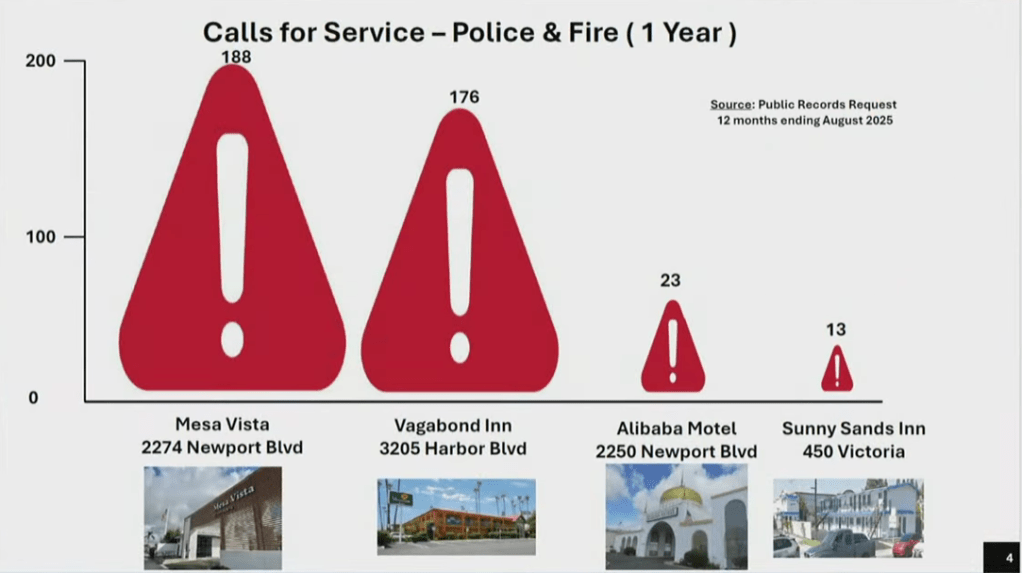
However, another Costa Mesa super-resident, Jim Fitzpatrick, came armed to the last City Council meeting with an alarming slide regarding the Mesa Vista Apartments, which is the Project Homekey site that took over the former Motel 6 site on Newport Boulevard. Someone should probably ask if these numbers are accurate and, if so, whether they represent a significant uptick from the Motel 6’s record for calls for service. And in any event, if we’ve spent all this money only to create a crime and overdose trap, it should probably cause the city to tap the brakes on future Homekey projects:
- And finally: will City Hall discuss its plans for a so-called “rental registry”? Remember back in September when the City Council held that odd “adjourned” meeting to clean up its grants to residents facing impacts from ICE raids? Well in the same breath, the city council approved those clean ups and instructed staff to bring back what ordinances would be needed to set up a rental registry and to track “at fault” evictions (i.e., payment evictions). So, without getting into the substance of that idea, here’s my question: How are we going to pay for this? Recall that we are still in a budget crunch, so much so that the anti-ICE assistance we doled out had to come from the city manager’s discretionary fund. Running a rental registry is a significant undertaking that would likely require adding an FTE to the city’s housing staff. Will we bill the landlords for the privilege of operating in city? Hard to see how that approach wouldn’t result in direct rent increases for the people the city is ostensibly trying to prevent from falling into homelessness due to payment-defaults. So it would be great to get a better understanding of what City Hall is thinking here.
Bonus: The City Council will look at the “preferred plan” (ha, ha) for Fairview Developmental Center next week. I laugh because there is nothing “preferred” about it; it is “preferred” only because it represents largest possible development envelope the city can stomach so that it can produce a maximally flexible CEQA approval. Every public meeting as roundly rejected the specifics of the “preferred plan” so we’re all just playing kabuki here.
So what might the City Council do next week? Well, on a quick look over, I’d say the Agenda Report leaves the door open to the City Council instructing the Staff to look very seriously at reconfiguring the site to include more frontage along Harbor Boulevard. What that means for the golf course is anyone’s guess. But I can tell you this: it’s very difficult to put housing on Harbor Boulevard, thanks to my favorite-ever-ordinance, Measure Y. Given that FDC ties into our overall Housing Element certification woes above, I don’t know if we have time for that.


 Goat Hill Rodeo
Leave a reply to Goat Wrangler Cancel reply