
At the end of the Summer I provided a preview of the three big “Fairview” fights I anticipated this fall: Fairview Road, Fairview Developmental Center, and Fairview Park. While all three are moving forward apace, Fairview Park has had probably the biggest recent developments. So let’s talk about what those are and where it looks like that process is going.
The first big bit of news is that the city has released the long-awaited draft Fairview Park Master Plan update, which I’ll refer to as the “Draft 2025 FPMP Update” from hereon to keep things straight.
What’s in it? Well, in most respects, it looks very similar to the 2008 Fairview Park Master Plan Update. There are a lot of words in there about conservation, environmentally sensitive habitats, endangered species, and culturally significant resources.
But there is one, big, glaring and likely controversial change, which is the relocation of the Harbor Soaring Society (HSS) fly field and the dirt mounds near the entrance to the park from their current locations on the westside of Fairview Park to the eastside, in the same area as the Goat Hill Junction model railroad.
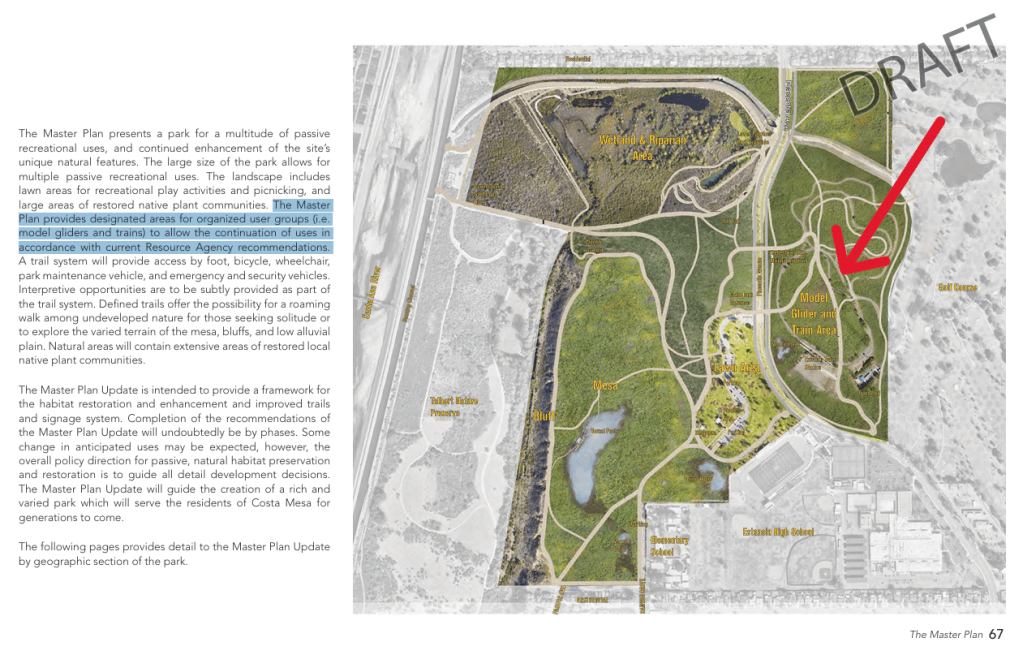

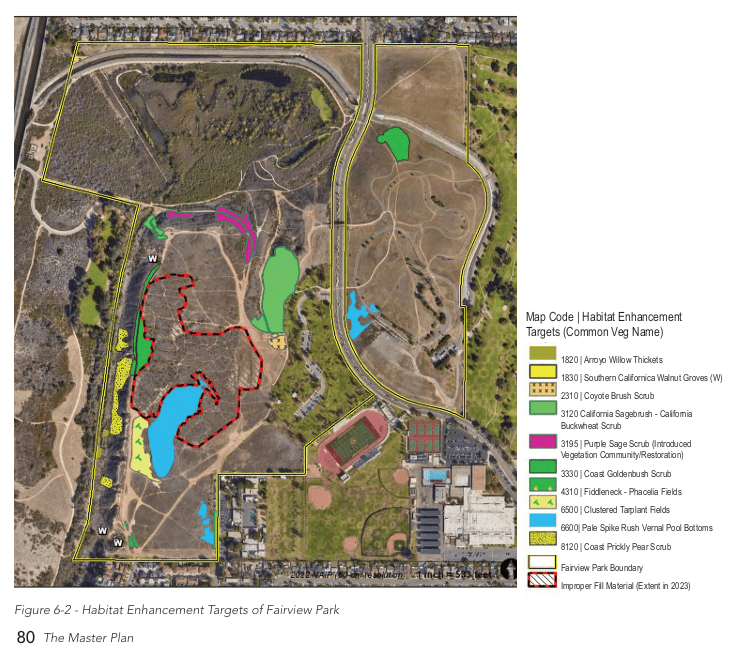
sensitive areas.”
At first blush this proposal seems responsive to the City Council’s repeated demands that city staff find a way to balance the human uses of Fairview Park, on the one hand, with the important ecological and cultural resources of the park on the other.
Yet, as I’ll dive into below, there is enough hair on this proposal to doubt Staff’s intentions.
Before I go on, let me stress that I don’t have a dog in this fight. I’m neither a birder nor a glider flyer, and I don’t live anywhere near Fairview Park. And while my kids did like the dirt bumps when they were little, we haven’t been over that way on a bike in years.
But I am a close observer of City Hall. And this so-called “compromise” set forth in the Draft 2025 FPMP Update strikes me as odd, for two reasons.
First: Um, won’t that require a Measure AA vote?
Sorry to be the nerdy lawyer in the room, but I can’t help but look at the Draft 2025 FPMP Update in the context of Measure AA, the ballot initiative passed in 2016 to “protect” Fairview Park by requiring “significant changes” to the “as-built condition” of Fairview Park circa 2016 to be first approved by a vote of the people.
I’ve littered that last sentence with scare quotes because each of those terms are, for lack of a better term, a bit mealy-mouthed. For example, as noted in my prior piece, the term “significant change” in Measure AA only applies to adding amenities, activities or infrastructure — not bulldozing such things in the name of conservation or restoration. And, as the name suggests, the “as-built condition” protects existing amenities that have been built in the park, but not activities that have occurred in the park for decades. This is what led me to call Measure AA a “one-way ratchet”: it allows for the removal of human activities that were ongoing in the park in 2016 without a vote (even if they are “passive”), while also allowing the space allotted to ecological conservation to expand without one.
So when I came across the suggestion in the Draft 2025 FPMP Update that the HSS fly field and the dirt mounds be relocated to the eastside, it made me wonder: can the city do that without triggering Measure AA? Personally, I don’t think so! This is what the Draft 2025 FPMP Update has in mind to be installed somewhere on the east side:
To avoid regular mowing and prevent colonization by ground-dwelling species, a compacted and stabilized decomposed granite paving area should be provided for the relocated launch site. Proposed improvements for the relocation site include an approximately 300-by-50-foot runway (partially surfaced with decomposed granite), pilot stations and pit area, a storage shed, an information kiosk, and installation of a low post-and-cable barrier.
Draft 2025 FPMP Update, p. 69
Fill material may be compatible for re-use in the creation of natural play features, or soil mounds that can be manipulated for sensory and spontaneous, creative play within the footprint of the narrow gauge railroad track located outside of culturally and biologically
sensitive areas.
Doing either of those things on the eastside, as well as providing the necessary vehicle and/or pedestrian access points (how will the planes/bicycles get there?), seems like they would certainly qualify as “significant changes” under Measure AA. And, at first blush, such construction and activities don’t seem to fall into any relevant exception.
So… is this really a compromise? I don’t think the city can break ground on the new flying site or new mounds before getting voter approval, and frankly, I don’t see why the city would spend hundreds of thousands of dollars to pursue such a ballot measure on behalf of these activities. If the City Council accepts this proposal, then, it seems it isn’t ensuring either HSS’s or the mounds’ survival: it is actually signing their death warrant, which isn’t how the choice is being presented to the City Council at all.
That feels deceptive.
Also, one other thing: Has anybody bothered to ask the Goat Hill Junction Railroad what they think about cramming not just the gliders, but also the dirt mounds into the eastside? I can’t expect it’s all that thrilled with that proposition.
Second: What are these “Resource Agency recommendations,” and what do they say?
But let’s back up and focus on the HSS part of the equation. The Draft 2025 FPMP Update says that the primary reason to move the HSS fly field to the eastside is to “comply with Resource Agency recommendations”. What are those? Well, the Draft 2025 FPMP Update neither defines the capitalized term “Resource Agency” nor appends these recommendations, but I think we can make a confident guess that they refer to communications the city has received alternatively from the California Department of Fish and Wildlife (CDFW) or the US Fish & Wildlife Service (USFWS).
As far as I know the City hasn’t received definitive guidance from the USFWS for some time. Or, maybe it has, but those communications haven’t been publicly disclosed.
But recently, a communication from CDFW was made public via disclosures to the Fairview Park Steering Committee. And it has a lot to say about gliders — so much so that I think the Fairview Park Alliance and other conservationists will view it as a trump card in their struggles against HSS. Essentially, CDFW strongly supports relocating the fly field, as operation of the model planes could, in theory:
- cause disturbance to sensitive bird species through noise and physical presence;
- conflict with habitat preservation in the vernal pool complex due to trampling caused by retrieval of downed planes;
- result unauthorized grading and mowing of sensitive habitats; and
- create risk of “take” of CESA candidate species (western burrowing owl, Crotch’s bumble bee).
While this also makes sense on its face, something is bugging me about it. First, at least three of these concerns could be mitigated by regulation of the fliers: for example, requiring only experienced fliers to use the fly field would minimize the number of downed planes, and if the fly field is regularly maintained (mowed, graded, maybe even replaced with decomposed granite as is proposed on the eastside), the likelihood of mowing sensitive habitats or “taking” a CESA candidate species seems very, very low.
And second: doesn’t the first bullet cover pretty much every human use of Fairview Park? Here’s a part of what the CDFW has to say on the matter:
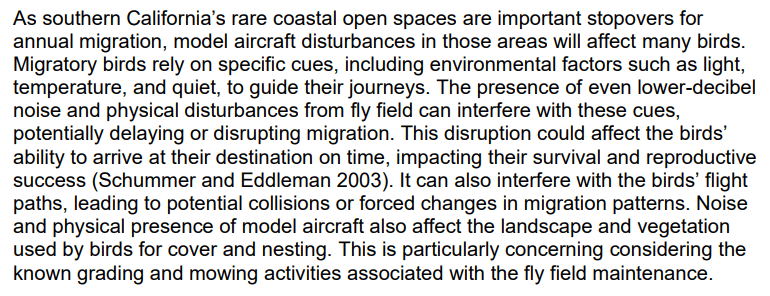
Yes, I could see how gliders could cause those impacts. But the CDFW letter doesn’t present evidence these impacts are occurring. Instead, it seems to be relying on evidence gathered by and presented to CDFW by the City — evidence that, to my knowledge, hasn’t been made public.
But in any event, wouldn’t putting gliders on the eastside also cause those impacts? Such a move would shift the launch site just 1,000-3,000 feet to the east, which feels like a scant distance for birds like burrowing owls that migrate 2,000-4,000 km every year.
There’s more. If “the presence of even lower-decibel noise and physical disturbances from fly field can interfere with [migratory] cues”, wouldn’t the much higher decibel activities like the Concerts in the Park and even the model railroad also interfere with such cues? When you add in the risks that human use of the trails through Fairview Park present due to unauthorized use — bikes cutting their own paths through the brush, humans walking on unauthorized trails, dogs running off-leash chasing birds and other animals — it’s hard to imagine a use that wouldn’t give CDFW cause for concern.
In other words, this letter from CDFW, if interpreted as an action mandate, would be inclusive of far more than just gliders. So much more, in fact, that I think it’s pretty dangerous for the conservationists to lean too heavily on this document. Vigorously following such “Resource Agency recommendations” in implementing the Draft 2025 FPMP Update would call into most current “passive” uses at Fairview Park — many of which are overwhelmingly popular. In fact:
I think it’s inescapable that, unless the City Council memorializes and commits to the current human uses like the gliders, the Concerts in the Park, bicycle riding/dog walking and the Goat Hill Junction railroad in the plan right now, and instructs City staff to work with CDFW post-haste to come up with an acceptable mitigation plan to ensure those uses can continue, it can pretty much kiss those uses goodbye — and potentially face the consequences next November.
But should the Council do that? In many ways the City Council has already answered this question. Recall that the City Council has voted to reopen the flying field on the westside of the park not just once, but twice in the last 4 years. And Council Members Manuel Chavez and Jeff Pettis, as well as Mayor John Stephens, reaffirmed this desire to see HSS — as well as the other current human uses — substantively remain in Fairview Park in their comments earlier this year.
Again, this is where I keep coming back to the uncomfortable feeling that something is off about this Draft 2025 FPMP Update process. It’s like the Staff wants the City Council to greenlight the “full-on nature preserve” version of Fairview Park, but knows it won’t get the right answer if it asks that question directly.
And I don’t like that.
One last thing: what about the *rest* of that CDFW letter?!
Another reason why the Fairview Park conservationists should think twice about waving about that CDFW letter is that it does far more than just throw shade on HSS. Read the rest of it: it alleges that the city has been non-compliant with the Lake and Streambed Alteration Agreement requirements for seven years (!), and we also have unfulfilled restoration commitments to the Orange County Transportation Authority going back to 2010 (!).
What is going on here? Isn’t keeping on top of all of these compliance matters the reason we hired a dedicated, full-time Fairview Park Administrator in the first place? And why doesn’t the Draft 2025 FPMP Update address any of these concerns?
Sheesh. Despite all the delays, the Draft 2025 FPMP Update still not be ready for prime time.

 Goat Hill Rodeo
Leave a reply to This Week at the Fall Midpoint: the The PC Goes to the Dogs, and the Fairview Park Master Plan Update Goes to PACS – Goat Hill Rodeo Cancel reply