
Yeah, that was bad. Sorry.
I was flipping through my notes (aka, this blog you are reading) and noticed that I’ve done a lot of previews but not a lot of recaps. The Fall has been busy for me in and out of City Hall so I’ve been scrambling to keep up.
But now the City Council schedule has dealt us a bit of a breather before the very consequential meeting later this month — more on that in a second — so I thought this would be a good opportunity to tie off the loose threads from the last month or so.
Did the Orange County Power Authority get sapped by FiPAC?
Near the beginning of October, the Orange County Power Authority (OCPA) visited the Finance and Pension Advisory Committee (FiPAC) to pitch itself as a financially sound option before going back in front of the Costa Mesa City Council later this Fall.
From what I heard (I didn’t attend), the meeting did not go well at all for OCPA’s representatives. My understanding is that the FiPAC members came armed with a number of tough questions for OCPA, including pressing it on whether it would allow Costa Mesa to join at the Basic Choice rate. OCPA’s representatives responded that would not be possible at this time.
This revelation must have left a very bad taste in FiPAC’s mouth. At the moment both Irvine and Fountain Valley have enrolled all of its residents in the cheapest Basic Choice rate. This means, certain FiPAC members apparently reasoned, that, if Costa Mesa joined at the slightly higher (and slightly more expensive than Southern California Edison’s default rate) “Smart Choice” rate, Costa Mesa residents would be effectively subsidizing Irvine and Fountain Valley residents, as the higher rates help to offset the costs associated with defending the Basic Choice rate from increases. And it further means that Costa Mesa residents would see their costs go up, rather than down, once the city switched over to OCPA.
While residents could always opt to switch back to SoCal Edison or even down to the Basic Choice rate after the city joined, it sounded like several FiPAC members were skeptical this would be enough to protect significant numbers of Costa Mesans from rate increases.
Ultimately this rocky exchange led the FiPAC to vote to not recommend the city join OCPA. And while OCPA could still scramble to push Costa Mesa to join before the end of the year — in theory, the required ordinances could get first reading next week, leaving one more meeting in December to formally pass it and meet OCPA’s internal deadlines — I think that’s unlikely. I’ve heard that OCPA has backed off pushing Costa Mesa to join this year.
What that means for OCPA in the long run, only time will tell. There is also a real possibility that OCPA regroups and takes another run at Costa Mesa membership next year. However, that would make membership a hot campaign issue and, given who we know is running so far, I can’t imagine that’s an exciting proposition for some of them.
FDC’s “preferred plan” heads to CEQA hell- I mean, review
After a very, VERY long discussion among the City Council members, the planning for the Fairview Developmental Center… ended up pretty much exactly where the Planning Commission landed earlier this year. The City Council agreed to allow staff to study the so-called “preferred plan” (with a slight bump up in the minimum acreage of open space) for purposes of the California Environmental Quality Act (CEQA).
What that means, essentially, is that the Fairview Developmental Center planning process is going to disappear from the public discussion for at least a few months, possibly more than year (and maybe even past the 2026 election). CEQA review is a long, long process that the City Council has been told by various consultants could take 12 to 18 months.
Now, if the City Council had stuck entirely with the Planning Commission’s recommendations, the City might have been previewing changes to the Mesa Linda Golf Course caused by the impending FDC redevelopment. However, strong supporters of the golf course — Mayor John Stephens foremost among them, but also including Council Members Loren Gameros, Mike Buley and Manuel Chavez — completely shut the door on that possibility.
Late in the discussion, which made clear that the pink area in the diagram below would, at the very least, have to be entirely redesigned to accommodate the required access road for the future FDC development, Council Member Andrea Marr made a motion to ask Staff to study alternative uses for this land:
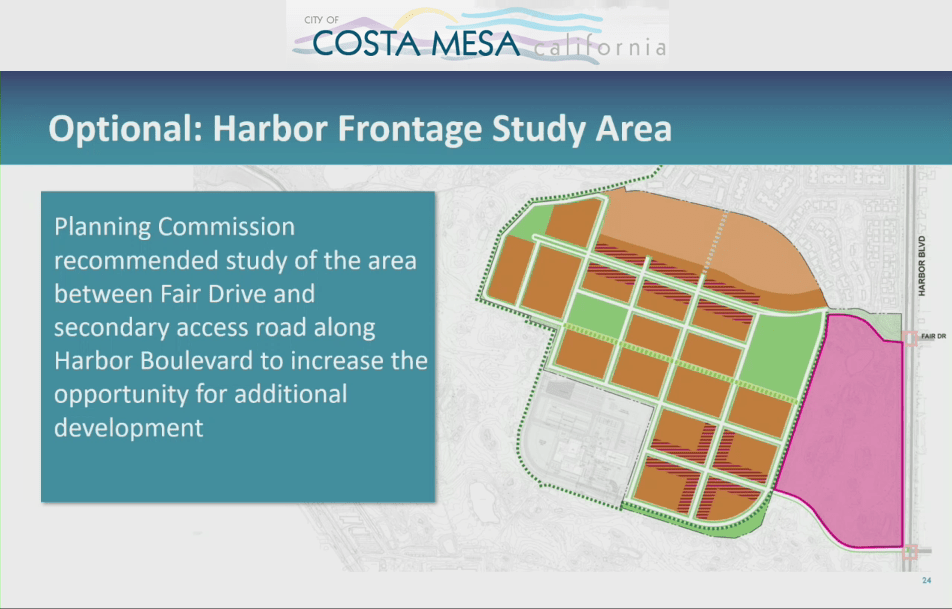
Unfortunately, in my opinion, the majority was having none of it, with Council Member Marr’s motion failing 5-2 (Marr and Council Member Arlis Reynolds being the lone “yes” votes). And, with that failed vote, the City Council made pretty clear that it did not want to consider any changes to the golf course as part of the FDC planning process.
I say “unfortunately” because I agree with Council Members Reynolds and Marr that it is a bit myopic to refuse to look at these possible changes, as they are coming to the golf course no matter how deeply the City Council puts its head in the sand. While I get some of the members might want to simply postpone this conversation — as I noted above, the CEQA process may push FDC past the 2026 election, after which Stephens and Chavez will be termed out and off the Council — it seems very silly to wait until this project is courting a developer to get a good understanding of what is going to happen to this parcel once 3,000-4,000 new households move in next door. I fear the city is going to be caught flatfooted yet again by some curveball that the State or the developer will throw at this site.
Oh well. Hopefully this is the last we’ve heard of this project for a good long while.
Costa Mesa responds to HCD and promises a “shortened” rezoning timeline
I nearly fell out of my chair when, at the last Council meeting when the members were discussing the public outreach process for the Measure K rezoning, Mayor John Stephens said offhandedly, “We are on a rocket ship to the moon here […] we are looking to get this thing finished […] by Saint Patrick’s Day. The whole thing. Adopt the zoning ordinance.”
…Oh? By March 2026? That seems… radically tight. And unfortunately I don’t think that the Mayor was simply speaking off-the-cuff here. Super-resident Cynthia McDonald wrested the City’s response from the city clerk to that California Housing and Community Development (HCD) nastygram the city received in August, and it contains promises that line up with what the Mayor was saying: “As a follow up to [the City’s prior] meeting [with HCD], the City is scheduled to discuss a shortened timeline with HCD staff on September 24, 2025, for completion of the rezoning required to achieve Housing Element site capacities” (emphasis mine).
I assume the September 24 call referenced above ended up being the one that Mayor Stephens attended. If so, that’s the one the Mayor reported HCD being “agitated” with the city.
Honestly I am pretty skeptical the city is going to be able to honor a March 2026 deadline. It’s been abundantly clear for several years now that the city’s Developmental and Economic Services Department, while professional through and through, has been woefully understaffed to take on huge rezoning projects like the Measure K sites and FDC. Additionally, the department has seen very significant turnover, up to and including its director, resulting in our current staff having very little experience with the city itself.
So, I wonder: is it time to give up the ghost and simply upzone the Housing Element sites? The Measure K rezoning sites encompass many more parcels than the ones that we list in the Housing Element as our “opportunity sites,” which are the ones HCD is spun up about. While it would be much better city planning to upzone the Measure K sites comprehensively, it would be much faster to simply break out the Housing Element sites, upzone them to be consistent with the Housing Element, and ship that good news off to HCD.
In fact, I believe that’s exactly what Newport Beach did when it scrambled to get its zoning done last year (it is on a difference compliance timeline because, unlike Costa Mesa, it actually met the original 2022 deadline to get its Housing Element certified by HCD). I haven’t been following that city super closely but my understanding is that Newport Beach chose to create a map of overlay zones that lined up with its housing element opportunity sites, and then upzoned just those parcels to accommodate the city’s required Regional Housing Needs Allocation (RHNA) units.
Just a thought.
Self-checkout regulations roll through City Council screening review
Moving into November, I regret to inform you that the ill-conceived effort to regulate self-checkout stations in Costa Mesa drug stores and grocery stores passed its first hurdle, with the instruction to staff to bring back a formal ordinance passing 5-2 (Council Members Mike Buley and Jeff Pettis voted no).
Oh well. The dissenters had the better of the argument but that doesn’t always carry the day. It didn’t help that the California Grocers Association sent a representative to oppose the measure in part by complaining it got late notice of the item, only to be gently corrected by Mayor Stephens that the agenda had been public for seven days. Hopefully they come with better arguments when this item comes back as a full-blown ordinance.
Finally: the draft Fairview Park Master Plan Update is on a collision course with the City Council. Where does that leave Measure AA?
After a long and very interesting Parks and Community Services Commission (PACS) discussion of the draft Fairview Park Master Plan update, the body ultimately approved most of the Fairview Park Steering Committee’s general “recommendations” with respect to Fairview Park. That approval included a narrow 3-2 vote to relocate the Harbor Soaring Society (HSS) flying field not just out of the Westside of Fairview Park, but out of the park entirely (two PACS members, Cristian Garcia Arcos and Jake Husen, were absent).
So, with that vote, a showdown over the draft master plan update is set for the next City Council meeting on November 18.
I hope and expect the conversation to center on three topics. First, I would be curious if the City Council might seek to slow down the master plan process, if only to get more feedback from the city’s liaisons at the U.S. Fish and Wildlife Service (USFW). My understanding is that it’s been crickets from USFW while the Federal government was shut down, but that may be poised to end as soon as this week.
Second, I wonder if the rest of that California Department of Fish and Wildlife letter will get any airtime at the City Council. You know, the part where CDFW threatens regulatory action against the city for failing to address all kinds of compliance and mitigation efforts in the Park. That didn’t get much attention at the PACS Commission so I’m hoping it will at least be discussed at the Council level.
And third, I hope the discussion at the City Council echoes the concerns raised by PACS about the impact of Measure AA on the draft Fairview Park Master Plan Update. As I discussed at length here, the PACS Commissioners discussed at length the need for a Measure AA vote to carry out many of the update’s proposed improvements, and Staff didn’t have a very compelling answer when confronted with that assertion (in one exchange, one Staff member asserted that a Measure AA vote would certainly be needed, only to be corrected by another Staff member that it would not be necessary; obviously, that’s a bit confusing!).
So it’s been a consequential few weeks in the City. Hopefully that catches us up. We’ve got two more meetings before the Winter break. Stay tuned for updates on those.


 Goat Hill Rodeo
Leave a reply to paradisemellow0ea7f0651c Cancel reply