
Happy Thanksgiving, everyone! I hope everyone had a wonderful week full of red-blooded Americana, including stressful travel, football, overcooked turkey and eating leftovers for at least three straight days. I did and it was glorious.
Sadly, the (soon-to-not-be-interim-anymore) city manager is having none of the holiday spirit, as she has cooked up an absolutely ridiculous City Council agenda for tomorrow night’s last regular meeting of the year. How shall we tackle such a beast? Probably the same way you might go about trying to eat a whale.
One bite at a time.
The Meeting-Before-the-Meeting: The Closed Session Agenda is Packed, Too
First, I’ll just mention this in passing since the agenda reports never give any details, but the City Council members are likely to walk into the 6:00pm meeting tomorrow pretty grumpy. And that’s because they first have to sit through 2 hours of a cram-packed closed session, including some big-ticket litigation on the agenda (Ohio House, former city manager Lori Ann Farrell Harrison, and perennial litigant D’Alesso Investments all make appearances). There is also a reference to three anticipated new cases against the city (!) as well a slew of negotiation behind the scenes to lock Cecelia Gallardo Daly, the current interim City Manager, in as the city’s permanent hire. More on that in a minute.
The Consent Calendar: A Bunch of Juicy Items that Won’t Get Their Due
One of the reasons I hate long agendas is, beyond being a pain to cover, they often include a lot of little issues that, if given space to breathe, could lead to really interesting discussions. But instead these gems usually just get brushed over, which is almost certainly going to be the case this time. Here are a few that, if this were a smaller meeting, I’d hope the City Council would at least peek at:
- Item 4: City Council meeting calendar for 2026. Staff wants to cancel the regularly-scheduled January 6 meeting due to the holiday break, claiming advance cancellation helps distribute agenda items. Yet here we are with another monster agenda at the end of the year.
Hate to break it to everyone, but the only real solution to meetings running past midnight is holding more meetings, not fewer. Several items here are time-sensitive, but I can think of at least one very big, very consequential item that could wait and would benefit from more individualized attention. - Item 8: Thanks to the I-405 freeway improvements, Costa Mesa is on the hook for higher maintenance and electrical costs. CalTrans upgraded the freeway and is now “renegotiating” cost-sharing agreements that have been in place since 2007 and 1993. Not sure why these need renegotiating at all, except that the State passed a regulation requiring it. Naturally, Costa Mesa pays more. At least Staff cleverly negotiated a 3-year “pilot program” limiting these additional costs to I-405-adjacent facilities.
- Item 9: A $2 million+ community workforce agreement project buried in Consent Calendar. I’m thrilled about the Adams Avenue corridor improvements described in this project, which will boost connectivity to the award-winning Adams Avenue/Pinecreek Drive intersection and build out our bike infrastructure around Orange Coast College.
But a project this big doesn’t feel right for consent calendar, and this is the city’s third Community Workforce Agreement project — one of my personal bugaboos. That said, Public Works nailed the bidding: eleven bids, winning bid came in $800K under estimate. With $1.7 million from a Federal grant, its hard to complain too loudly. Unless you hate green paint.
Old business: All Eyes on Fairview Park
While there are technically three items of old business, I expect the City Council to breeze through the first two: one is a continuance request of the ongoing drama with Ohio House, some of which I covered here, and the other is the city’s annual certification of its traffic impact fee report. Rumor has it that the latter was the subject of some controversy at the last Traffic Impact Fee Committee meeting (yes, the city has a whole committee for that, don’t get me started) when someone in public comment expressed doubt the city could spend fees raised through the program on active transportation projects.
But outside of that narrow issue, I am assuming the Council will speed along to the main course, which is the continuance of the discussion of the draft Fairview Park Master Plan Update.
Here is what I am looking for in this conversation: I sincerely hope the City Council gets back to basics, rather than getting lost in the weeds (pun intended) of technical reports and expert consultant feedback. Those things are important. But they have to be read in service to the spirit and purpose of the park itself.
For example, I’ve not heard one member of the City Council or Staff reference the General Plan, which in many ways is the spiritual constitution of the city. The Open Space and Recreation Element of the General Plan states that the number one, overarching goal of the the city’s park program is to “maintain and preserve existing parks, and strive to provide additional parks, public spaces, and recreation facilities that meet the community’s evolving needs.”
That the General Plan has been completely overlooked is an indictment of the Staff’s and consultants’ overall approach to this project. A stop at the Planning Commission for a General Plan consistency check likely would have fleshed out these kinds of fundamental questions. But, given that Staff nearly skipped the Parks and Community Services Commission on its way to rushing the draft Fairview Park Master Plan Update to Council, it’s no surprise it bypassed the keepers of the City’s General Plan as well. So unfortunately it’s on the Council to figure this out on its own.
In any event, I’ll be glad when this issue is finally put to bed, one way or another.
WAY TOO MUCH NEW BUSINESS: Shelter Warning Signs, New Taxes, and Hiring the New City Manager
Remember when I said big meetings meant little issues fall through the cracks? Well, this one is so big that even the big issues might get short shrift.
The Bridge Shelter gets a devastating ultimatum from Newport Beach
First up we have the very ominous news that Newport Beach is requesting to reduce its number of dedicated beds at the Costa Mesa Bridge Shelter from 25 to 20, which will reduce its contribution to the shelter’s funding. While the immediate financial hit to the shelter’s ongoing operations are bad enough — it will cut Newport Beach’s pay-in by about $160,000 annually — I’m more concerned by this passage:
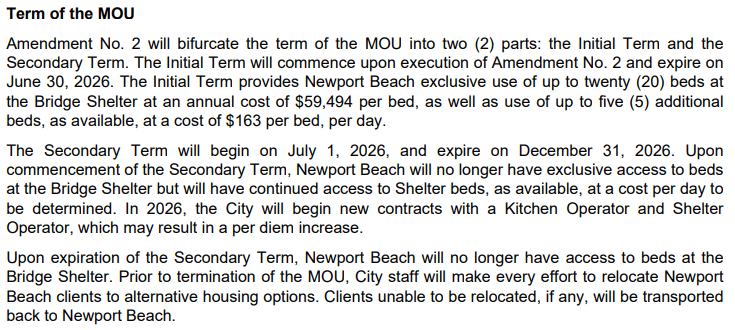
So if I’m reading this correctly, Newport Beach will switch in July 2026 from a model where it has exclusive use of a portion of the shelter’s beds (for a fixed contribution per year) to one where it rents beds only as needed (with, presumably, no fixed contribution). Then, in January 2026, that arrangement will expire… and Staff will relocate any Newport Beach clients back to Newport Beach, rather than attempt to negotiate another long-term shelter space rental contract.
I hope I’m wrong, but this sure sounds like Newport Beach is seeking to remove itself from supporting the shelter entirely by 2027. Which… would make a lot of dark sense.
I have to admit I wondered what the city was up to when it held that town hall on its homelessness efforts back in October. Now, I have a bad feeling that event was battle space preparation for the looming political fight to save the shelter from extinction next year. I think it will be extremely difficult for Costa Mesa to carry on without Newport Beach’s support. So the City is going to have to ask itself: how far is it willing to go to keep the shelter afloat?
Council will consider placing two new taxes on the ballot next year
Those in-the-know have been aware that the Finance and Pension Advisory Committee have been discussing some new tax increases for at least the past few months, with that body forming subcommittees to study increasing the transient occupancy tax (TOT) as well as the business license fee. Under California law, any such increases have to be put to a vote, so preparation for that process has to start now to get those proposals on the 2026 ballot.
I expect the conversation here to be somewhat high level, as Staff is merely asking for direction from the Council whether it should pursue these tax increases at all. The specific proposals won’t come until the early part of next year. So let’s table getting into the details (and philosophy) of these taxes for a later date.
And finally: Costa Mesa will hire its most important employee, and possibly give her immunity from being fired around municipal elections?
Assuming they’re all still awake and cogent, the City Council will review the employment contract for Cecilia Gallardo-Daly to bring her on as the permanent city manager. Given how the last city manager ended her employment with the city, it’s worth taking a look at Gallardo-Daly’s proposed employment contract to see what’s changed from the one Lori Ann Farrell Harrison signed in 2020. There are some interesting differences. Here are some that jumped out to me, and there may be more because the city didn’t provide a redline:
- Gallardo-Daly’s term is for three years, while Farrell Harrison’s contract was for an indefinite term.
- Gallardo-Daly’s contract contains a provision that the city’s human resource manager and the city attorney will coordinate to ensure that she is evaluated every year. My understanding is that Farrell Harrison didn’t get an annual performance review — possibly because the City Council overlooked it — and this may have resulted in the parties having a lot of unaddressed concerns. Looks like Gallardo-Daly doesn’t want to repeat this mistake.
- Gallardo-Daly has negotiated for herself a much more generous severance package: whereas Farrell Harrison’s initial contract only anticipated receiving six-months severance pay in the event she was fired without cause, Gallardo-Daly’s contract stipulates the city must pay her a full year’s salary for such termination, with the maximum possible payout set at 18 months’ pay. Given that her base salary is going to start at $320,000, 18 months’ pay would be at least $480,000 (I say “at least” because that base salary will only go up over time).
- That said, that severance package comes with strings: not only does Gallardo-Daly have protect the city’s confidential information from unauthorized disclosure in order to receive her severance, she also have to not breach her employment agreement — which likely makes it a bit harder for her to sue the city for unlawful termination in the event of a bad break.
- There is an interesting proviso added to Gallardo-Daly’s contract that protects her from being fired when the City Council is changing personnel (“provided, however, that in no event may Employee be terminated within ninety (90) days after any municipal election for the selection or recall of one or more of the members of the City Council”). I have to say, this strikes me as a bit of overreach by Gallardo-Daly. Given that the City Council’s only real lever of control over City Hall is its hiring — or firing — of the city manager, this “election protection” provision seems to me to subvert the residents’ ability to change administrations through Council elections.
- Unsurprisingly, Gallardo-Daly’s contract also seems to contain a hefty dispute resolution section that Farrell Harrison’s original contract lacked. So, what happens if the city manager gets into a dispute with the City Council — which need not be just over this contract? Well, first the aggrieved party has to send a “dispute notice”, which then must be followed by a good-faith face-to-face discussion. If that doesn’t work, then the parties have to go to formal arbitration, which, while less formal than litigation, is still quite the escalation compared to the normal communication that occurs between the city manager and the city council.
All in all it’s a pretty sweet deal for Ms. Gallardo-Daly, who must have a fair amount of leverage in order to command such attractive terms.
One last note regarding that dispute resolution section, which gets very lawyerly. I’m not really sure the City Council can agree to a binding arbitration provision without giving up a lot of power over the city manager. And the contract is silent on whether the City Council has to go through this dispute resolution provision before deciding to terminate the city manager. And when there is ambiguity, there is legal risk. Just something to think about. Hopefully it won’t come back to bite the city in the future.
 Goat Hill Rodeo
Leave a comment