
Want to listen to this interview? Check it out on the Goat Hill Rodeo Podcast.
*** Begin transcript ***
Jenn Tanaka
So today I’m talking with Daniel Morgan, who is a candidate for District 3. So thanks for being here.
Daniel Morgan
Thank you for having me.
Jenn Tanaka
Why don’t you tell us a little bit about yourself and why you’re running for this seat?
Daniel Morgan
Sure. I’ve lived in Costa Mesa for mostly 20 years. I say “mostly” because I did have a small stint back in South County. I live here with my wife Christine, our two kids, Elizabeth and Kate, who are both in our public elementary schools. Running a small business is not the easiest thing in California. And it’s also not the easiest thing in our city. After the Palisades fires, I became acutely sensitive to the kind of permitting problems that face our city. I have one project I’m working on right now where I am 11 months into “expedited permits.”
If I was in our neighboring city of Newport Beach, we would have had it five months ago. And, you know, if we need, if an emergency happens, like we as a city just frankly aren’t able to rebuild.
And I think about more recently, a neighbor I met through the campaign process, Shannon, her husband recently broke his back like two weeks ago surfing. And they need to rebuild their home to make it [Americans with Disabilities Act, or] ADA compliant.
Permits isn’t something she ever thought about before this. All of a sudden it’s the most important thing in the world. And as I’ll talk about probably, I’m sure, later on, everything in our city is downstream from two things, and that’s public safety and permits. So that was really kind of the catalyst to get involved. I’ve been trying to make a point of speaking with people on all sides of the political spectrum about the importance of this issue for at least eight years, and it hasn’t really gotten any better.
[Photo credit: Daniel Morgan for District 3 Campaign]
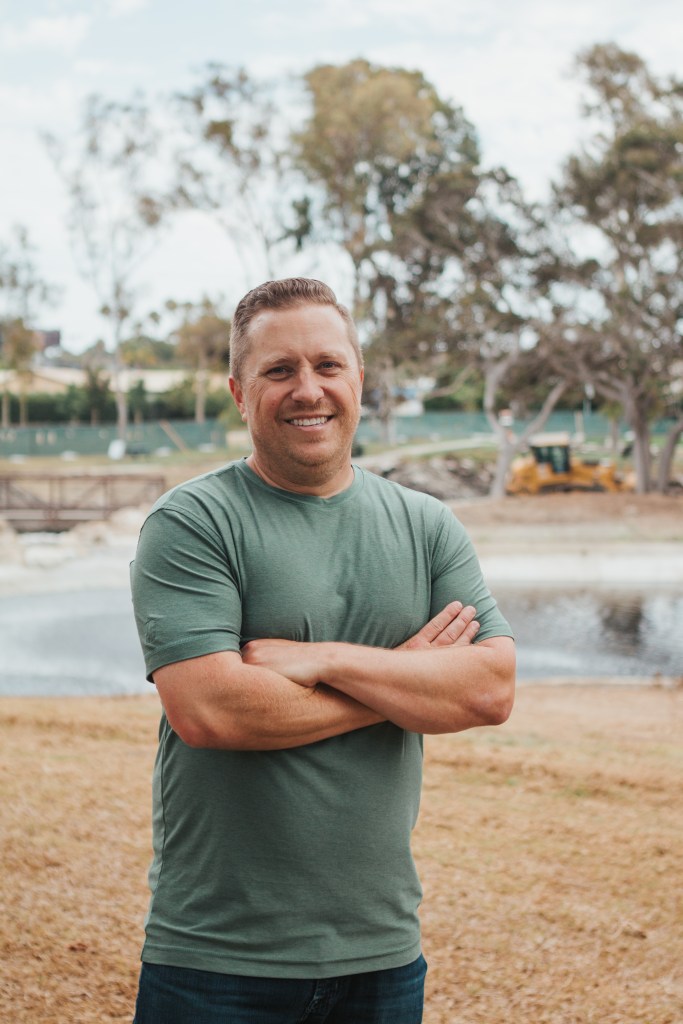
So it became clear to me that in order for someone to actually make a difference in it, it has to be someone who’s experienced it, who actually understands the importance of it. Because again, until you need a permit, you don’t understand the importance of it.
Jenn Tanaka
I want to dig into some issues that I think maybe have come up in District 3 particularly.
One thing that might surprise people, and it certainly surprised me when I looked at the District 3 map, is that Fairview Developmental Center, which is this property that sits inside the Costa Mesa Golf Course, is technically part of District 3.
Just to catch people up, Fairview Developmental Center is a property, it’s about hundred to a hundred and twelve acres or so that sits between the two courses on the Costa Mesa Golf Course. And it used to be a state run facility and the state still owns that land. And now they’ve shut down that developmental facility that used to be there and they’ve handed over to the city the opportunity to develop the specific plan to build out that property. And among other things, one of the things that the state would like the city to do is build a significant amount of affordable housing.
So, one of the core tensions seems to be how to balance the needs of current residents with the potential needs of future residents, given that this current plan will expect a fair amount of housing to be built there. How do you approach projects, maybe not of this size because not very many are going to be of this size, but how do you approach the fact that, you know, you have the needs of current residents, but you also will have future residents that potentially could also be your constituents?
Daniel Morgan
Right. Before I answer that, I just want to give a little bit of background on myself on this. Prior to starting our business, I spent the better part of a decade, more than a decade, working master plan community development all across the state. I was one of the original employees for Five Point Communities, which is the developer of the Great Park Project of this scale is something that I have quite a bit of experience with.
I’m also a former planning commissioner for the county. So I have some experience with Housing Element and trying to work through all of that. The state requirements, to my understanding, is across the city. And in our housing element, we do have a 2,300 unit allotment, 2,300 home allotment for the Fairview Development Center. There is no state requirement for “X” number of those units to be affordable at Fairview. It’s really up to the city to deploy those across the city however they so choose.
And I understand the appeal for simplicity’s sake of trying to drop everything in one place. The problem is that because of the nature of that site and how it’s developed and how there’s really only the ability to access it through Harbor, the intensity that becomes as a result of the what I’ll refer to as an overallocation of affordable housing creates a disproportionate amount of impacts, not just on District 3, but it really will ripple through not just Costa Mesa, but residents of Huntington and Newport Beach as well. Because the traffic impacts on Harbor [Boulevard] – we’re looking at 20,000 plus cars a day. It’s not a workable solution.
So there are opportunities to still build affordable housing, but we just need to be a little bit more open-minded about how we approach it.
I’ve worked on a project down in San Diego in the city of Carlsbad, where they allowed the city to purchase market rate apartments and deed restrict them affordable. You can do that for about half the cost of building an affordable housing unit. So it’s an economically viable way to start to allocate units throughout the city.
In my rough math, every one affordable unit that you put at Fairview Development Center, because of the infrastructure costs there, requires 3.3 market rate units. So for every affordable unit that you can move to another location, you can reduce 4.4 units. And for every hundred units that you remove, you can pick up about one acre of usable space. So if we want a fire station, we need at least two more acres.
Other potential solutions are there are sites on our corridors that frankly you could build just about whatever you want there and no one’s going to get mad at it. Those are prime locations for us to build what are referred to as tax credit affordable housing deals. Those are things that there’s actually capital that’s interested in building those because of the federal subsidies. And those allow you to move, you know, 100, 200, 300 units somewhere else in a location where there’s other access points. So you don’t burden the entire city with this one kind of choke point at Fair and Harbor.
So that’s one potential solution. Obviously, in the Housing Element, we don’t need to put 40% on one site. No other site in the city has that burden.
Jenn Tanaka
And when you say “40%”, just to catch other people up, I think that’s because in the original Housing Element, in order to meet various income goals, it was required that we distribute a certain number of deeply affordable units across the city. And there was a decision made many years ago as part of the original Housing Element to concentrate a fair number of these deeply affordable units at the Fairview Developmental site. Is that what you’re referring to?
Daniel Morgan
Yeah, that’s exactly what I’m referring to. That decision was a mistake. We had other options back then. My contention is that unfortunately, when that decision was made, we didn’t have enough developmental or residential housing expertise to understand what the downstream implications of that decision was.
And now we’re living with likely what’s going to be the result of that, which is one failing intersection, one very close to failing intersection. And that’s also not anticipating [Orange County] Fair traffic. So you will have multiple, multiple failing intersections, which is frankly a safety issue during the Fair.
Jenn Tanaka
And we’re talking in early September. So they’re still considering the Fairview Developmental Center Specific Plan at the City Council level. And it’s possible they may have at least an approved draft by the time that the election comes around. So what I’m curious about is that the Fairview Developmental Center debate has really hinged around the number of units and whether or not they’re economically feasible and then the kind of known impacts that those might have.
But if you’re looking at a new housing development project someplace else in District 3, how do you think about that? Is that the right way to think about these trade-offs? Is it a matter of units versus feasibility? Are there other considerations that if you were on the dais you would want to bring into the conversation?
Daniel Morgan
Each site’s going to have different math based upon site constraints, based upon access, based upon environmental concerns. The reality is you can have inclusionary housing on a lot of sites, just it’s never made sense at 40%.
Jenn Tanaka
Well, and let’s just back up just because I’m not sure everyone knows what inclusionary housing is. So why don’t you describe what that is first?
Daniel Morgan
Broadly speaking, there’s two types of affordable housing. There’s inclusionary where a market rate developer will sell a few homes at below or sell a few homes or rent a few homes at directionally below market rate. And it depends on the income level for that specific unit. And that essentially gets subsidized generally by additional density.
And then there’s non-inclusionary housing, which is generally more the tax credit project, which does have a prevailing wage requirement for it, yet it’s still pencils.
Jenn Tanaka
What’s a “prevailing wage”?
Daniel Morgan
Prevailing wage is essentially a requirement to pay the people who work on the project a predetermined hourly rate.
So because of the federal subsidies, those projects still work. And it’s interesting because if you look at groups like Cal YIMBY, who are affordable housing advocates, but not in the sense of the type of affordable housing that we’re talking about in Fairview Development Center, but just generally lowering the cost of housing, or, better put, improving affordability – they’re big advocates that. They’re big advocates that inclusionary housing is actually net negative for overall affordability.
And so it’s one of those things that sounds really good, but it really just creates a few winners and losers. If you get a deed restricted home, that’s great. Your housing is cheaper. However, every young person who moves into the city, their housing’s going to be more expensive because you’re going to have more supply constraint. Any family who gets displaced from their apartment will see a higher rental rate because again it doesn’t improve affordability for people who don’t have those deed restricted units.
It’s really just picking lottery winners versus making the entire ecosystem better.
Jenn Tanaka
It sounds like affordability is something that you would consider?
Daniel Morgan
Absolutely.
Jenn Tanaka
And do you think that’s a significant issue that’s facing the city?
Daniel Morgan
As a small business owner, one of the biggest things that I have to think about as it relates to our team is making sure that they all have reliable housing that’s reasonably close proximity. We’ve gone to great lengths to make sure that everyone on our team has, you know, an affordable, relatively affordable place to live. As a business owner, if your team can’t afford to live in close proximity to where you operate, that’s your problem. Not just the people that are struggling.
Jenn Tanaka
There’s another “Fairview” that I think is very central to District 3, which is Fairview Road. For those who maybe don’t live in District 3, it goes right down the middle of the district. Is that right?
Daniel Morgan
That’s correct.
Jenn Tanaka
In the last, I think, year and a half or so, the city’s been doing a pretty significant road project there where they reconfigured the stretch of Fairview from Newport Boulevard up to about Fair Drive to reduce one of the lanes in each direction, add protected bicycle lanes, green striping, and a protected crossing near College Park for the Monticello community right around there. I just wanted to see, you know, how do you think this project fits into where the Costa Mesa street grid is now, and maybe where it’s going? How do you think about a project like this?
Daniel Morgan
Let me start with a few things that I really like about the project. One is it was clear we needed to have a safer way for people to cross Fairview. I drive on that road at least twice a day, and I can say I’ve seen people use the new crosswalk, which is an improvement, but the number of people who don’t use the crosswalk is shocking. And I think that there’s something important to think about when we look at projects like this and just behavioral science. If you want to have someone do something, you have to make it easy. We made it easier, but clearly not easy enough. Because again, I see people jaywalk on that road, and that is a quick road every single day.
I really do appreciate the aesthetic improvement that came with the trees down the median. And I also, as a member of [the Finance and Pension Advisory Committee], I am acutely aware of and appreciative of the fact that projects like that that improve active transportation often have access to state and federal funding, which allows us to pave our roads economically. So I do appreciate all of that.
There are certain elements of that design that I think we’re going to probably need to redo in the relatively near future, especially as we continue to build out Measure K sites and as Fairview [Developmental Center] gets started.
In particular, that’s the bus island and the bus stopping. Because when the bus stops, granted, I’ve only been stuck behind it a few times. It feels like each time is a few times too many. Because it takes the road down to the one lane. That’s something we’re going to probably have to revisit. And I think when we’re doing projects like this, we need to think into the future – while we do have capacity on the road today, will we have capacity on the road in five years? Because then we’re going to be spending money to redo something.
I recently joined Garage Dad’s workout. And one of the guys rolled his ankle and one of the dads was like, Who’s going to fix these streets? And I know that people in College Park have been asking for their interior streets to get re-slurried, and I think we’re about almost 10 years past when it was supposed to get done. We need to focus on our interior streets as well.
I know neighbors on streets like Princeton [Drive] and Fordham [Drive] have been begging for speed bumps. People want traffic calming, in particular in front of their houses where their kids play. And if there’s a sense and a frustration that there’s an overemphasis on the major corridors? I have seen more people riding their bikes on Fairview [Road], but not as many I’ve seen riding their bikes on Princeton.
Jenn Tanaka
So if you were on the dais and a project like Fairview Road were to come before you, what lessons have you learned from this project that maybe you would express up there on the dais?
Daniel Morgan
My biggest critique is really the bus island, and I would want to sit down with [Costa Mesa Transportation Services Manager] Paul Martin and the rest of the transportation team and really understand the rationale behind it. I have sat down with Paul and kind of did a deep dive – “deep” is maybe generous, maybe a “medium” dive – on the project itself. I think there’s places where we need to have a healthy friction with plans and stress test things.
And I think if people really that thought that through – we’re taking a three lane road down to essentially a one lane road – I think if we had asked the right questions, we might have said, “let’s do this incrementally and see if and see how it goes,” versus do it all at once and then potentially have to undo it later.
Jenn Tanaka
You touched on this and I just want to dive a little bit deeper into something you said that, talking to some of your neighbors, had come up, which is that District 3, one thing that jumps out at you if you look at it on a map is it has you have some really great, vibrant residential neighborhoods. It’s got College Park, where I believe you live.
Daniel Morgan
That’s correct.
Jenn Tanaka
There’s also Mesa del Mar, which I think is mostly in District 3, and then you have the Monticello Community in there as well. But then, you know, District 3 has these great amenities that don’t exist in other places in the city. You have Orange Coast College is right there, you have the Jack Hammett Sports Complex, and then of course you have the Orange County Fairgrounds. One thing that I’ve heard talking to people in District 3 is that there is some feeling of pressure in the neighborhood with the number of visitors who come through, particularly with respect to cut through traffic, speeding, and overparking. So, I was curious – what are your thoughts on how to deal with those pressures given that having those amenities close is really great, but it’s also definitely put some burdens on the neighborhoods?
Daniel Morgan
The amenity that drives the most impact to the neighborhood, hands down, is the Fair. And I can’t speak for everyone, but I do know a lot of us who get “friends of the Fair” tickets. There’s a huge Fair culture in our communities. We love it, but it is a burden. You plan your day around how you’re going to get home on Friday because it takes a while. If you go to an office, you may leave early on Fridays just to make sure it doesn’t take you that extra time.
And I think that’s where a lot of the sensitivity around Fairview Development Center comes in, is that the Fair on its busiest day generates less traffic than we’re expected to have. And that doesn’t come with the same amenities that we get.
All of my neighbors who have kids, in particular daughters who play flag football, like they absolutely love that [Jack Hammet is closeby]. And so it’s a trade-off, but you get something in return. With Fairview Development Center, there is no trade-off. It’s just a taking.
I’ve knocked on over 2,000 doors, I’ve talked to hundreds of people about it. I’ve yet to meet one neighbor who is advocating for the 4,000-unit plan. With the Fair, you know, they bought us off pretty cheap with the “friends of the Fair” tickets, and we use them every year. And we absolutely love the Fair, but there’s a trade-off and it’s fine because you know, we deal with it. We knew that that was a thing when we moved into the neighborhood versus something that came in later.
No one’s opposed to housing. They’re opposed to having their quality of life completely turned around, with no say and no consideration.
You know, the community that’s going to be impacted the most with Fairview [Developmental Center] is absolutely Cornerstone. I don’t know how they’re going to get out of their homes and there is no good answer. There is no way to make that okay for them. And they’re just being told, “we’re doing this”. Even at the lower density, that community is going to have meaningful impacts.
Jenn Tanaka
Let’s assume there’s no project at Fairview Developmental Center for, at least there won’t be for the next three or four years probably. Even with no project though, it sounds like with these amenities, there’s these significant trade-offs.
You said earlier in the interview that people want to be able to have their kids play outside in front, in their yards. Does it sound like they can’t do that now? Is there something more that we need to consider?
Daniel Morgan
I think the biggest thing about kids being able to play outside is, that’s kind of separate from the Fair, because most of those impacts are really on Fair [Drive] and Fairview [Road]. The reality is: drive down Princeton [Drive], you’ll see a bunch of makeshift “stop” signs or “slowdown” signs. There’s this desire to have traffic calming measures.
And I know people who’ve asked for speed bumps or other traffic calming measures on both Princeton and Fordham and kind of those bigger thoroughfares throughout our neighborhoods and Drake [Avenue] in Mesa Del Mar. And those aren’t happening. And I don’t think, if there’s a good reason for it [not happening], that it’s been well explained to the residents.
And I think that the residents, their lived experience is that the city doesn’t care about that. They care about these big projects. And so if there’s a really good reason why we can’t take some of these traffic calming measures into the neighborhood.
I personally hate speed bumps, which is why I think they are effective. And so if you put a speed bump on Princeton [Drive], you might not drive through Princeton.
Jenn Tanaka
You know, there’s a city survey that the Parks Department did at the Concerts in the Park this year at Fairview Park. And they asked residents as they came up to the booth what they thought about the parks in the city. And one of the things that they asked was, “what park related improvements residents most wanted to see?” And admittedly the answers were kind of all over the place. Everyone kind of wants different things. But the one thing that the most people selected were sports courts and playing fields. And I wanted to ask you about this because District 3 is somewhat of a sports hub. You have Jack Hammett [Sports Complex] as we discussed, but also Costa Mesa High School has a huge athletic complex that is used for Little league and soccer and all sorts of things.
So I wanted to know: where is finding opportunities for structured, outdoor recreation like sports and sports courts on your priority list, and where do we find them?
Daniel Morgan
There’s a great quote and it often gets assigned to Mark Twain. It was, “buy land. I heard they stopped making it.” As a side note, that’s not financial advice. He went bankrupt twice buying real estate. So don’t do that.
But they stopped making land and we’re pretty close to built out. So there isn’t really opportunities to find land. It’s really an opportunity for us to leverage what all already exists. And I think a big part so there’s definitely a shortage of opportunities for structured sports.
And you know, Jack Hammett [Sports Complex] is great, but you can’t use it unless you go through this like whole process.
My older daughter is incredibly – I think obsessed is the only word that I can use? – with soccer thanks to the World Cup. And she’s got a new friend/neighbor who we’re trying to get her to go like, practice soccer with, but there really isn’t an opportunity for her to go do that in a place that makes sense.
And you drive around and we have so much, for lack of a better term, “park space” available at our schools. And I know there are opportunities to leverage those. It requires permits and it requires fees and requires coordination with [the Newport-Mesa Unified School] District. But I think that’s something that in terms of a priority, I love low-hanging fruit and that feels like a very easy thing for us to figure out a way to open up these schoolyards that have sports courts, that have playgrounds, that have amenities.
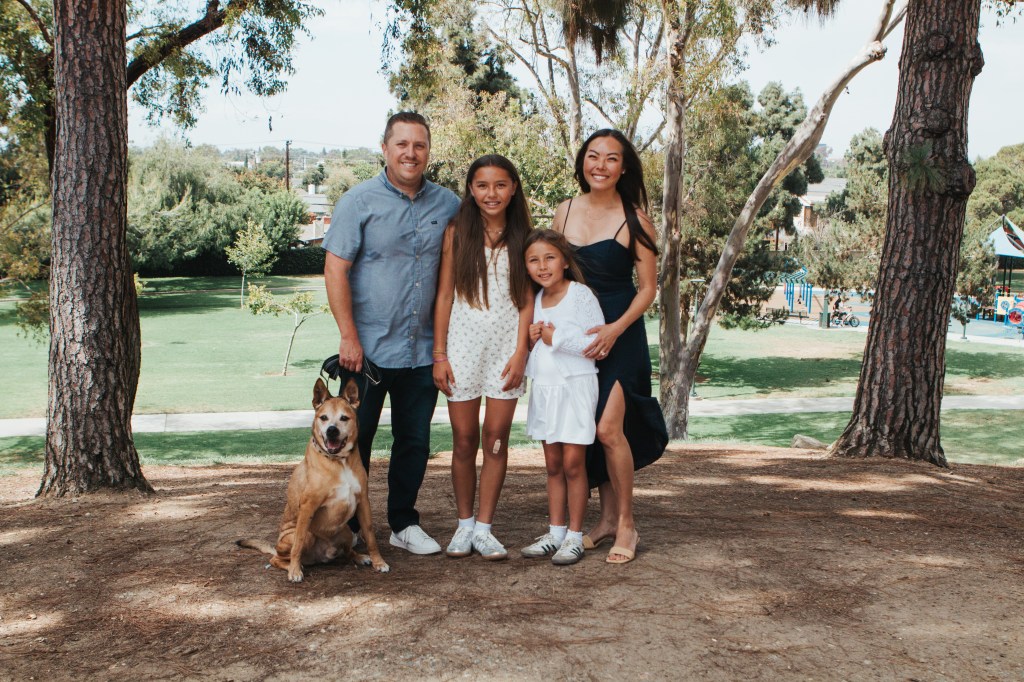
A few people in our neighborhood did Thursday nights at College Park Elementary and they went through the process. And one of the comments that we kept hearing from people at these events was, This is so great because we get to be at the park with our kids and not have to look over our shoulders.
[Photo credit: Daniel Morgan for District 3 Campaign]
And I think that, you know, part of it is that our parks do have what I’ll refer to as nuisance issues. So we have certain parks where there’s not really kids using them, there’s another, there’s other populations using them. I know people need a place to go, both the unhoused, but also, like, kids, especially in this era.
So I think we need to find better leverage in how to maximize the space that we have. We don’t have enough. So we need to make sure that we’re getting every ounce of park utility out of those parks as possible.
That’s one of the reasons why, for the existing parks, I think [about] increasing staffing on park rangers. My kids can’t walk to the park and go use the park without adult supervision. When I was my daughter’s age, that was a hundred percent okay. And it was just little kids at the park.
So for me, [it’s about] finding a way to get the most out of those assets as possible, because we can’t get more. So the only thing is to increase the utilization rate of what we do have.
Jenn Tanaka
If you were elected to the City Council, how would you go about bringing some of these changes to these parks? What is the role of a city council person with respect to interfacing with Newport-Mesa [Unified School District] or the [Costa Mesa] Police Department?
Daniel Morgan
I think as it relates to public safety, like we’re “fully staffed,” and I’m using air quotes. “Fully staffed” is a budget number in my opinion. It’s not if you go ask the Police Department, “how many police officers do you need, how many park rangers do you need?” They were [like], “here’s your budget, solve to that.”
And so it really comes down to prioritizing what I refer to as the four “P”s, which is public safety, parks, permits, and potholes. Prioritize those items, free up spending that’s going elsewhere into those items, and you’ll have more dollars to spend on the core function of the municipal government.
Back to your question as it relates to Newport-Mesa [Unified School District], is those [fields] are primarily their assets. We don’t control them. But if we offer to open up a dialogue to say, “hey, how can we make this work for you? What resources do you need to make this work? I know that, if the schoolyards are used as a park, they’re going to get more wear and tear. They’re going to have trash that needs to be cleaned up. That’s just the nature of when people use things.”
So [it’s about] making sure that we’re entering into an open dialogue with the school board where we’re able to provide them with the resources they need to make those assets available. Because the same kids who are going to use those assets are the same children that they’re serving. So it’s a place where I think, if we give them what they need, we’re going to have common ground and be able to find a solution to open those assets up.
Jenn Tanaka
I wanted to change gears a little bit now, and I noticed that there was a [University of California, or UC] Irvine poll that was conducted this summer on Orange County residents, and they were talking about Orange County politics. And one of the things that they polled was trust in different levels of government. And only about four-in-ten respondents to this poll said that they trust their city government in particular. What do you think is the biggest thing that the city council could do to build public trust in City Government?
Daniel Morgan
I don’t think there’s one biggest thing, but I think it’s worth kind of analyzing the root cause of where I think some of this mistrust comes from. If you go back to when our council fairly recently terminated its contract with our city manager – I’m not going to comment on whether that was a good idea or a bad idea.
One city council member made a comment that the role of city council was to, they’re a part-time body and they need to essentially defer to the “experts” or, in this case, staff. And I think that it’s important that we have healthy, a healthy and respectful friction with the various interests that are in our city.
City staff has interests and that’s appropriate. There’s nothing wrong with that. But then if you kind of go little bit further, you have, you know, the [proliferation] of cannabis. And I have to give a lot of credit to Andrea Marr –-
Jenn Tanaka
The current council member for District 3, right?
Daniel Morgan
Yeah. Current Council member for District 3 who did, who did oftentimes speak up at city council meetings and vote against things that were… I was at one meeting where they were trying to put a dispensary within 500 feet, as the crow flies, from a park. And the rest of the council was saying, oh well, but if you take Google Maps, like the walk is like over 500, and she was taking positions that were definitely more aligned with our, you know, our residents’ interests.
Not that people are against cannabis dispensaries, but, like, I think everyone thinks, many people agree that like, a lot happened really, really fast. And so I have to give a lot of credit to her there.
Meanwhile, at that same time as July 12th, I forget the year, but it’s right before they were rolling out Measure K at the request of several council members, I came to speak on behalf of the importance of housing. And I shot an email to my planner on one of my projects and I asked him where we were at. And I’d submitted my plan three months prior and he hadn’t looked at it. And he responded back with, “sorry, haven’t looked at it yet. We’re focused on cannabis.”
So we have city council members pounding the table saying we have a moral obligation to build housing, yet cannabis, which again is an interest – there’s nothing wrong with something being an interest – was taking priority over housing, taking priority over our Housing Element.
And so I think it’s really important that we are clear as to who the interests are within our city. And then another kind of recent example, one of the Planning Commissioners, who I hold in exceptionally high regard, – very, very smart gentleman – made a comment at the Fairview Developmental Center meeting saying, more or less, this is a complicated issue. You have what the residents want and you have [City Council] priorities which are affordable housing, environmental sustainability, and then there was something along the lines of financial stability.
And there are times when I think it’s appropriate for Council to not necessarily vote a hundred percent aligned with what maybe the vast majority of the residents want. And those are going to be situations – and I’m saying that to be generous, you know –- where [City Council members] are privy to information that we’re not. So it’s an asymmetrical information situation. So I want to give people grace in situations like that.
But this like Fairview Development Center is like a 99-to-1 issue. And he said it’s a complicated issue because we have to balance what the residents want and Council priorities. So like what are the Council priorities and where are those coming from? And I think it’s important that if the Council’s going to have priorities, that they’re very transparent about what those are and why those are.
And the Council priorities – So, like, what are the Council priorities and where are those coming from? And I think it’s important that if the Council’s going to have priorities, that they’re very transparent about what those are and why those are. And I think that when there are those situations when Council, like in cannabis, is voting sometimes against what people specifically want for their city, that it’s just very clear as to what the rationale is, right? And I think that’s and that’s where I think it’s important for people to have dialogue.
I want to give a lot of credit to Council Member Jeff Pettis, who does, like, “Pettis and the Parks.” He just goes and sits there and he lets people come up and talk to him. I haven’t participated in it, but I think it’s stuff like that where you can go up and you can engage face to face and actually have a dialogue. Again, that’s one of the reasons why I think knocking on doors is so important, is having dialogue with the residents and understanding their interests, and it’s them understanding your perspective. Because again it’s not always going to be asymmetrical information.
But I think that it’s the transparency and the open communication that’s really going to help regain trust within the city, especially when there are things that are being voted on that are clearly in opposition to what residents want.
Jenn Tanaka
Your term, if you were to be elected, would be four years. Looking forward into that time frame. What do you think are some of the biggest challenges for the city in the next four years?
Daniel Morgan
On [the Finance and Pension Advisory Committee, or] FiPAC, we received a memo basically laying out a five-year plan for the city. And we are going to have a significant budget deficit going forward. There are what I’ll – I don’t want to call them easy solutions, I’ll call them lazy solutions – which is raising taxes, raising tax rates, and you know, cutting spending. And there’s various types of cutting spending and that’s, you know, obviously cutting staff, cutting programs. And neither one of those answers is a good answer. I think that, you know, managing the budget’s going to be kind of the most important thing.
And that goes back to the thing that I started talking about originally, which is permits. The city of Newport Beach tracks their permits, applications, issuance, and closures as a leading economic indicator for a city. The restaurant that I talk about a lot took many years to open, generated $5 million of sales their first year. That’s a lot of sales tax revenue. And that’s just one restaurant.
You have all these different businesses who – I talked to a fairly large retail owner the other day who said the number of businesses that go out of business before they open up, because it takes them so long to get through this conditional use permit [process], and then their subsequent permit requirement is astounding. He thinks that the city loses a million dollars a year just off his property that we’re completely ignoring.
One note I want to give is that million dollars, I believe, if the way that I internalize that is not just tax revenue, but also economic output and more [gross domestic product, or] GDP. But that’s still a lot of sales tax revenue just from one owner’s property that we’re completely ignoring.
So before we go to the lazy answers, we really, really need to focus on the fundamentals and we need to focus our government on again the four “P”s: public safety, parks, permits, and potholes. Everything outside of that is a dollar that could have been applied towards paying staff, a dollar that could have been applied towards hiring another police officer.
And so I think by having a disciplined focus on really the core functions of municipal government, we’ll combat a lot of that kind of scope creep, but also we’ll be able to encourage economic development. Like I said earlier, if you want someone to do something, make it easy.
Jenn Tanaka
And again, imagining that, you know, you’re successful and you win a seat in November, what do you want people to think changed because you were just representing District 3?
Daniel Morgan
Absolutely. I’ve said it, I get criticized for it and some people love it, but I don’t think Newport Boulevard and Harbor Boulevard need suck. There are some absolute psychopaths, and I mean that is the most complimentary term I can give to people who’ve taken incredible risks to do cool things in those places. I’d like to see more revitalization of those corridors. I think that there’s a huge opportunity for both property tax and sales tax revenue generation.
But, also College Park – like you said, it does have some amenities, but before recently, if we wanted to get a good cup of coffee, we had to drive to another district. We have more opportunity and capacity for walkable retail uses near our centers.
And so I think the way that you see the revitalization of our corridors happening is it’ll happen naturally if we focus on the two most important things in my mind, [the first of] which is public safety. The guy who opened Bei Restaurant, which is the former Wienerschnitzel on Harbor [Boulevard], talked about how challenging the first couple of months it was because he would come in and there’d just be, what I’ll refer to politely as “nuisance behavior” right in his restaurant. If customers don’t feel comfortable or safe, they’re not going to go there. These businesses won’t survive.
And the other thing is it took him two and a half years to go from one restaurant use to another restaurant use. I manage some property and usually that’s a six-month process. Most people go out of business before they stick around. So we need to look at rolling back some of the unnecessary processes that we go through, especially on the corridors, to attract investment. And I think if we can streamline the permit process, improve public safety in particular along the corridors, you’ll see money flowing in there and you’ll see fun, exciting new amenities, retail amenities for our residents, but they’re also going to generate property tax and sales tax for our city.
Jenn Tanaka
We’re getting close to the end here. I just wanted to ask you a couple rapid fire questions at the end. So these you know, you can just kind of name off whatever comes to the top of your head. The first one is: what is a place in the city of Coast Mesa that brings you peace or happiness?
Daniel Morgan
If i’m going to give the right answer it’s Noguchi Gardens.
I absolutely adore all of the small businesses that are on our corridors, Feed Barn, Bei Restaurant, Salty Horse, all the people who are doing – Tacos Madre, that are doing cool things in places that are challenging. I love the entrepreneurial spirit and the absolute grit that those people have to have to take the bets that they’ve done. And I think it’s inspirational, makes me giddy.
Jenn Tanaka
That’s awesome. And then what is your favorite business – and it can also be an institution that Costa Mesa used to have – that either went out business or went away that you really miss?
Daniel Morgan
I’m going to get some grief for this one, but I don’t care. Pierce Street Annex. I met the owner years ago and I got laid off from a job in the Great Recession. I got to know him pretty well. And he hired me as a bouncer for a couple of weeks to help me stay on my feet. And that place, it was gritty. You could go barbecue on the fire pit out there. It was such a random mix of people, incredible, eclectic – the dance floor was uneven and probably super dangerous. But yeah, Piece Street Annex. That place was — that place was something.
Jenn Tanaka
Awesome. And lastly, what is the best kept secret about Costa Mesa that you’re willing to share with the audience?
Daniel Morgan
This is an easy one for me. And it’s going to sound cheesy, but it’s true. It’s the people. There’s just incredible examples of people who do incredible things. I’ve talked about the entrepreneurs, but in the kind of, I don’t know what to describe the spaces, but you’ve got [people like] Rebecca Robeck at 13 who started Let’s Be Kind, which has become a huge thing. Not just anti-bullying, but like spreading kindness throughout the city. Isaac, who I mentioned before with Garage Dads, who’s helping encourage dads to be supportive and vulnerable and work out at the same time. You’ve got Kohl doing bike bus in College Park.
You have all these great people doing these incredible things. And I would love to see our city give leverage to these people because I think it’s, it’s the people that make the city. The buildings can go away and the people are still there. So I think that’s absolutely hands down my favorite part.
Jenn Tanaka
Great. That’s awesome. Well, thank you, Daniel. Thank you so much for joining me with this.
Daniel Morgan
Thank you. I enjoyed it.

