
Hi friends, I’m back! Back from vacation, back from hosting an excellent guest essay by my friend Costa Mesa Jaywalker, and back from getting distracted by the relentless national news cycle.
City Council Agenda for March 3, 2026
City Council of course meets tonight, and mercifully it is about as low-stakes as last meeting. In fact, the items are once again so manageable that one gets the sense we are in the calm before the storm.
Here are the biggest items on the agenda tonight:
- The City Council will likely sign a consultant agreement with Kimley-Horn and Associates, Inc. to modernize its Traffic Impact Fee Program, which both sets the fees paid by developers to offset additional road maintenance and establishes metrics to measure the impact of additional car trips. In particular, this update will move the city from measuring traffic impact in terms of “loss of service” (LOS) — measuring only increases in traffic delays experienced by drivers thanks to a new development, assuming everyone drives — to “vehicle miles traveled” (VMT), which takes into account both the number of new trips generated by a new development as well the likely length of those trips, as estimated by the development’s proximity to jobs and amenities. VMT is almost certainly a more comprehensive metric, as it implies cities should mitigate impacts felt not only by drivers but also by other road users, such as pedestrians, bicyclists, and transit riders. However, I expect there to be some grumbling about adopting a measure that also happens to align with California’s crunchy climate initiatives.
- The City Council will also take a look at the various California State bills that are winding their way through Sacramento, and consider lending the city’s support to ones that are in alignment with the city’s values and interests. Honestly, I don’t think State lawmakers take these city-level endorsements particularly seriously. I’m also pretty skeptical that the ones singled out by they city’s lobbyist and staff are really the ones that may have the biggest impact on city policy in the future. But if you’re interested, check it out.
- Finally, the City Council will likely approve an agreement with the City of Irvine to give it access to beds at the Bridge Shelter. This item was already broadly discussed in one of the City Council’s January meetings, and it doesn’t look like much has changed since that time. As before, the deal only requires Irvine to pay for shelter beds if and when it needs them, and the agreement only runs through June 30, 2026 (after which, presumably, a longer-term deal will be hammered out). So it’s hard to get too excited about this one given that it covers such a short period of time.
So that’s the City Council this week. But I wanted to also highlight the work of the Parks and Community Services (PACS) Commission in the last few weeks, as they’ve been tasked with chewing on two items that certainly will come up for citywide action in the near future.
PACS chewy item #1: Senior Center rides are in fiscal crisis
For over a decade, Costa Mesa has offered one of the most generous senior transportation programs in Orange County. The Senior Transportation Program (STP) provides free, door-to-door rides for seniors across the city, with no limit on trips (including trips outside the city limits) and no co-pays. Seniors can use the STP to schedule a grocery run, attend a doctor’s appointment, or simply get out of the house.
Since 2011, the program has been fairly sustainable thanks to dedicated funding coming primarily through Orange County’s Measure M2 transportation sales tax, the Enhanced Mobility for Seniors and Disabled (EMSD) program operated by the Orange County Transit Authority (OCTA), a grant from Hoag Hospital and some matching funds provided by the city.
However, that’s about to change. Not only has the program seen exploding ridership since 2020, the EMSD grant is set to expire without being renewed. And to make matters worse, the city’s contract with its current taxi operator, which has been in effect for several years, is also scheduled to expire this year. As the prior contract did not account for the rapid inflation experienced by our area in the last couple of years, the operator is proposing rates that are almost double those currently paid by the city.
The expected consequences for the program are dire:
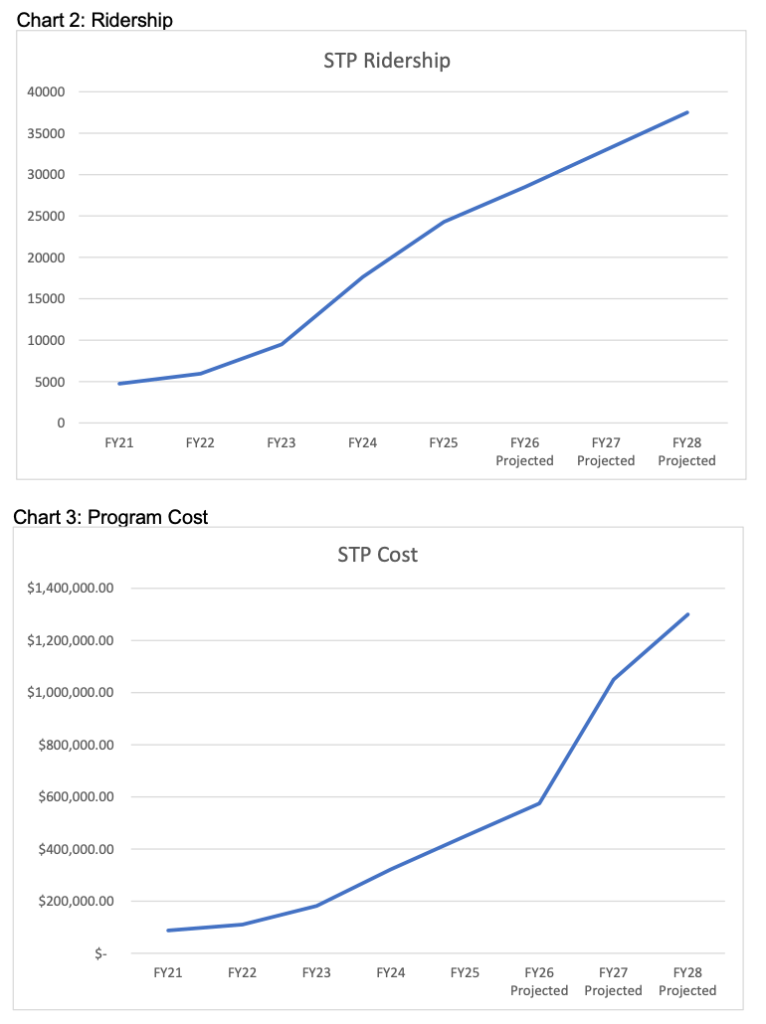
You are reading that right: with no changes, costs to simply run the program under its current (generous) parameters could top $1 million in FY27/28, and possibly crest $1.2 million by FY28/29. And that’s not considering the fact that, with the EMSD grant out of the picture, dedicated outside funding for the program is set to decline by *gulp* more than 50 percent (dropping from $418,675 in FY 25/26 to $208,125 in FY 26/27).
To borrow a colorful analogy from a friend of mine, the program is left trying to put 20 pounds of shit in a 5-pound bag. That math ain’t mathin’. In fact, to make the math, math, staff estimates that the program will likely need to reduce ridership by 70-80%. Youch.
So what is to be done? According to the presentation at the PACS Commission meeting a few weeks ago, City Staff is expected to explore at least three cost-containment strategies and start feeling out the population served by this program about which ones they would prefer. These strategies include limiting the destinations served by the program, requiring co-pays for rides, and/or limiting the number of rides taken by each eligible resident per month.
Regrettably I doubt public input, while valuable, will be enough to get the city to the right answer here. Even if the city could reduce ridership to 2021 levels, it’s not clear that would be sufficient to make the program sustainable given it is working with greatly reduced outside funding.
Which means… there will be enormous pressure on the city to retain the program at a fairly high level, even if it means supporting it out of the general fund. And I have no doubt all kinds of “creative” solutions — from means testing to reframing this as part of the city’s climate action program — will be offered to justify doing just that. We’re all about to get a crash course in the difficulties of providing free stuff to sympathetic populations in perpetuity.
PACS chewy item #2: The park assessment is here, and it’s ugly
Then, last week, the PACS Commission held a special meeting to consider only one item: the long-awaited citywide parks and playground assessment the city commissioned last year.
So what did the assessment say? Well, it’s not exactly a glowing report. The assessment was conducted over the Summer and Fall of 2025, so the brand-new improvements in various stages of completion at Shalimar Park, Ketchum-Libolt Park, the Skate Park and Brentwood Park weren’t taken into account. But even setting those parks aside, twelve city parks received a “C” grade, slating them for “medium” funding priority and signaling that at least one element of such parks received either a “poor” or “very poor” rating:
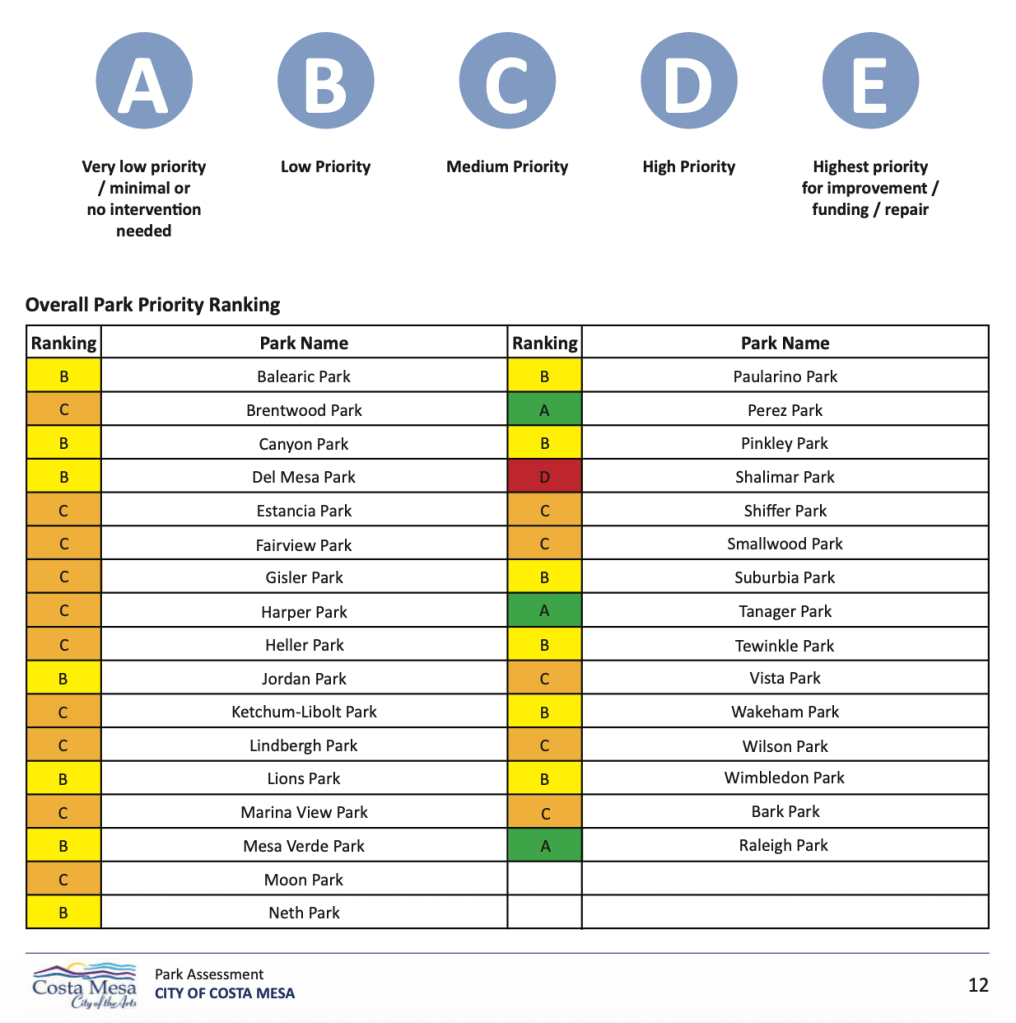
In other words, at least more than one third of all of the city’s neighborhood parks were given a “C” rating. How is that possible?
One way it is possible is that many of Costa Mesa’s parks — and many of the poorly rated parks in particular — sport some very old playground equipment, and playground condition accounted for a whopping 45% of a park’s overall score. Many sets date back to the mid-nineties, which is around the time the city adopted its first Parks, Recreation, and Open Space Master Plan. Staff noted in its presentation that they weren’t sure why so many playgrounds were installed at that time. I poked around and my best guess is that it might have been trying to comply with federal safety standards from the Consumer Product Safety Commission that came out in 1994, which required many older metal and wood playgrounds to be replaced or upgraded. But that’s just a guess.
Whatever the reason, we’re stuck with a bunch of playgrounds that are all reaching their breaking points at the same time. The average life of most playground sets is 20-25 years; if many of these were installed in the 1990s, they’re all due for replacement now, and have been for some time.
This is has been a time bomb that has been quietly ticking away in Costa Mesa for many, many years. I think this Council has been pretty happy to let County, State and Federal grants do the heavy lifting when it comes to park projects, but with those benefits concentrated in so few parks — recall that, despite receiving millions in such grants in the last few years, the only parks that will be substantially improved by them are Shalimar Park, Ketchum-Libolt Park, Fairview Park and the Skate Park — neighborhood parks across the city have been severely neglected.
Hopefully this assessment will serve as a wake-up call, not only to City Council but to city staff as they start to make their funding priorities known for next year.
So while business has been pretty quiet at the City Council level, much is happening a level or two below. And, with budget season almost upon us, I expect a lot of these issues to start percolating up very soon.


 Goat Hill Rodeo
Leave a comment