
Hi everyone. Sorry for the long hiatus; my time has been literally on loan to God for the past couple of weeks as I get fully sucked into Vacation Bible School planning. Check it out at St. Andrew’s Presbyterian Church if you have young kiddos (or you are just young at heart!). It promises to be illuminating.
I had hoped to get my “open mic nights” series done before the budget season hit us, but alas, it wasn’t meant to be. There are at least two topics worth spending some time on under that heading — the drama going on at the city’s animal shelter as well as the wayward ethics policy — so hopefully I’ll get a chance to circle back to them.
But it’s numbers time. And there is a fair amount to catch up on.
The mid-year budget update: have it all, lose it all
A couple of weeks ago, the City Council was treated to a (not-so-mid-year) budget update that went over how the city was doing in this current fiscal year, both in terms of revenues and expenditures. So, how are we doing?
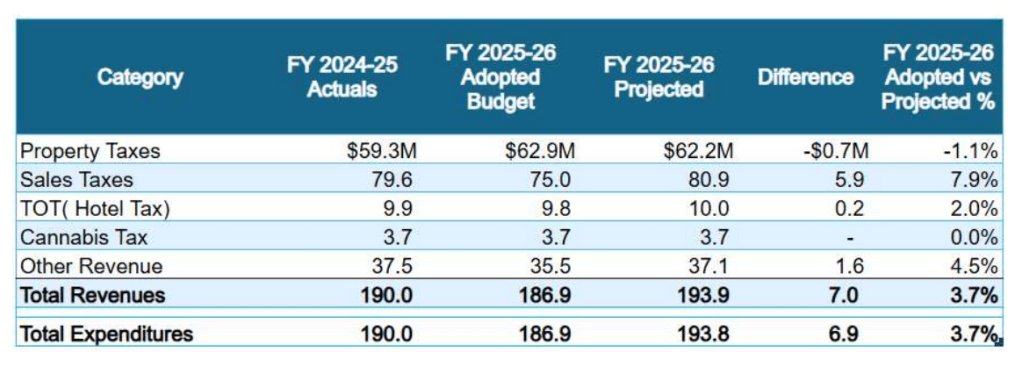
The short answer is that the revenues are tracking expenditures, resulting in a balanced budget with a cute little $100,000 surplus.
The longer answer is much wilder. Turns out anticipated expenses are tracking $6.9 million above the FY 2025-2026 Adopted Budget, a 3.7% miss. The culprit? Essentially, the Costa Mesa Police Department (CMPD) and a few other departments filled out their budgeted positions, resulting in a big spike in salary expenses.
But if they were budgeted, you might ask, how could we go “over budget” for these positions? And you’d be asking a great question. The answer lies in the assumptions the Finance Department, led until recently by former Finance Director Carol Molina, used when calculating the anticipated savings from not filling vacant positions. By overestimating these savings — effectively, guessing that the positions the CMPD and other departments knew it needed to fill would remain vacant for the entire fiscal year — the budget didn’t anticipate the full amount of salary spend that would accrue if vacancies were actually filled.
And they were filled at a rapid clip. As I noted at the beginning of 2025, the CMPD faced massive attrition in the years following both the COVID-19 pandemic as well as the fallout from the George Floyd/”Defund the Police” movements, despite the fact that Costa Mesa never “defunded” its police. On the contrary, in 2024 the City Council waved through a massive $900,000+ spending package to entice police recruits to join the CMPD. Two years later, those efforts have yielded some very expensive fruit.
This massive increase in spending was, thankfully, more than offset by City Manager Cecilia Gallardo-Daly’s forward-thinking decision to cut $1.5 million in operating expenses this year as well as $5.9 million of windfall revenue from unanticipated sales tax receipts.
But the stark reality remains: salaries go straight to the city’s baseline spending, and inflate the cost of everything from maintenance and operations (every new hire needs a desk, a car, a badge, a computer, etc. — whatever they need to get their job done) to pension obligations. And FY 2025-2026 has reset that baseline upward by about 3.7%. Gulp.
How are we going to manage that?
Enter: the FY 2026-2027 budget
So Molina is out, and Budget and Purchase Manager Mark Khou and pinch-hitter consultant Kingsley Okereke, a former assistant city manager, is in. The City Council got the first stab at the budget this past Tuesday in a study session. How did they do?
Revenue projections in 2026-2027: too rosy?
I hate to do this to you but comparing numbers across two fiscal years is going to require looking at some tables. To compare revenue projections, let’s look at the table presented with the mid-year budget update for FY 2025-2026, which is probably our best guess as to how much revenue the city will actually generate this fiscal year:
… And look at that beside the table presented this past Tuesday showing the FY 2026-2027 revenue estimates:
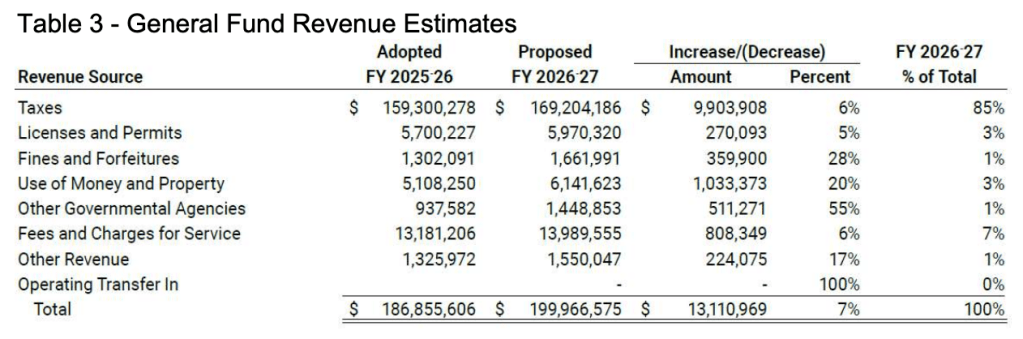
I get that the 7% revenue estimate jump in the second table feels very aggressive. How could any city expect a 7% revenue increase when it hasn’t either raised taxes or cured cancer? But when you look at it against our very strong performance during this fiscal year, it isn’t so outlandish: Staff is projecting only an approximate $6 million in revenue growth from FY 2025/2026 to FY 2026/2027, or a ~3.13% increase. That’s about bang-on of the inflation estimates during the past year. Sales tax revenue is our primary driver and very sensitive to inflation, so that seems like a reasonable guess.
However, there is reason to pause a bit here. Yes, sales tax is quite sensitive to increases in prices (duh) and we have lots of things increasing prices right now, including an international war, fluctuating tariff rates, and growing pressure to monetize the ballooning national debt. But it is also very sensitive to consumer confidence. Will people keep spending through price hikes that hit everything from household goods to food to rent to transportation costs? Maybe. Maybe not.
Spending projections in 2026-2027: We know about the salaries. What about everything else?
Here is what I really wanted to get to: Thanks to the mid-year budget update, the City Council was well aware that it was going to see some eye-watering growth in salary spend year-over-year in the FY 2026-2027 budget. And that is certainly in there. I spot almost $10 million in new salary and benefit spend between the adopted FY 2025-2026 budget (third column) and the proposed FY 2026-2027 budget (fourth column):

But note also the changes to the Maintenance and Operations M&O) line, as well as the Fixed Assets (FA) line. This is where the budget gets a little fuzzy for me.
First, when read in light of the table above, I find the following passage from the Agenda Report a bit perplexing:
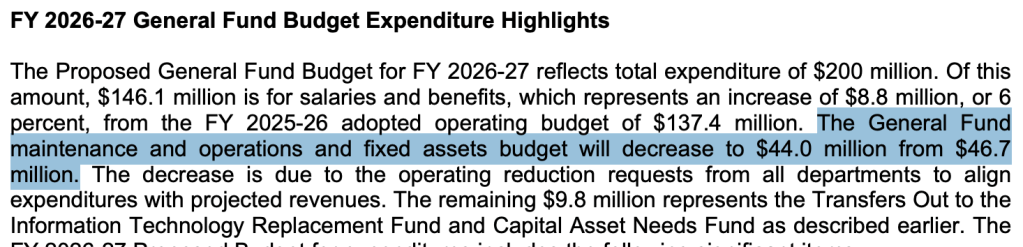
At first glance at the table, M&O + FA expenses do not add to $46.7 million in FY 2025-2026 and they do not add to $44 million in FY 2026-2027. But I’m guessing the reason is that the Agenda Report is talking only about the general fund, while the table above is from all funds. That means that some M&O and FA spending must be coming from funds outside the general fund — i.e., grant funds. This phenomenon probably also explains why the Agenda Report passage reports that salaries and benefits increased only $8.8 million, rather than the close to $10 million shown on the table above. Some of this salary spend is being tucked into grant-funded programs or, much to my chagrin, into the capital improvement budget via the Capital Asset Needs (CAN) ordinance.
That we are increasingly relying on outside funds for M&O and FA spend is worth an entire additional post. Let’s put a pin in that for now.
Instead, I think there is cause for concern regarding the Staff’s estimates that M&O and FA spending will go down this year, cost-containment not withstanding. M&O is all the stuff that makes the city look good, from tree trimming to power washing to keeping the streetlights on at night. And FA spending accounts for all the spending the city does on tangible things, like car leases or (ahem) Flock camera subscriptions. Both those things are hard to “compress” in terms of costs, right?
Council Member Andrea Marr zeroed in on this on Tuesday, where commented that it seemed like the Staff was chronically underestimating these expenses to help balance estimated costs:
She called it “sandbagging”, which is harsh but fair. I would call it the cost-of-living vice quietly eating away at government services. I don’t think the city is going to spend more than it budgeted for. I think it is trying to tell the council that it is reducing services, without saying that out loud.
Don’t believe me? Let’s dive just into the M&O numbers, which are sobering.
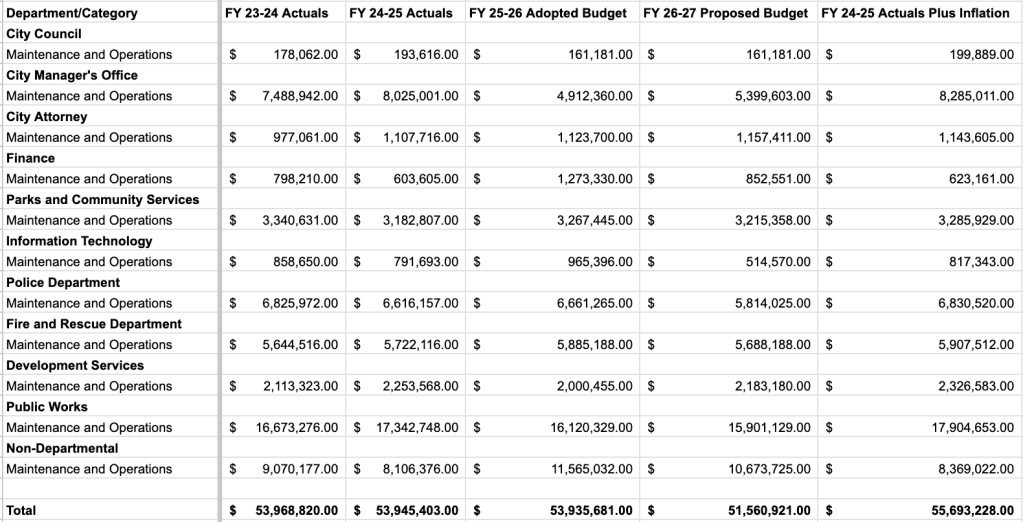
Yes, I recognize that table is nasty. Let’s walk through it.
In FY 2024-2025, the table shows that the city actually spent about $53.9 million on M&O across all funds. Scoot over a couple of columns and you’ll see that the FY 2026-2027 proposed budget is reserving only about $51.6 million, which means an approximately $2.4 million decrease in M&O spending year over year.
Now, maybe I could believe that the City can find that much savings using cost containment measures to keep providing the current level of services.
But, like Council Member Marr, I’m somewhat skeptical. And, while that’s bad enough, I am really bothered by what is happening in the last column. That column takes the city’s actual M&O spend in FY 2024-2025 and adjusts that spending for the rate of inflation that took place between from June 2025 to today (3.24%). Do that, and I estimate our M&O costs should be something more like $55.7 million.
In other words, if you made the assumption that baseline M&O spending from FY 2024-2025 just remained flat and increased only by general inflation, we’re going to be cutting M&O spending this year by closer to $4.2 million in terms of real purchasing power.
If you look at what departments are going to shoulder that burden, there are three departments that will see the biggest real M&O cuts according to my calculations: the City Manager’s Office, the CMPD, and Public Works. Parentheses indicate deficits in the current proposed budget compared to a straight-line estimate of M&O costs based on FY 2025-2026 actual M&O spending in each department, plus inflation:
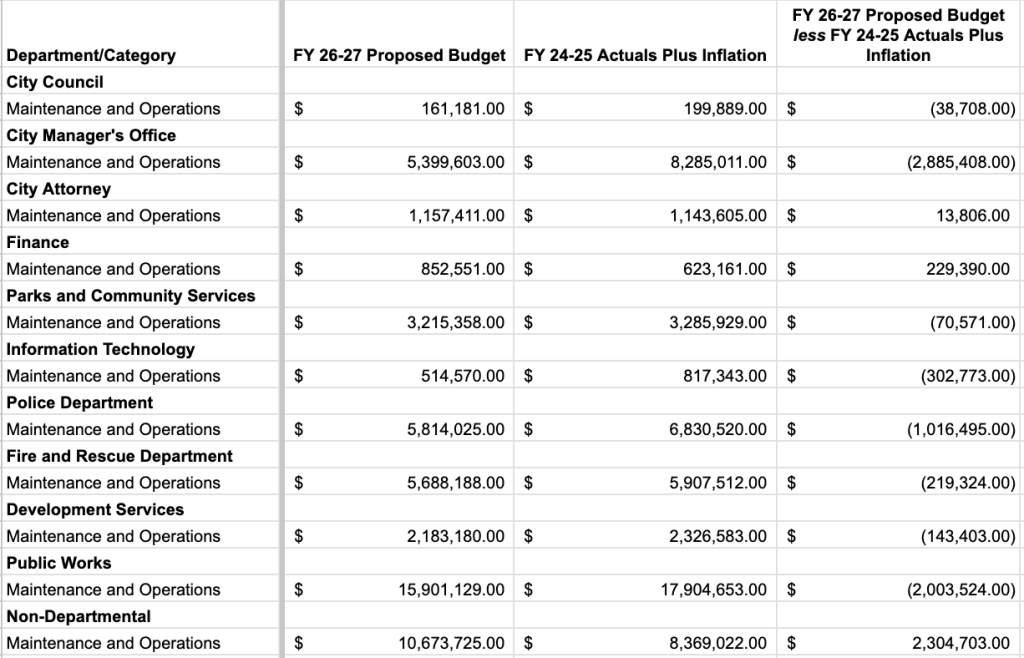
Now, I’m going to be honest: I have very little idea what goes into the “M&O” bucket for the City Manager and the CMPD. But with respect to Public Works, I have a bad feeling that real M&O cuts to the tune of $2 million of purchasing power (on a total budget of only about $15 million) is coming straight from the maintenance sub-department, which is under Public Works. And those guys take care of everything you see in the city, from curb paint to tree trimming to cutting the grass.
Doing those things hasn’t gotten radically cheaper. So I really have only one conclusion: we’re going to be doing less of those things this year, which is just a straight-up reduction in services.
Like Mayor John Stephens quipped last meeting, budgets shouldn’t be conservative or liberal, guarded or aggressive, generous or stingy. They should, as he said, be accurate.
But I’ll go one more: they should also be honest. Reading between the lines, this budget says to me that we can’t afford to keep maintaining the city at its present level while keeping all our promises to staff — new and old — and the constituents that heavily rely on key programs. It should have said that up front, rather than burying it.


Leave a comment