
It’s been a long, hot summer in Costa Mesa government, particularly in the planning department.
While we were all enjoying our vacations, the city’s Planning Commissioners have been chewing on some of the city’s thorniest issues. They’ve been busy trying to clean up our zoning code with respect to various commercial uses, fix our Housing Element to appease State officials, and commenting on the city’s novel draft Climate Action and Adaptation Plan.
And, between all that work, they also likely decided the fate of the city’s largest single development in its history. And, I’m sorry to say: the Cronenbergian horror show that is the Fairview Developmental Center Specific Plan not only cleared its California Environmental Quality Act (CEQA) review, it’s gotten the blessing of a majority of the Planning Commission to head to the City Council for final approval.
I’ve already written reams on this plan’s problems as well as its terrible public outreach process, and few if any of these issues have been addressed since last May.
So, instead of dwelling on those issues, I want to take a look at two claims that, unfortunately, I think are on pretty solid ground:
- The draft FDC Specific Plan, as written, will destroy the Mesa Linda Golf Course as we know it today, and
- The City Council has no choice but to pass it and do just that.
Let’s take each in turn.
Does the draft FDC Plan spell the end of the Mesa Linda Golf Course?
First, let’s set down some establishing info for folks that have never set foot on the Mesa Linda Golf Course (a rather large number of Costa Mesans, including myself!). My buddy ROBO-Goat provides this background:
The Costa Mesa Country Club’s Mesa Linda course was built in 1967, designed by William F. Bell — the golf architect behind Torrey Pines, Bermuda Dunes Country Club, and Sandpiper Golf Club — and was developed as a local recreational amenity alongside the adjacent Fairview State Hospital campus. The land itself was transferred from the State to the City of Costa Mesa in the 1980s, after which the course became a municipally owned facility. Today it operates as part of the Costa Mesa Country Club, a 36-hole public golf complex combining Mesa Linda and the Los Lagos course.
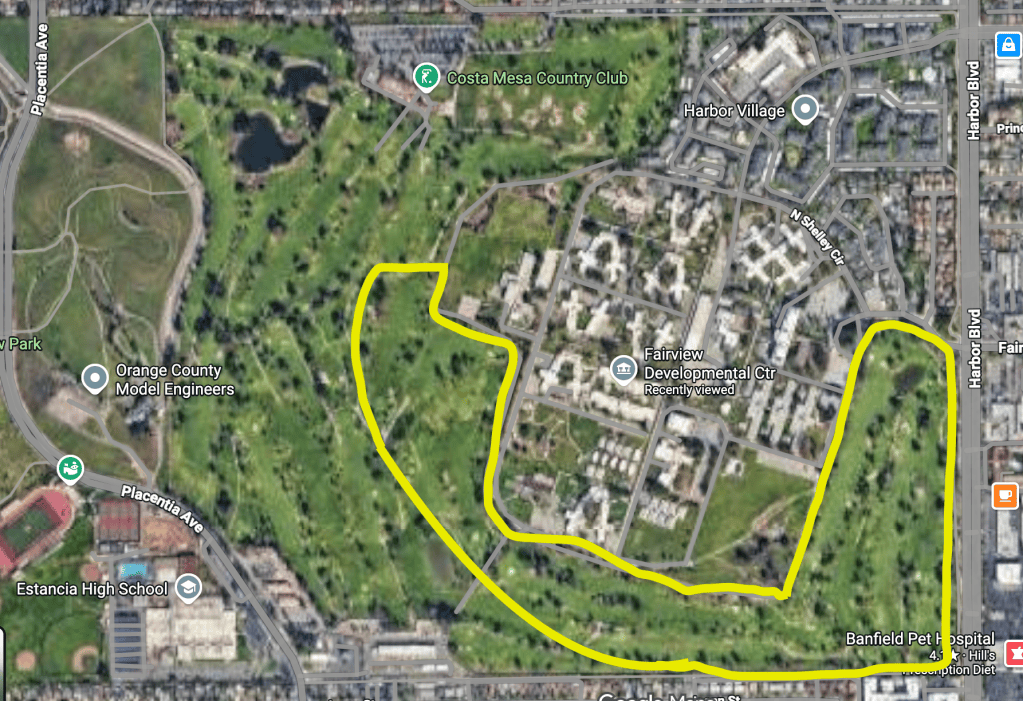
For the more visual among us, the Mesa Linda Golf Course is approximately outlined in yellow (don’t come at me golfers: I couldn’t find a good map available online! I’m guessing here!):
The core problem with the draft FDC Specific Plan for this course is that both safety and basic decency require a second access road to the property for any number of housing units above 2,300. As the city’s own feasibility study ruled out building fewer than 3,500 units as economically not viable, the secondary access road highlighted in blue below is going to be built. Period.
[As a side note: wondering about that little access road to the north, aka Merrimac Way? Technically that’s cutting through state-owned land, and the state is being a real Grinch about allowing regular traffic through that road. So that’s a no-go for now.]
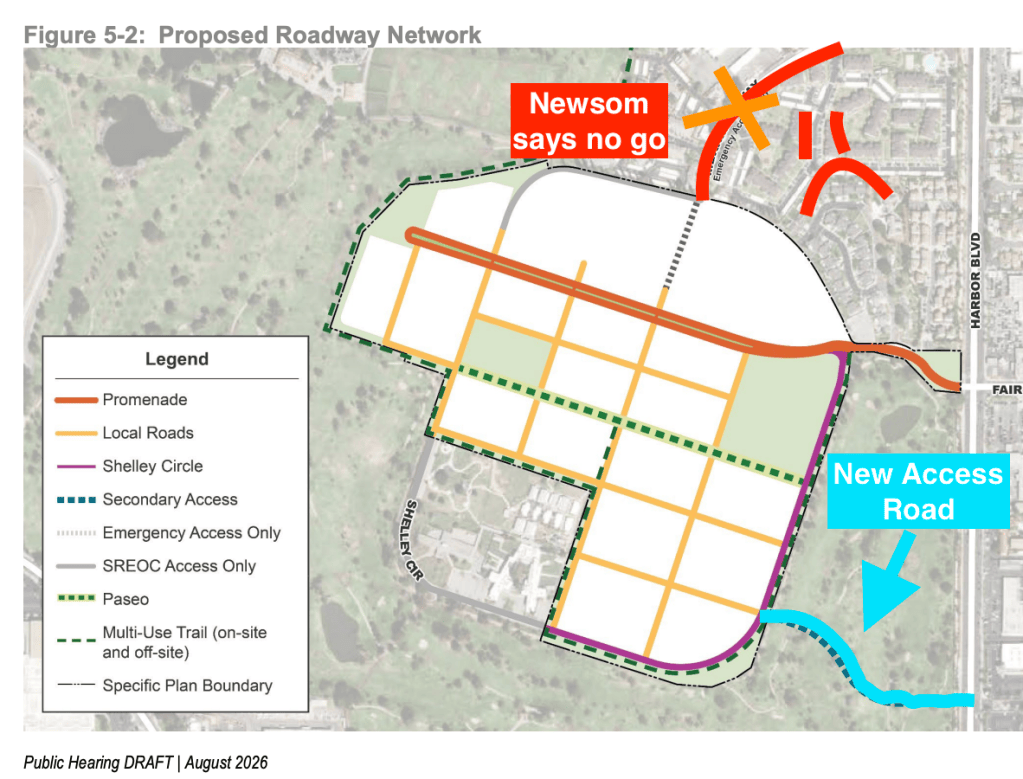
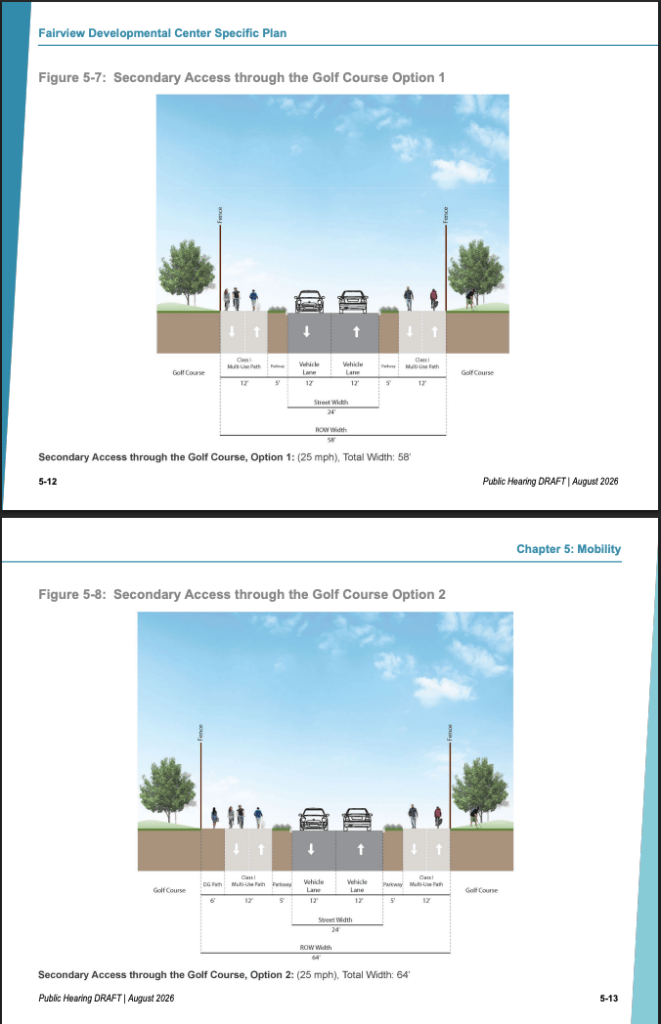
So, long story short, the Mesa Linda Golf Course stands to lose — I mean, reconfigure — up to six holes, thanks to the necessity of installing a massive, likely at-grade, 55-65′ wide road cutting through the middle of its fairways, complete with tall stands of netting to keep errant balls out of windshields. Here are the proposed possible cross-sections of that new road from the draft FDC Specific Plan:
Now, is it theoretically possible to cut a 60’+ swath through the Mesa Linda Golf Course and keep it whole? Sure. Oakmont Country Club in Pennsylvania, one of the courses used for the US Open, has the gosh-darned Pennsylvania Turnpike running through it and it seems to be getting along just fine.
But in terms of what the city’s already come up with, one of the city’s key decision-makers, Mayor John Stephens, an avid golfer (specifically at the Costa Mesa Country Club) took a peek and he wasn’t satisfied yet. “Five of holes of the back nine were three-pars and, I mean, I looked at it and I’m going, it won’t fly,” he stated during the City Council’s discussion of the golf course in the context of the FDC Plan last fall. “I don’t want the city to redesign a golf course,” he continued. “I don’t want us to spend any money redesigning a golf course. That’s up for a developer to do.”
Which brings us back to whether or not the draft FDC Specific Plan puts the Mesa Linda Golf Course in mortal peril. The problem with stating that redesigning it is “up for a developer to do” is that the draft FDC Specific Plan says only that. Unless I’m missing something, this is the only statement the plan contains that places an obligation on the master developer vis-a-vis Mesa Linda (PDF page 86):
A secondary access road will be required for additional safe ingress and egress for development of 2,300 residential units or more. The secondary access via a new street is proposed through the golf course connecting to the existing intersection at Harbor Boulevard and the Harbor Shopping Center Driveway and aligned with the shopping center east of Harbor Boulevard.
This roadway alignment will be finalized with a master developer, and a redesign and/or reconfiguration of impacted golf course holes is required.
That’s it. Does the redesign need to… maintain a 36-hole course? Nope. How about “improve or maintain the playability of the course compared to its pre-development state”? Nope. “Maintain the character and usability of the course by local teams”? Don’t see it. Does it define what “impacted” means, so that interpreting that term isn’t left in the hands of the developer? Nah.
In fact, the golf course is barely mentioned in the document’s “vision statement”, which frankly, is probably the weakest part of the entire document:

If “creating an affordable, desirable, and inclusive place to live for families, young adults, and seniors” really is “what matters most to the [sic] Costa Mesa”, then let me tell you what is not most important: fixing, improving or preserving the Mesa Linda Golf Course, let alone adding more sports fields, integrating the neighborhood with the rest of the community, or minimizing traffic impacts.
In fact, if I were a developer looking at this, I would think to myself: “Hmm. It seems like the State and the city’s governing document both are telling me to build as many deed-restricted affordable housing units as humanly possible, and the sky’s the limit as long as those units are surrounded by bike trails. Everything else — the golf course, park space, interconnectivity with the rest of the city, limiting negative externalities, etc. — is negligible or, at worst, negotiable.”
I don’t think that’s at all what the many, many, MANY public meetings on this topic have revealed about what “the Costa Mesa” thinks. And it’s where this draft FDC Plan fails the hardest. At the end of the day, the master developer and the market 15-20 years from now is going to decide what can be built — not a plan. But a plan should define the objectives that a developer must meet in order to get a glide path to city entitlements. Sadly, other than parroting the state’s goal of “housing, housing, housing,” this plan doesn’t bind the master developer to achieve any other benchmark.
So unless the City Council is ready and willing to course-correct here, Mesa Linda is probably toast. Maybe it gets a serviceable rework around the secondary access road that lets it limp along for another 20 years. But, without the city throwing its leverage behind forcing meaningful improvements as part of the FDC redevelopment process, it will do so in a wounded and crippled way. Which means, eventually, it will go the way of Oak Creek Golf Course. If it can’t support itself as a golf club, it will become a generally accessible public amenity.
Notwithstanding the flawed nature of the draft FDC Plan, does the city have to move forward anyway?
Probably. Maybe. Actually, I’m not sure.
From the very beginning the FDC planning process has seemed to respond only to its own strange gravity. Its “planning” meetings seemed to float above any feedback actually received in them. Calls for resident committees to dig into the limitations and opportunities of the site were sublimely rebuffed as being too costly of staff time and resources. And, despite multiple rounds of feedback from both the Planning Commission and the City Council, the draft FDC Plan seemed impervious to any suggestions other than ones that increased the maximum number of units anticipated at the site.
Which makes me think that all of this is a fait accompli. The State has a litigation gun pointed at the city’s head thanks to its Housing Element incompetence. The State also happens to own the land underneath the existing Fairview Developmental Center and it has the prerogative to select the master developer of the site. And, perhaps most tellingly, the State is paying for the entire FDC planning process. So it has skin in the game to produce “a plan”, even if it isn’t a very good one.
On the other hand…
It has never been entirely clear to me how the Fairview Developmental Center Specific Plan process fit into our Housing Element woes. It is certainly true that we pushed a huge amount of the city’s deeply affordable regional housing needs allocation (RHNA) into the site, so much so that it would need at least a 40% affordable inclusionary housing requirement distributed across at least 2,300 total units to make the numbers work.
However, it is also the case that staff confirmed that completing the FDC Specific Plan is not a condition to getting Housing Element certification. If that’s true (and really, can we get in more trouble with HCD at this point?) then maybe it isn’t such a crazy idea to take a moment to rethink whether this draft FDC Plan is reflective of the city’s revealed values. I am one thousand percent sure that neither the Staff nor anyone on the dais wants this process to continue. But it does seem to be getting to the point that the city is risking long-run execution risk — particularly, lawsuits aimed at protecting aspects of the city that the plan itself does not — in its desire to rush this to the finish line.
As a final note, it piqued my interest to see that Mayor John Stephens will be holding an unusual community discussion on the topic of the draft FDC Plan next week. I don’t recall the last time a council member took the opportunity to hold his or her own open community meeting on a particular topic prospectively (arguably last year’s homelessness town hall was council-member driven, but that was more informational and retrospective). So that’s an event that’s definitely circled on my calendar, if only to see what the temperature in that room turns out to be.


Leave a Reply