
After hours of staff presentations and questions from the dais last evening, another couple of hours of public comment, a detailed discussion amongst the members of the City Council themselves, and a decisive motion that won unanimous approval, it certainly feels like maybe, just maybe, our long municipal nightmare known as the Fairview Developmental Center (FDC) Specific Plan could be over.
Or at least over for now.
To refresh folks, the City Council walked into chambers yesterday confronted by a draft FDC Specific Plan that was, in essence, similar to the one it reviewed this past spring. The only difference was that, thanks to increasing unit count for the purposes of studying the potential environmental impacts of the project under the California Environmental Quality Act (CEQA), the maximum number of units contemplated by the draft FDC Specific Plan had climbed to 4,000 units:
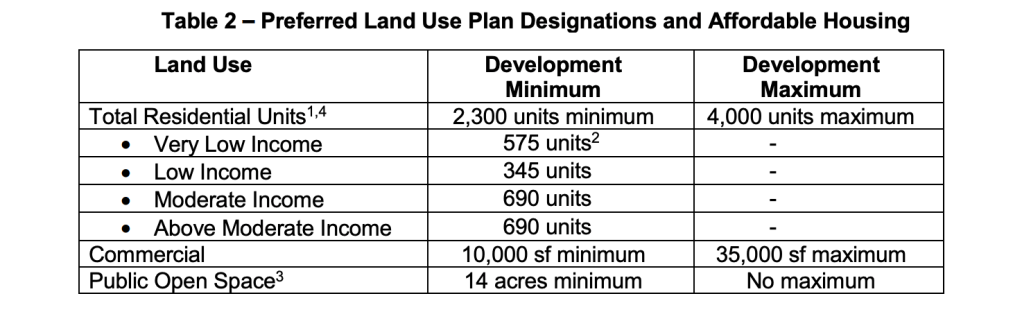
To cut to the chase, following the lead of a very specific and likely prepared-in-advance motion (not that there’s anything wrong with that) by Mayor John Stephens, the City Council ended up unanimously approving parameters for the FDC Specific Plan that looked, well, quite different:
- The development’s maximum allowable units would be capped at 2,300
- The development must provide for 920 low/very low income affordable units only (I believe the requirements for both permanent supportive housing and moderate income housing were removed)
- The development must provide a minimum of 15,000 square feet of onsite commercial space, up to a maximum of 35,000 square feet of commercial space to conform with the amount studied in the environmental impact report (EIR) required by CEQA
- The site must accommodate at least 25 acres of open space, including (but not limited to) lighted sports fields
- The FDC Specific Plan would prohibit a route being cut through the Mesa Linda Golf Course, unless:
- An additional traffic study was conducted after the site was somewhat built out that showed a full build out would require a secondary access, and
- The city had exhausted all options to open a secondary access road on Merrimac Way, which is controlled by the California Department of Developmental Services (DDS), and
- The FDC Specific Plan were amended to include specific benefits and guarantees from the developer to ensure the integrity of the golf course
Outside these changes to the FDC Specific Plan, Mayor Stephens’s motion also directed staff to (1) seek, at minimum, a $30 million subsidy from the State of California to address site remediation/clean-up costs that would otherwise be borne by the developer, (2) to return with a proposal to form a seven-member citizen’s advisory committee to monitor the progress at the FDC site going forward, and (3) return with a proposal to form an ad hoc committee of the City Council also devoted to FDC-related issues.
So, all good right? Well, there’s definitely some good in there. But, as I sadistically giggled yesterday, it’s a motion that also throws a lot of chaos into the mix.
Let’s start with the good.
Good: The City Council’s action will *probably* satisfy HCD
Although Mayor Stephens was tempted to trim the unit cap down to 2,000 units, his final motion ultimately stuck with the 2,300 units contemplated by the City’s draft Housing Element that’s currently under review by the California Department of Housing and Community Development (HCD). It also retained the existing allocation of 920 units of deed-restricted low and very low affordable housing, while relying on the city’s excess capacity in moderate income housing elsewhere in the city to make up the shortfall for purposes of satisfying HCD’s Regional Housing Needs Assessment (RHNA) numbers. So even though the approved FDC Specific Plan parameters were far tighter than the staff’s recommended plan, city staff seemed to indicate last night that it would be *just* good enough to satisfy HCD. So, barring any other objections HCD might cook up in the mean time, the city may finally be on the glide path to Housing Element certification. Phew.
Good: Mayor Stephens’s motion finally incorporates public input
I’ll give Mayor Stephens this — every single one of his bullet points above responded to, and incorporated faithfully, input received from the public. The reduction in unit count addressed concerns about traffic impacts on Harbor Boulevard and Fair Drive. The retention of low and very low income units assuaged affordable housing advocates, including the second on the motion, Mayor Pro Tem Manuel Chavez. Beefing up the open space requirements from a minimum of 14 acres to a minimum of 25 acres makes carving out space for youth sports, a repeated and consistent request at pretty much every FDC meeting from the beginning, much more plausible. And, of course, staying true to his comments all the way back in October 2025, Mayor Stephens’s motion directed staff to do everything within the city’s power to protect the Mesa Linda Golf Course.
Mayor Stephens also offered a remarkable mea culpa for the failures of the city’s public input process with respect to the FDC Specific Plan:
I think I am somewhat accountable for what we’ve had [in terms of public input]. I do believe we should have had an ad hoc committee, I should have been a better leader about that. We should have had a city council ad hoc committee from the very beginning. […]
Also, some community members have been calling for a citizens committee; we should have done that. And we should have gone out and been a little more proactive. I thought that the town hall we did the other day was productive. We should have been doing that for the last three or four years.
So, to the extent that my leadership has failed us […], I am sorry about that and I am accountable.
Mayor John Stephens, Costa Mesa City Council Meeting, September 15, 2026
Accordingly, it was no surprise when Mayor Stephens eagerly accepted Council Member Loren Gameros’s friendly amendment to constitute both a citizen’s advisory committee and a City Council ad hoc committee devoted to FDC going forward.
[Though, as an aside, I must commend Council Member Andrea Marr for her delightfully snarky, hot-mic remark during the committee discussion: “It’s three years too late.” She’s 100% correct.]
So one positive from last evening is that the City Council’s action did make some progress on restoring the public’s faith in its leadership. As Arts Commission Vice Chair Fisher Derderian put it well in a public comment he delivered last evening, “the fundamental issue in this is the complete breakdown of trust in the public input process.” He then went on to describe the extremely demoralizing effects of continually “providing input” — filling out comment cards, placing sticky notes on posters, making public comments, filling out surveys — only to see the most popular proposals and plans set aside in favor of complying with State requirements or protecting profit margins for future developers. He was right, and it was great to see the City Council finally step in and force the plan to reflect the residents’ concerns.
I should also note that Mayor Stephens deserves enormous credit for putting forward his bold motion in the first place. The consistent drumbeat from city staff, State officials and affordable housing advocates has been that the city simply had to accommodate the biggest development possible in order to appease various state agencies and avoid ugly penalties, fines and lawsuits. It took courage to chart a different course. So, even if he was feeling a bit sheepish about his stewartship on this issue to date, he clearly showed that he is a leader that can build consensus and fight for the city’s residents when it counts.
So let’s take a moment to bask in the euphoria of finally getting some real public input injected into this process.
**********
Ok, moment over. Back to reality, which, unfortunately, bites.
There is no escaping the fact that the City Council very much chose chaos with this vote. And as such, we are now all climbing the chaos ladder with it, whether we like it or not. So let’s turn to the bad.
Bad: The State will probably hate this, and it could set aside the FDC Specific Plan
First, the motion last evening crossed at least three “red lines” set out by various California state agencies. I put “red lines” in scare quotes because, although these have all been presented to the public as hard-and-fast requirements, no representative from any State body has ever shown up in chambers to explain them or to state for the record directly exactly how hard-and-fast they actually are.
First, by limiting the number of units in the FDC Specific Plan to 2,300 units, the motion blew through the “requirement”, as described by city staff, that the plan be “financially feasible” to build. This requirement traces back to statutory language found in California Government Code § 14670.31(c)(1), which states that any city-drafted specific plan must “address[…] the economic feasibility of future development for the purposes intended by the Legislature.”
While Stephens’s motion gestured at making the overall plan more financially feasible by cutting out the mandate to build 200 very expensive permanent supportive housing units (more on that in a second) and dropping the moderate income affordability requirements, it almost certainly missed the mark. The Staff’s presentation last night stated plainly that, pretty much any way you cut it, a 2,300 unit or below development simply cannot financially support 920 units that are deed restricted as low or very low income units.
Second, DDS has already rejected prior plans that incorporated large amounts of open space dedicated to sports fields. Remember waaaay back in 2024 when the city proposed to DDS a land swap between the FDC site and the Costa Mesa Golf Course, which would free up land along Harbor Boulevard for a sports complex? Welp, I do, and I also remember DDS dismissing that notion out of hand as follows: “As DDS staff advised in previous discussions, the inclusion of such a sports and recreation complex is incompatible with the State’s interests.” If DDS didn’t love the idea of Costa Mesa building a sports complex out of golf course land it owns outright, I can’t imagine it will be all that excited about the prospect of building a significant number of sports fields in the FDC site itself.
And third, Mayor Stephens’s gambit to drop the permanent supportive housing requirement runs into language in SB 188, which states that “it is the intent of the Legislature that the Fairview Developmental Center property be utilized for a mixed-use development, including mixed-income housing. The development would include and prioritize affordable housing, including at least 200 units of permanent supportive housing, and open space” (emphasis mine). While Mayor Stephens tried to justify his request by referencing the other permanent supportive housing developments (aka, the Project Homekey motel conversions) that the city has facilitated in the past few years, it’s not clear whether DDS would view it the same way.
So what happens if the State hates our plan so much that it sets the approved plan aside and forges ahead with its own plan? I HAVE NO IDEA!! But I guess that’s a risk the City Council thought it should take. Recall that, at the end of the day, the FDC site is state-owned land. The California taxpayers didn’t need to give the city $3.5 million to develop the specific plan; the State could have forged ahead without us and there wouldn’t have been a damn thing we could do about it. Hopefully we won’t have to test what that scenario would look like in real life.
Bad: the FDC Specific Plan itself still sucks, and the City Council’s planning-from-the-dais probably made density at the site much worse
While I am relieved to see the residents’ concerns get their day in City Hall, there’s just one, teensy, weensy little problem.
The public is, and continues to be, a terrible planner.
Remember, back when we first saw this plan earlier this year, I kvetched about the plan’s unrealistic expectations when it came to meaningful commercial space, its lack of consideration for commute times/methods for grade-school students, and its over-reliance on the city’s crippled “Open Space Master Plan” to fill in the gaps in park planning? Yeah, those problems are still there.
But more pressingly, the City Council’s plan may have inadvertently mucked up the urban design of the FDC site itself.
In crafting his motion, Mayor Stephens said he picked 25 acres as the amount of open space he wanted to see in the plan because that was the original requirement set forth in the General Plan for this site before the FDC planning process began (the site was originally anticipated to be approximately 100 acres, and the General Plan specified that at least 25% of the site would be set aside for open space). “I don’t think that [the State’s decision to withhold land for DDS and the Emergency Operations Center] should require the city of Costa Mesa to take a haircut in terms of open space,” Mayor Stephens explained.
And that’s good politics, because Costa Mesans have been dreaming of sports fields at FDC for decades.
But, as one expert familiar with the situation pointed out to me this morning (and hat tip to him — you know who you are), it’s lousy geometry.
Like it or not, the total planning area for the FDC is currently 80 acres. If 25 acres are now reserved for open space, that leaves only 55 acres to contain every building, every road, every median, and every yard/setback on the entire property. Even if mandatory land uses like streets and utilities ate up only 5 acres (a radically generous assumption), the city would be left with only 50 acres on which to build actual units.
2,300 units divided by 50 acres results in a density of 46 dwelling units per acre. If a developer then uses the State Density Bonus Law to gain additional bonus density as it provides the required deed-restricted affordable units, it could achieve densities closer to 60-70 dwelling units per acre.
Here’s a slide the city prepared way back at the beginning of the FDC process to show what buildings at 30-100 DU/AC look like. So imagine this, but wall-to-wall in every square inch of the FDC that isn’t open space or roads:
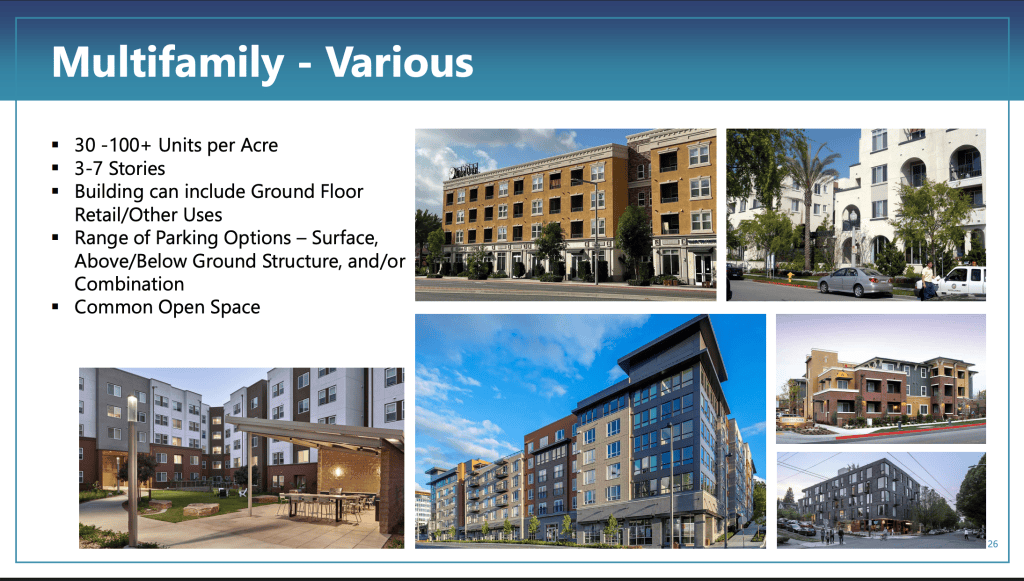
So, by radically upping the minimum required amount of open space from about 18% of the site to 30+% of the site, the City Council upset the delicate balance between open space and building density that the planning staff and Planning Commission have been wrestling with for years now. Forget Council Member Gameros’s quaint suggestion during deliberations last night that the city set aside golf-course adjacent parcels for single family homes only. The only housing units that can be built under the City Council’s chosen parameters, assuming they could ever pencil out, are going to be massive 5+ story wrap and podium buildings with concrete first floors and giant parking garages.
*************
I know that’s a lot, so I’ll end here. But the bottom line is: I don’t think this process ends here. Instead, we still seem to be trapped in a Lamb-Chopian dystopian nightmare. This song just doesn’t end.
 Goat Hill Rodeo
Leave a comment