
And my goodness, this one is boooooring. Well, except the part where City Hall is $70 million + in the hole when it comes to aging facilities and the urgent need to replace… well a a whole lot of them. NBD. So I’m gonna let 🤖🐐ROBO-Goat chew through it, and then see what it can tell us about the mess we appear to find ourselves in.
🤖🐐ROBO-GOAT COUNCIL PREVIEW: Thursday, Oct. 29
BEEP BOOP. AGENDA SCANNED. HERE IS WHAT MATTERS.
When: 6 p.m. at City Hall (77 Fair Drive) or on Zoom. This is a special meeting. Public hearings start at 7.
Presentation: Safe Routes to School.
[Wait, 🤖🐐ROBO-Goat – What’s this about? Is it the same presentation the Active Transportation Committee got a few weeks ago?]
It may be, but it has been a few weeks since that meeting so the content may be updated. The city is writing its first citywide plan to make it safer for kids to walk and bike to school, paid for by a federal Safe Streets for All grant. Consultants walked the neighborhoods around each school and logged hundreds of problems, like missing crosswalks, broken sidewalks and curb ramps that don’t meet ADA rules. They also held three public meetings and collected more than 300 comments. Draft fixes include high-visibility crosswalks, flashing beacons, curb extensions and protected bike lanes. The final report is due this winter.
Consent calendar (the quick-vote pile):
- Final Parcel Map 2023-160 and easement agreement for 695 W. 19th St. This splits the Senior Center property into two parcels so the Jamboree affordable senior housing project can move forward. An easement guarantees the Senior Center keeps its parking, access and drainage.
- Arts Specialist reclassification. The title becomes “Arts and Culture Supervisor.” The pay stays the same.
Public hearings:
- Development Impact Fee Annual Report and Traffic Impact Fee. The traffic fee on new development stays at $231 per daily car trip. Developers still get trip discounts for bike and pedestrian improvements, and up to 10% of the money can go to traffic signal timing. ROBO-GOAT NOTE: the state wants this report public for 15 days before council reviews it, and this goat counts 14.
- User Fee Study and Master Fee Schedule. About 170 city fees go up, 22 are new, and 14 go down. The city expects about $1 million a year more. Some planning fees drop a lot, including density bonus review, which is nearly cut in half. A new “Development Technology Fee” adds 5% to building, planning and fire permits. ROBO-GOAT NOTE: one table says the new General Plan Update fee is 3%, and the text says 5%. Which is it?
New business:
Facilities Master Plan. A consultant says the city needs about $70 million over 20 years just to keep its buildings working, with City Hall alone at about $850,000 a year. Rebuilds and renovations would cost another $59 million or so, including Fire Station 2, Fire Station 4 and the Westside police substation.
The Facilities Master Plan agenda report also contains a table showing the condition of various city facilities. A higher “FCI”, or Facility Condition Index, means that the facility has more wear, tear, or other age-related problems:
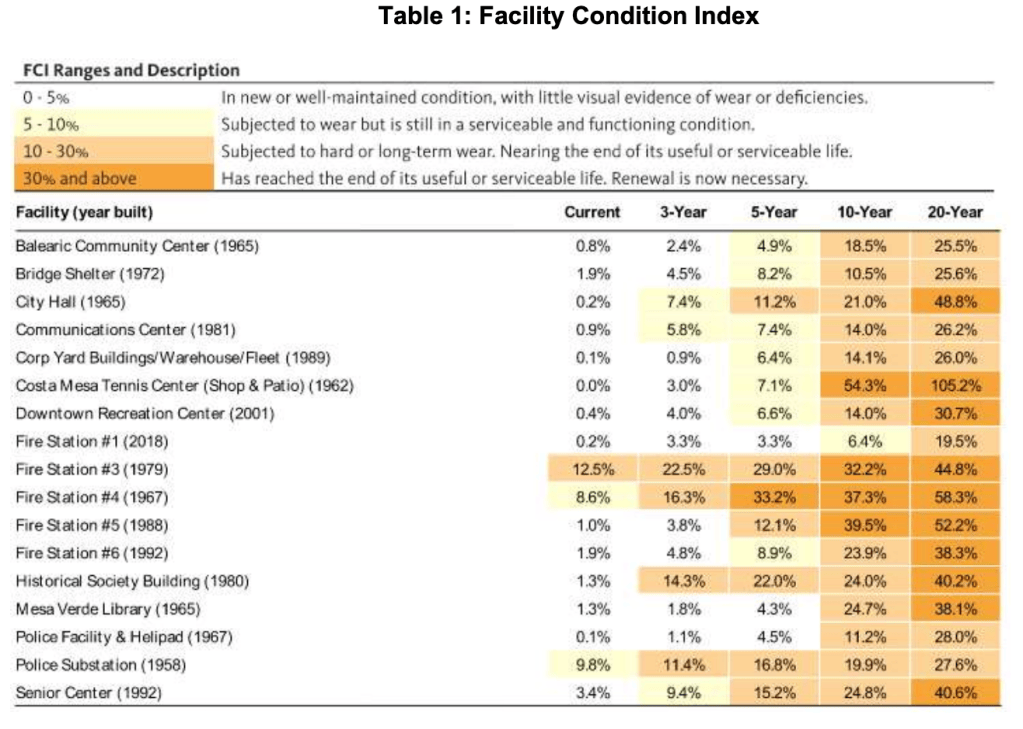
There’s no vote tonight; council just receives the report. The big question is how it gets paid for.
[No joke, 🤖🐐ROBO-Goat! How the heck does the city plan to pay for this???? $70 million over 20 years sounds like a lot of money…]
That is a long explanation… I will put my analysis in a toggle because most normal humans will not want to be bored to death with numbers…
The agenda report says very little. The fiscal section says facility needs “will be incorporated into the CIP budget development process.” It names only two sources:
- The annual 5% General Fund set-aside for Capital Asset Needs (CAN)
- “Future county, state, and federal grant opportunities”
There’s no funding plan, gap analysis or financing scenario in the report. That’s notable for two reasons. Phase 3 of the consultant’s scope was explicitly “Cost Estimates and Funding Strategies.” And at the March 10 study session, council specifically asked for more on funding strategies. The report doesn’t show what came back.
The Scale of the Ask
| Bucket | 20-year total | Rough annual |
|---|---|---|
| Replacement reserves (keeping existing buildings running) | $70.1M | ~$3.45M |
| Major capital (rebuilds and renovations) | $59.1M | ~$3M average, but front-loaded |
| Combined | ~$129M | ~$6.5M average |
The near term is heavier than the average:
- Capital spending is about $6.8M in each of 2026 and 2027 and $9.2M in 2028. Most of that is the $16.5M Fire Station 2 replacement and the $4M Communications Building renovation.
- Reserves add $2.7M in “immediate” needs and $5.7M in “short-term” (2026–27) needs.
- That puts the next two to three years at roughly $10M+ a year.
Existing tools (no new revenue)
- CAN allocation. This is the only named source. Facilities would compete with streets and parks for the same pot. It is also already used to fund debt service on the Donald Dungan Library/Lions Park project as well as the new Fire Station No. 2 bonds that will be priced in December. It is not clear how much annual CAN allocation is available to fund these facilities projects.
- One-time General Fund surpluses or reserves. These are good for the “immediate” maintenance backlog, but not dependable year to year.
- Development impact fees. The Fire Systems Development Fee fund has about $379K. Under the Mitigation Fee Act, it can only pay for capacity needed because of new growth, not deferred maintenance or like-for-like replacement. It’s a minor contributor at best.
Grants
- These are realistic for slices of the plan: solar, EV charging and efficiency upgrades; resilience and emergency-operations work; possibly CDBG-eligible public facilities on the Westside.
- They’re unrealistic as a main source for rebuilding fire stations or City Hall.
- Leaning on “grants” mostly signals that no dedicated source has been identified.
Debt
- Lease revenue bonds or certificates of participation. This is the most common route for fire stations and police facilities. It needs no vote, but the debt service becomes a fixed General Fund cost for 20 to 30 years.
- General obligation bonds. These need two-thirds voter approval and are paid by a property tax override. Cities rarely use them now, but they’re used for public safety buildings.
- Mello-Roos (Community Facilities District). This works for new growth areas, not citywide deferred maintenance.
New revenue
- A general sales tax measure. This needs a simple majority, and the money isn’t legally restricted.
- A special tax dedicated to public safety facilities. This needs two-thirds approval.
- The business license and TOT reforms already in progress would go to the General Fund, not specifically to facilities.
Fire side letters and executive pay resolution. This fixes pension paperwork for firefighters’ “move-up” pay. It also raises the Assistant City Manager’s pay range 2% to stay ahead of the police and fire chiefs. That triggers a clause in the City Manager’s contract, so the City Manager gets 4.64% more.
Surplus Land Act declaration. Council would declare the 70-unit Jamboree senior housing lot “exempt surplus land,” which the state requires. The goal is to start construction financing in December.
🤖🐐ROBO-GOAT HAS SPOKEN [WRITTEN?]. GO TO THE MEETING. OR WATCH ON YOUTUBE. BOOP.


Leave a Reply